Vacuum die-casting die for aluminium HPDC: the deaeration valve on the die, two-stage cavity vacuum and what 70–200 mbar does to porosity
A die-casting die built for vacuum: the deaeration valve mounted on the die that pulls air out of the cavity and shot sleeve before the metal arrives, the cavity pressures it reaches in one or two stages, and the porosity and strength measured on aluminium castings at 1013, 200, 170, 100 and 70 mbar
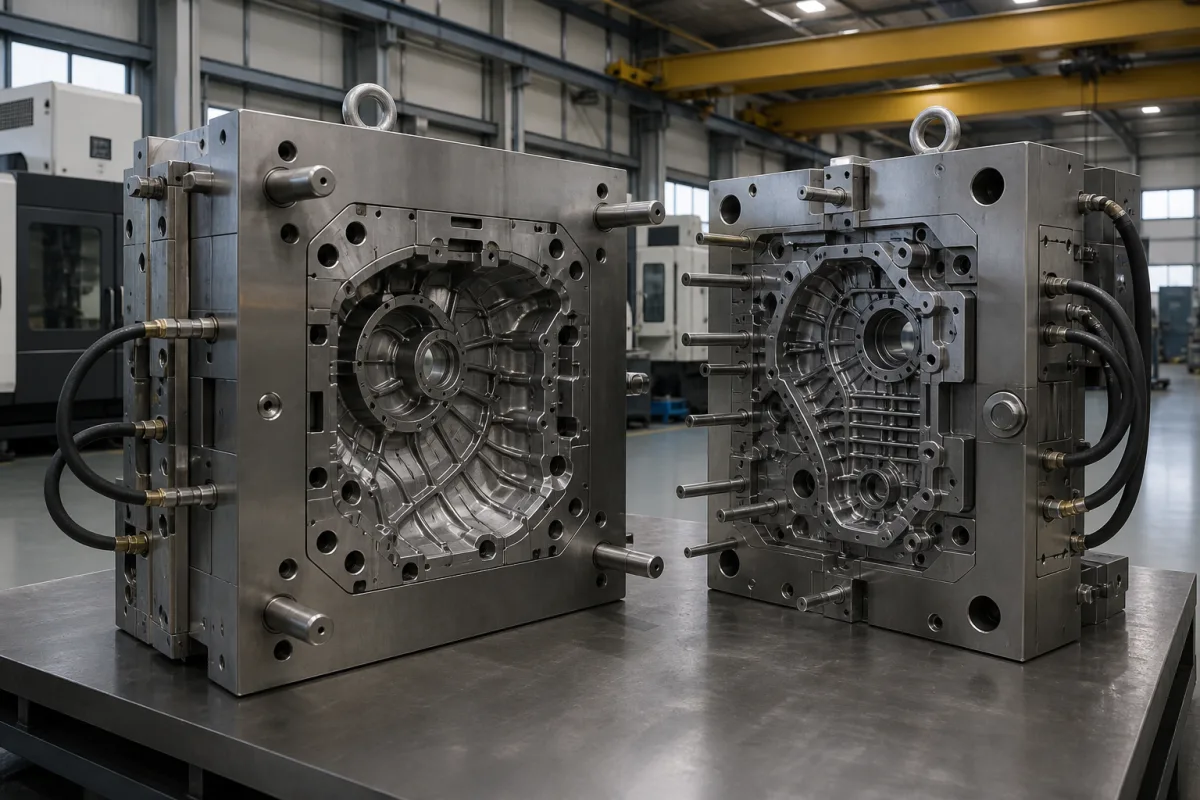
In high-pressure die casting the cavity is full of air when the shot starts, and whatever the vents do not let out is trapped in the casting as gas porosity. A die built for vacuum casting has a deaeration (vacuum) valve mounted on it, connected to a vacuum system that lowers the pressure in the cavity and shot sleeve before filling. The die halves pictured, with their cooling hoses and guide pillars, are the part of the cell that has to carry that valve and stay tight enough to hold the vacuum.
High-pressure die-casting dies for aluminium that are vacuum-vented: the deaeration valve mounted on the die, its connection to one- or two-stage vacuum systems, the cavity pressures reached and the effect of cavity vacuum on porosity, tensile strength and elongation. Gate velocity, fill time and the die-casting machine are covered on the High-pressure die casting machine page; cavity insert steel on the Die-casting mould cavity insert page; the moving half's steel and heat treatment on the Moving die half page; ejector pins and ejection on the Ejection mechanism for high-pressure die casting page; and die heating and cooling units on the Mould temperature controller page.
CNFX editorial research · Sources checked October 13, 2026 · 3 sources
The deaeration valve on the die and a two-stage vacuum: 975–200 mbar, then down to 60–20 mbar
Fundación Azterlan's European patent application EP 4 219 043 A1 sets out how a vacuum system reaches the cavity of a die with a fixed and a movable part: through a conduit and a deaeration valve mounted in the mould, fed from a manifold with vacuum vessels and a Venturi ejector, with the gas, steam and fumes from the cavity expelled through the system. [1]
The application reviews earlier systems the die has to suit. One removes air in two stages, first from the shot sleeve through a wide cross-section line and then from the mould, with the drawback that aluminium closes the wide line once it fills the sleeve. Another vents moulds with no moving parts and no vacuum pump or tank, using a Venturi device, and the application states that such a device cannot reach vacuums below 200 mbar. It also cites a vacuum process in which the melt is drawn into the casting chamber by the vacuum in the mould, controlled through a buffer vessel with valves, filters and pressure measurement. [1]
First-stage control in the application is by a valve triggered by the plunger position or by a delay from the injection permission signal, and a cleaning system can be connected to the cavity opposite the shot sleeve to clean it while the die is open after demoulding. [1]
After the first stage is established and before cavity filling begins
200 to 0.1 mbar; preferably 60 to 1 mbar, more preferably 60 to 20 mbar [1]
Ask where the deaeration valve sits on the die, which vacuum system it is built for, the cavity pressure the die is guaranteed to hold before filling, and how the valve and its channel are cleaned.
02
Porosity and strength measured at 1013, 200, 170, 100 and 70 mbar in AlSi9Cu3
Two studies on the same alloy family put numbers on what the cavity vacuum buys in the casting. Both measured AlSi9Cu3 castings made by vacuum-assisted high-pressure die casting at two or more absolute cavity pressures (1013, 200 and 100 mbar; atmospheric, 170, 90 and 70 mbar).
Cao and co-workers at Chongqing University measured density rising from 2.526 to 2.682 g/cm³ between 1013 and 100 mbar against a standard density of 2.76 g/cm³ for EN AB 46000, and found large, clustered pores on the fracture surfaces of the 1013 mbar samples but smaller, more evenly spread pores at 200 and 100 mbar. [2] Szalva and Orbulov compared atmospheric venting with cavity pressures of 170, 90 and 70 mbar and report a 57 % reduction in porosity, a 10 % gain in tensile strength and a 50 % gain in elongation at 70 mbar. [3]
Editorial calculation: in the Cao data, going from 1013 to 100 mbar cuts porosity by about 59 % and raises tensile strength by about 18 %. The two studies start from different porosity levels without vacuum (6.8 % against 1.10 %), so their absolute values should not be compared across studies, only the direction and size of the change within each.
Ask which cavity pressure the die and vacuum system were proven at, and for porosity or density results on the actual casting at that pressure.
03
Information for a vacuum die-casting die
Paste it into your enquiry below or into an email to a maker, then replace every bracket.
Casting: [part; alloy, e.g. AlSi9Cu3; wall thickness; porosity or leak-test requirement]
Machine: [make and locking force; shot sleeve size]
Vacuum: [vacuum system; one or two stages; target cavity pressure]
Valve: [deaeration valve type and position on the die; cleaning]
Proof: [porosity, density or tensile results at the target pressure]
Explore company information and manufacturing capabilities, then discuss the scope of your project with a relevant supplier.
Share this page
Compiled and source-reviewed by the CNFX editorial team.
Each manufacturer above links to the page on that company's own website where the product is listed, with the date we checked it. How we source and review
· Page last updated 13 October 2026
Buyer questions
What does the vacuum valve on a die-casting die do?
In Azterlan's EP 4 219 043 A1 a deaeration valve mounted in the mould connects the cavity to the vacuum system, which evacuates air, gas and fumes before filling. [1]
What cavity vacuum is used in vacuum die casting?
EP 4 219 043 A1 gives a first stage of 975–200 mbar and a second of 200–0.1 mbar, preferably 60–20 mbar; it says Venturi-only venting cannot go below 200 mbar. [1]
How much does vacuum reduce porosity?
Cao et al. measured 6.8 % porosity at 1013 mbar and 2.8 % at 100 mbar in AlSi9Cu3; Szalva and Orbulov measured 1.10 % with atmospheric venting and 0.47 % at 70 mbar. [2][3]
Does vacuum improve die-cast strength?
Szalva and Orbulov report tensile strength rising from 271.6 to 299.8 MPa and elongation from 1.66 to 2.49 % at 70 mbar. [3]
Sources and what still needs a direct check
Sources checked 2026-10-13. The vacuum stages and the valve on the die come from a Fundación Azterlan European patent application; porosity and strength from a Chongqing University paper in Materials and a Szalva and Orbulov paper in the International Journal of Metalcasting, held in the Hungarian Academy of Sciences library repository.