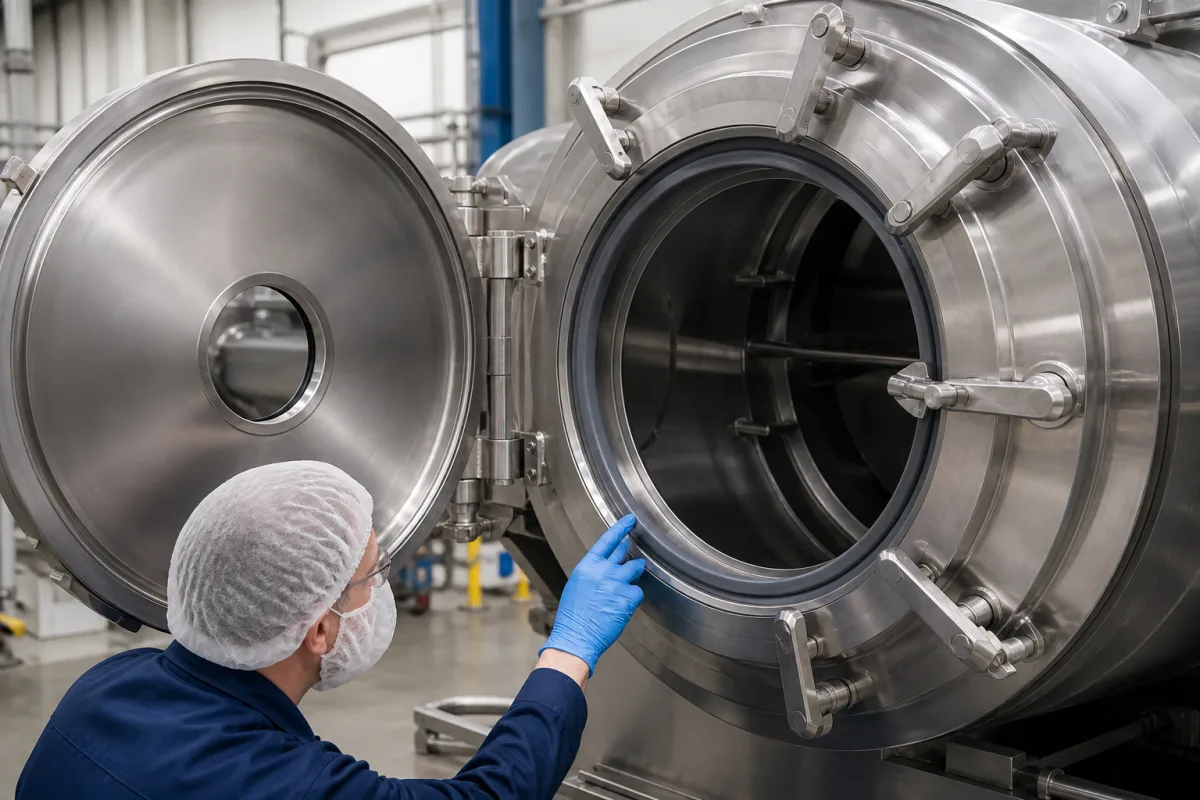
Vacuum tumbler door and seal: choosing a food-contact gasket compound, compressing it correctly, and clamping the door before vacuum is drawn
The hinged loading door and its gasket on a vacuum tumbler drum · FDA extractive limits for repeated-use rubber in contact with brine and fat, compression set and temperature range by elastomer, and how hard the door has to be clamped
A vacuum tumbler is only a vacuum tumbler while its door holds. The gasket on that door spends its life in cold brine and meat fat, is squeezed every batch, opened and wiped every batch, and has to seal again before the pump can pull the drum down. What it is made of, how much it is compressed and how the door is clamped decide whether it does.
The loading door of a batch vacuum tumbler or massager and its seal: the door leaf and sight glass, hinge, swing-bolt or cam clamps, and the elastomer gasket and its groove, judged by food-contact compliance, compression set, temperature range and clamping. The tumbler as a machine, its tumbling cycle, drum design, vacuum pulsing and labelling of added solution, is covered on the Industrial vacuum tumbler page; vacuum pumps, brine injectors and massager drums without vacuum are not covered here.
CNFX editorial research · Sources checked October 12, 2026 · 3 sources
Gasket compound for cold brine and meat fat: FDA extractive limits for repeated-use rubber, and compression set of EPDM and silicone at 25 % squeeze
In the United States a door gasket is a rubber article intended for repeated use in contact with food under 21 CFR 177.2600, which lists permitted polymers, including ethylene-propylene copolymer elastomers and silicone elastomers, and sets extraction limits on the finished food-contact surface. [1] A tumbler gasket touches both water-based brine and fat, so both limits apply.
The regulation also requires finished repeated-use rubber articles to be thoroughly cleansed before their first use in contact with food. [1] ERIKS notes that compression set rises with temperature and time and depends on cross-section: the same NBR compound measured 14.8, 12.8 and 9.2 % after 22 h at 100 °C on 1.78, 3.53 and 6.99 mm cross-sections. [2] Compression set figures from different temperatures are not directly comparable; ask for the value at the temperature your cleaning cycle reaches.
Requirement or property
EPDM
Silicone (VMQ)
Source
Aqueous food: total extractives with refluxing distilled water
≤ 20 mg/in² in the first 7 h, ≤ 1 mg/in² in the next 2 h
Ask for the gasket compound by name, a statement of compliance with 21 CFR 177.2600 (or the food-contact rule in your market) for both aqueous and fatty food, and its compression set at your cleaning temperature.
02
Clamping the door: about 29 kN of air load on a 600 mm door at full vacuum, 25 % gasket compression, and a groove that holds the seal when the door swings open
Editorial calculation: atmospheric pressure of 101.3 kPa on a 600 mm diameter door (0.283 m²) gives at most about 28.6 kN of closing load once the drum is fully evacuated; spread round a 600 mm seal (about 74 in of circumference) that is about 87 lbf per inch. Before the pump has pulled the drum down, the swing bolts or cams have to seat the gasket on their own, and a real tumbler runs at partial vacuum, so the air load is lower than this bound.
For large high-vacuum chambers, NASA's preferred practice PD-ED-1223 calls for O-ring volume larger than the groove cavity so that about 25 % compression closes the diametrical gap, and a total clamping pressure from vacuum and bolts of about 800 lb per lineal inch of O-ring. For a seal on a vertical face, as on a chamber door, it recommends an undercut groove so the ring is held in place and does not drop out when the chamber is open. Groove and mating flange finishes should be at least 32 microinch and preferably 16, with no tool marks across the groove, because even minute scratches can leak. [3] Editorial note: that practice targets pressures as low as 10⁻⁸ torr, far below a food tumbler, so its clamping figure is an upper reference rather than a requirement here; the calculation above shows how far apart the two are.
ERIKS gives a minimum O-ring squeeze of about 0.175 mm, because with very light squeeze almost all elastomers quickly take 100 % compression set, and limits gland fill to 95 % because a fully confined seal expanding with heat can exert very high forces on the groove. [2]
Specify the door diameter, the vacuum level of the tumbler, the number and type of clamps, gasket cross-section and squeeze, and whether the gasket is retained in an undercut or dovetail groove.
03
Why a door seal starts to leak: compression, permeation through the rubber, and the surface it seals on
NASA's practice gives a rough leak estimate L ≈ 0.7 F D P Q (1 − S)², with F the gas permeability of the elastomer at temperature, D the ring inside diameter, P the pressure difference, Q a factor for compression and lubrication, and S the fractional compression, with ±50 % expected scatter. Increased compression lowers permeation by lengthening the gas path and shrinking the entry area, and presses the rubber into small irregularities in the metal. [3] Editorial calculation: raising compression from 15 % to 30 % changes the (1 − S)² term from 0.72 to 0.49, about 32 % lower, before any change in Q.
The same document names butyl and fluorocarbon as the least permeable seal materials. [3] Neither appears in the food-contact comparison above; whether a tumbler door can use them depends on the compound's food-contact status, so the choice weighs leak tightness against the food-contact status of the specific compound offered. [1]
Ask how the door seal is leak-tested at handover, what vacuum hold the drum must show over a set time, and the replacement interval for the gasket.
04
What to send when specifying a vacuum tumbler door and seal
Paste it into your enquiry below or into an email to a maker, then replace every bracket.
Door: [diameter; hinge side; sight glass; clamp type and number]
Vacuum: [operating vacuum; hold test required]
Gasket: [compound; hardness; cross-section; groove type]
Food contact: [aqueous and fatty food; compliance statement required]
Temperatures: [product temperature in the drum; cleaning temperature]
Service: [gasket replacement interval; spare gaskets]
Explore company information and manufacturing capabilities, then discuss the scope of your project with a relevant supplier.
Share this page
Compiled and source-reviewed by the CNFX editorial team.
Each manufacturer above links to the page on that company's own website where the product is listed, with the date we checked it. How we source and review
· Page last updated 13 October 2026
Buyer questions
What food-contact rule applies to a tumbler door gasket in the US?
21 CFR 177.2600 for repeated-use rubber articles: total extractives no more than 20 mg/in² in 7 h with water and 175 mg/in² with n-hexane, then 1 and 4 mg/in² in the next 2 h. [1]
Is EPDM or silicone better for a vacuum tumbler door seal?
In ERIKS's standard compounds at 25 % squeeze, EPDM shows max. 30 % compression set at 100 °C and silicone max. 40 % at 200 °C; silicone has the wider temperature range (−60 to +220 °C against −50 to +120 °C). [2]
How much should a vacuum door gasket be compressed?
NASA's vacuum-seal practice uses about 25 % compression; ERIKS gives a minimum squeeze of about 0.175 mm. [3][2]
Why should a door gasket sit in an undercut groove?
For a seal on a vertical face, NASA's vacuum-seal practice recommends an undercut groove so the ring is held firmly and does not drop out when the chamber is open. [3]
Sources and what still needs a direct check
Sources checked 2026-10-12. Food-contact limits come from the US Code of Federal Regulations; compound data from the ERIKS O-ring technical handbook; compression, groove, finish and leak estimates from NASA preferred reliability practice PD-ED-1223.