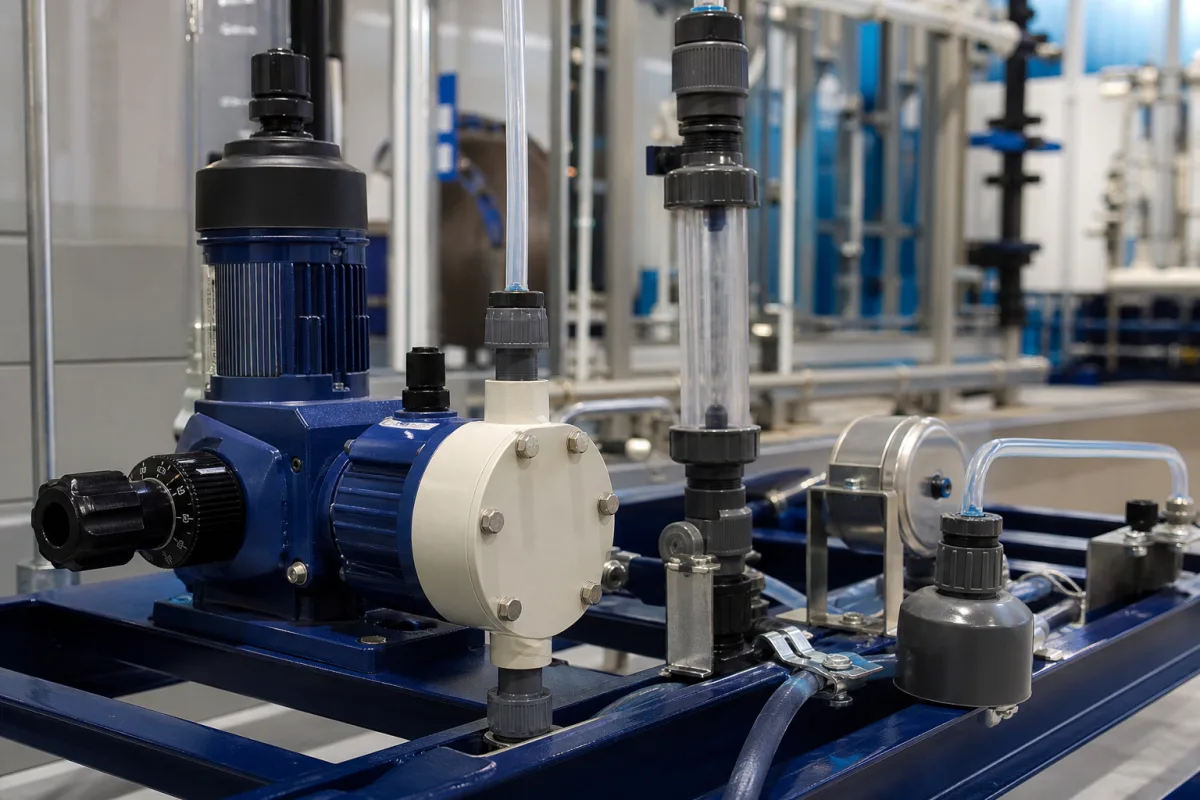
Chemical dosing pump skid (packaged duty/standby dosing system for water treatment)
Chemical dosing pump skids · duty/standby pumps on a frame with calibration cylinder, relief and back-pressure valves, sized from flow and dose
A chemical dosing skid is a dosing pump package: in the published examples, two pumps (duty and standby) piped on one frame with a suction manifold and strainers, a calibration cylinder, a pressure relief valve and back-pressure valve on each discharge, a pressure gauge, drip tray or cabinet, and a terminal panel for the plant's control signals. Ask three things first: what pump rate the dose and flow really require, which protection and check items each pump line carries, and how the skid is controlled and calibrated on site.
Packaged dosing systems built around dosing pumps — duty/standby and duty/duty skids and cabinets with calibration cylinders, relief and back-pressure valves, strainers, dampers and control panels — for disinfection, pH adjustment, coagulation, antiscalant and similar water and wastewater treatment duties. Choosing the metering pump itself by accuracy, turndown and installation is covered on the Metering pump page; ceramic-piston pumps that dispense set volumes per shot are covered on the Precision metering pump page. Chemical storage tanks and bulk unloading are outside this page.
CNFX editorial research · Sources checked October 12, 2026 · 3 sources
Work out the pump rate from flow, dose and solution strength
Florida DEP's operator formula sheet gives the chain a dosing skid has to deliver: feed rate in lbs/day = dosage (mg/L) × flow (MGD) × 8.34 lbs/gal; for sodium hypochlorite, gallons of solution = pure chlorine required (lbs/day) ÷ (purity as a decimal × 8.34 lbs/gal); and chemical feed pump setting (% stroke) = desired feed flow ÷ maximum feed flow × 100%. It also gives chemical flow (gpm) = volume pumped ÷ (pumping time × 60), the basis of a drawdown check. [1]
Editorial calculation (metric form of the same arithmetic, with an assumed solution strength): 50 m³/h of water at a 2 mg/L dose needs 50 × 2 = 100 g/h of active chemical; with a solution assumed to contain 120 g/L of active chemical, the pump must deliver 100 ÷ 120 ≈ 0.83 L/h. Use the strength stated on your supplier's certificate, not the assumption. [1]
Batch dosing works the same way. The City of Winnipeg's specification for a metering pump skid at its North End Water Pollution Control Centre requires each pump to discharge 11 to 27 mL of product per batch, which it states corresponds to 3 to 7 mg/L in a 3,800 L batch; the plant control system starts the pump at the start of the batch sequence and the pump injects the volume needed, then shuts off. [2] Editorial calculation: 3 mg/L × 3,800 L = 11.4 g and 7 mg/L × 3,800 L = 26.6 g, matching the 11–27 mL range at about 1 g of product per mL. [2]
Trility's dosing standard skids are selected by pump size (listed as DDA7.5, DDA12, DDA30, DME375 or DME940), by capacity from virtually zero up to 940 L/h for duty/standby or 300 L/h for duty/duty, and by chemical group — group 1, for example, covers sodium hypochlorite, all acids to 96% solution and general chemicals. [3]
Give the supplier the chemical and its strength, specific gravity and viscosity, water flow range and dose range (or batch volume and dose), injection-point pressure, suction arrangement, duty/standby or duty/duty, control signals and site ambient range.
02
Lay out the skid: duty/standby pumps, protection and calibration
Trility lists the key components of its two-pump standard skids: a fully enclosed cabinet as a chemical barrier, duty/standby dosing pumps, a rigid PVC suction manifold with in-line strainers, a pressure relief valve on each pump, a PVC pressure loading valve that keeps the dose rate accurate and prevents siphoning, a drain/flush system, a calibration cylinder to test pump settings, a pressure gauge with protector, and a pre-wired termination panel for pump input and output signals. Dampeners, check valves, a flow meter and a dilution line are options. [3]
The City of Winnipeg specification spells out the same items as purchase requirements: each pumping system includes the metering pump, a pressure relief valve, a pulsation damper if the pump is a diaphragm type, pressure and back-pressure valves, a drip tray and the piping; each pump discharge gets a relief valve and a back-pressure regulating valve sized for maximum pump flow with an adjustable range. It sets the duty points — maximum back-pressure 100 kPa before the back-pressure valve, maximum suction lift 2.5 m with the drum empty, and maximum differential pressure 135 kPa — and a pumping accuracy of ±5%. [2]
Site conditions enter the specification too: an ambient range of −40 to 35 °C, heat tracing with a thermostat on the enclosure if needed, 120 V motors, and a gearbox with manual speed adjustment. The spare parts list names two diaphragms (diaphragm pump) or four hoses (peristaltic pump), check balls and seats, gaskets and O-rings, and a diaphragm each for the back-pressure and relief valves. [2]
Editorial calculation: the Winnipeg duty points leave 135 − 100 = 35 kPa between the stated maximum back-pressure and the maximum differential pressure across the pump. [2]
03
Duty/standby, duty/duty and drum-fed batch dosing skids
Ask each supplier for a P&ID of the skid, the list of valves and instruments on each pump line, and the materials of every wetted part for your chemical.
Arrangement
Published layout
Published figures
Standard skid, duty/standby (Trility DSS)
Two pumps in an enclosed cabinet; relief and loading valves; calibration cylinder. [3]
Pump drives listed span electromagnetic solenoid, stepper-motor digital (the EX-B series, up to 30 L/h), motor-driven, diaphragm, piston and hydraulic types, and one supplier lists its pumps with tanks and stirrers.
Basidewt
Manufacturing site to be confirmed for the order
Lists dosing pumps with tanks and stirrers among water treatment equipment.
Explore company information and manufacturing capabilities, then discuss the scope of your project with a relevant supplier.
Share this page
Compiled and source-reviewed by the CNFX editorial team.
Each manufacturer above links to the page on that company's own website where the product is listed, with the date we checked it. How we source and review
· Page last updated 13 October 2026
Buyer questions
How do I calculate the dosing pump rate?
Florida DEP's formula sheet gives feed rate in lbs/day as dose (mg/L) × flow (MGD) × 8.34, and pump setting as desired feed ÷ maximum feed × 100%. [1]
What does a duty/standby dosing skid include?
Trility lists duty/standby pumps, a suction manifold with strainers, relief valves on each pump, a pressure loading valve, a calibration cylinder, a pressure gauge and a termination panel in an enclosed cabinet. [3]
What accuracy and pressures did a municipal skid specification set?
The City of Winnipeg specified ±5% accuracy, up to 100 kPa back-pressure, 2.5 m suction lift and 135 kPa differential pressure. [2]
Sources and what still needs a direct check
Sources checked 2026-10-12. Florida DEP's sheet is a state operator-certification formula reference; the City of Winnipeg document is a municipal purchase specification; Trility describes its own standard skids. Ask for the skid P&ID and datasheets for the exact configuration you buy.