Compressors and vacuum pumps · Residual oil, pressure drop and change-out, oil return and vapour tolerance
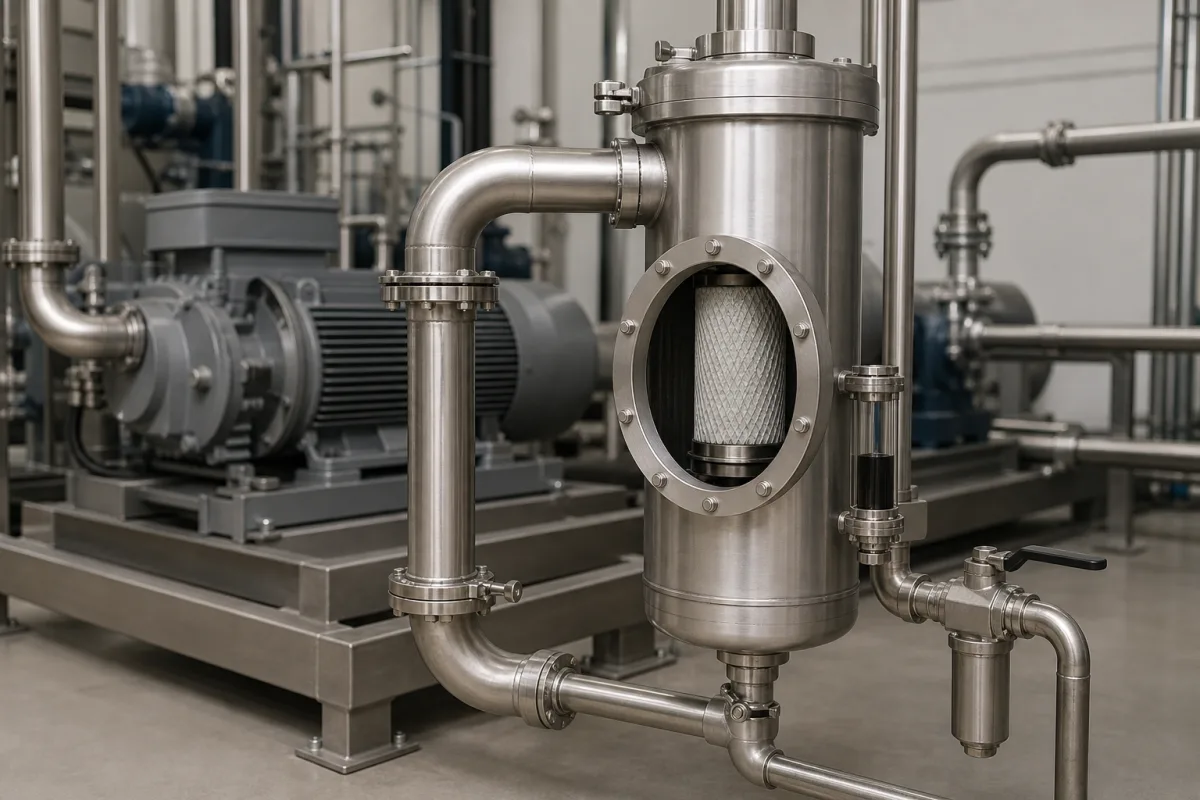
An oil separator removes lubricating oil from the gas leaving an oil-flooded compressor or oil-sealed vacuum pump, by coalescing fine droplets in a filter element, with the separated oil drained or returned. Ask three things first: the residual oil content it achieves and how it is measured, the pressure drop new and at change-out, and how separated oil is drained or returned.
Coalescing air/oil separators and separator elements for oil-flooded compressors, and oil-mist (exhaust) separators for oil-sealed vacuum pumps. Disc-stack centrifuges for liquids, compressed-air water separators in air-preparation units and refrigeration-circuit oil separators are outside this page.
CNFX editorial research · Sources checked October 11, 2026 · 4 sources
Solberg's spin-on air/oil separator elements for rotary and piston compressors use glass media and are rated for residual oil of up to 3 mg/m³ (3 ppm), a pressure drop of about 0.2 bar at nominal flow and 7 bar operating pressure, element change-out at a 1.2 bar increase, elements withstanding 5 bar differential, maximum operating pressure of 20 bar and continuous temperature from −40 to 120 °C. [1]
Atlas Copco's guide to ISO 8573-1:2010 explains that compressed air purity is classed for particles, water and oil, with oil from 0.01 mg/m³ in class 1 to 5 mg/m³ in class 4, and that in its terminology class 0 refers to air from an oil-free compressor. [2]
Editorial calculation: a separator rated at up to 3 mg/m³ meets the class 4 limit of 5 mg/m³ but not class 3 (1 mg/m³), so applications needing class 1 to 3 need further filtration downstream or an oil-free compressor. [1][2]
Give the supplier the compressor or pump type and model, flow and pressure, oil type and temperature, required residual oil class, allowable pressure drop, element thread or housing, oil return or drain arrangement, and service interval.
02
Size vacuum pump exhaust separators for oil return and vapour tolerance
Leybold's Fundamentals of Vacuum Technology says oil-sealed rotary pumps emit oil vapour and mist from the discharge; a coarse separator in the discharge line retains larger droplets, and a fine oil-mist filter retains the finest droplets, with the separated oil returned to the pump. Discharge filters are recommended where no outlet line is connected, and condensate traps where water or other vapours are pumped. [3]
The same text shows that exhaust-filter pressure drop, 0 to 0.5 bar, adds to the pressure the pump must compress to: with 1 bar exhaust plus 0.35 bar across valve and filter at 70 °C, water vapour in the pumped air must not exceed 23% of the mixture. [3]
Editorial calculation: if a loading filter added another 0.35 bar, the total would be 1.70 bar and the limit would fall to about 312 ÷ 1,700 ≈ 18%, so a clogged exhaust filter reduces vapour tolerance as well as raising back pressure. [3] Ask for the filter's pressure drop new and at change-out.
03
Compare what suppliers offer
Suppliers linked to this page list air/oil separator elements; each card links to the page reviewed.
Shenglian, Ruiqian and Shengda list air/oil separator elements alongside air, oil, fuel and hydraulic filters.
04
Match a vacuum pump oil mist filter to flow, catchpot and relief valve
VACUUBRAND's FO R 2/2.5/5/6 oil mist filter mounts directly on the oil reservoir outlet of its RE and RZ 2, 2.5, 5 and 6 rotary vane pumps. Its product data give a permissible volume flow of 6 m³/h, a 180 ml transparent catchpot for draining separated oil, an ambient range of 10 to 40 °C, dimensions of 119 × 80 × 181 mm and an integrated pressure relief valve for burst protection if the filter is blocked. VACUUBRAND states that its oil mist filters "separate nearly 100% of oil mist at the ultimate vacuum of the pump". [4]
Editorial calculation: if a pump sheds an assumed 10 ml of oil per day into the filter, the 180 ml catchpot is full after 180 ÷ 10 = 18 days, so measure your own collection rate and set the draining interval from it. [4]
The relief valve links to the Leybold figures above: a blocked exhaust filter raises the pressure the pump must compress to. [3] Ask the supplier for the permissible flow against your pump's pumping speed, the catchpot volume, whether a relief valve is fitted and at what pressure it opens, and the efficiency figure with the condition it applies to.
Fill the specification fields with values for your machine
An oil separator quotation needs values for your compressor or pump. The table explains each field, gives published values where a reviewed source states them, and says what to obtain from the supplier.
Explore company information and manufacturing capabilities, then discuss the scope of your project with a relevant supplier.
Share this page
Compiled and source-reviewed by the CNFX editorial team.
Published product pages show what a company offers, not tested performance. Confirm the legal seller, factory and scope for your order. How we source and review
· Page last updated 13 October 2026
Buyer questions
How much oil passes an air/oil separator?
One spin-on separator is rated at up to 3 mg/m³ residual oil, within ISO 8573-1 class 4 (≤5 mg/m³). [1][2]
When should a separator element be changed?
The example element is changed at a 1.2 bar increase in pressure drop. [1]
Does an exhaust filter affect a vacuum pump's vapour tolerance?
Yes. Leybold shows its pressure drop adds to the compression pressure; in its example 0.35 bar across valve and filter limits water vapour to 23% of the mixture. [3]
How do I match an oil mist filter to a rotary vane pump?
Compare its permissible flow, catchpot and relief valve with the pump: VACUUBRAND rates its FO R 2/2.5/5/6 filter at 6 m³/h with a 180 ml catchpot and a relief valve for a blocked filter. [4]
Sources and what still needs a direct check
Sources checked 2026-10-11. Solberg is a filter and separator maker; Atlas Copco a compressor maker; Leybold a vacuum pump maker. Their guidance is their own.