Bottle Indexing Turntable
View system integration details
This page explains how Turntable Plate is classified within Machinery and Equipment Manufacturing. Technical values and manufacturer relationships are research references; confirm the current specification and supplier evidence for each order.
The rotating platform component of a bottle indexing turntable that supports and positions bottles during automated handling processes.
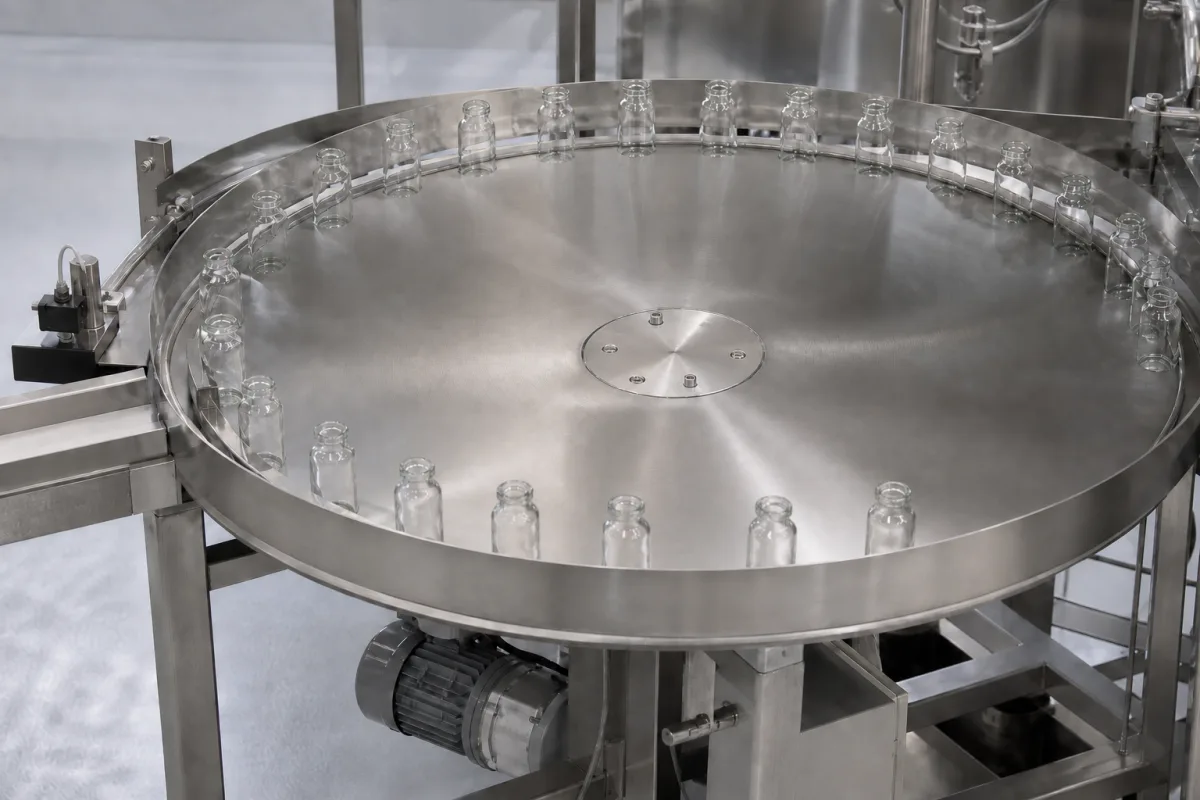
Technical details and manufacturing context for Turntable Plate
| Parameter | Typical range | Notes & selection driver |
|---|---|---|
| Plate Diameter | 600–1200 mm | Determines number of stations and bottle size capacity. |
| Plate Thickness | 10–20 mm | Affects rigidity and weight. |
| Max Load Capacity | 50–200 kg | Total weight of bottles and tooling on plate. |
| Rotational Speed | 5–30 rpm | Higher speeds may require dynamic balancing. |
| Indexing Accuracy | ±0.05 mm | At the outer radius; critical for filling/capping alignment. |
| Surface Flatness | 0.05–0.1 mm | Ensures stable bottle support.ISO 1101 |
| Surface Roughness | 0.8–1.6 µm Ra | Smooth finish reduces friction and wear.ISO 4287 |
| Material Hardness | 45–55 HRC | For stainless steel; higher hardness improves wear resistance.ISO 6508 |
| Operating Temperature | -10–60 °C | Beyond range may affect material properties and seals. |
| Weight | 15–60 kg | Affects inertia and motor sizing. |
Ranges are indicative industry figures for RFQ preparation, not a supplier commitment. Confirm every value and standard with the legal manufacturer before ordering.
| pressure: | Max 0.5 bar (support load only, not pressure vessel) |
| other spec: | Max rotational speed: 30 RPM, Max load capacity: 50 kg, Positional accuracy: ±0.5 mm |
| temperature: | -20°C to +80°C |
Indicative industry ranges for design and RFQ preparation. Confirm the exact figures and applicable standard with the manufacturer before specifying.
Quoted from the published standard.
A practical evidence checklist for RFQ preparation and supplier evaluation.
Compare the published product scope and source details, then include your specifications and quantity in an enquiry.
Manufacturer profiles associated with Turntable Plate.
Explore company information and manufacturing capabilities, then discuss the scope of your project with a relevant supplier.
Ask for use case, specification boundaries, supplier type, and RFQ preparation information for this product.
Common materials include stainless steel, aluminum alloy, and engineering plastic. The choice depends on factors such as corrosion resistance, weight, and cost. Stainless steel offers high hardness and wear resistance, while aluminum alloy is lighter and engineering plastic may be used for lower-cost applications.
The indexing accuracy is typically ±0.05 mm at the outer radius. This ensures precise positioning for operations like filling or capping. However, the actual accuracy must be verified for the specific model and application, as it can be affected by the drive system and wear.
The plate diameter determines the number of stations and the bottle size capacity. It typically ranges from 600 to 1200 mm. The required diameter depends on the number of bottles to be processed simultaneously and the space available for the turntable system. Consult the manufacturer for guidance based on your specific needs.
Regular inspection for wear, alignment, and surface condition is recommended. Check for any deformation or damage that could affect indexing accuracy. Ensure that the plate is clean and free of debris. Lubrication of moving parts may be necessary as per the manufacturer's instructions. If the plate shows signs of excessive wear or damage, it should be replaced to avoid compromising the production process.
This component is essential for the following industrial systems and equipment:
Editorial classification, named public sources where available, and source-reviewed manufacturer records.
Compare manufacturer profiles with relevant product and process capability.