Industry-Verified Manufacturing Data (2026)

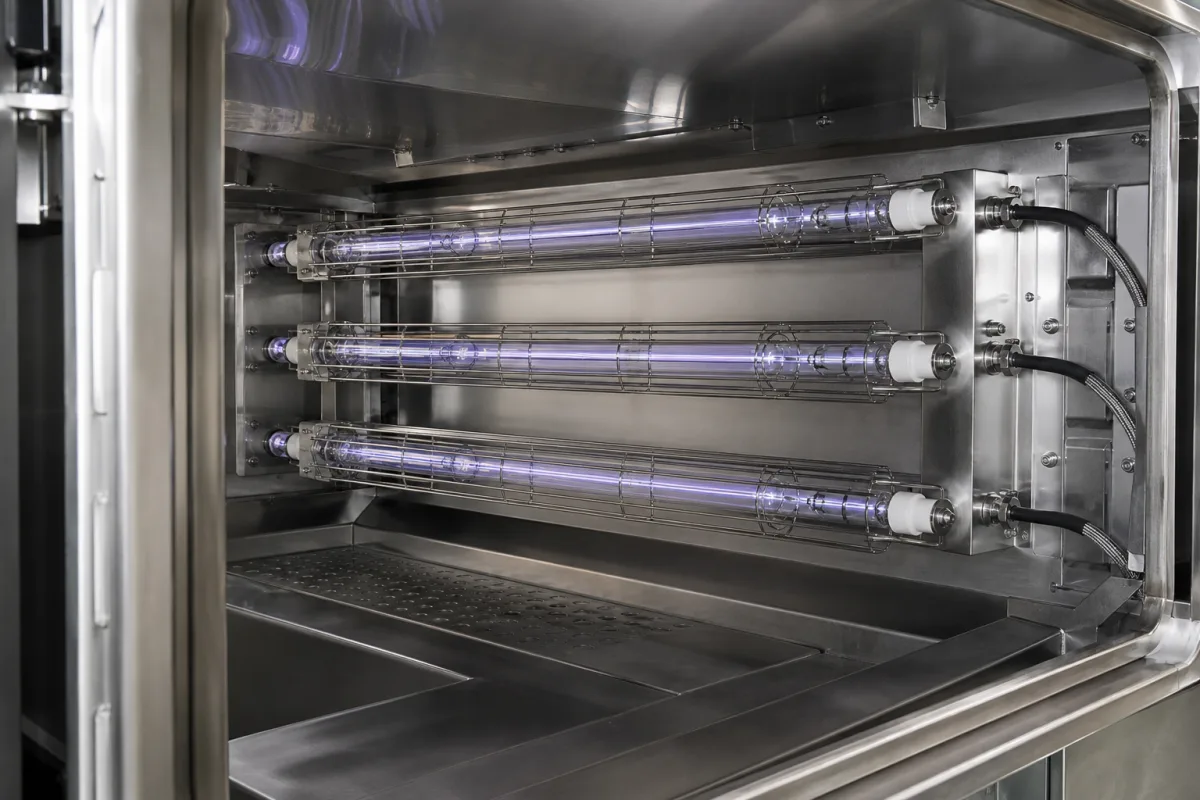
UV-C Germicidal Lamp

Based on aggregated insights from multiple verified factory profiles within the CNFX directory, the standard UV-C Germicidal Lamp used in the Machinery and Equipment Manufacturing sector typically supports operational capacities ranging from standard industrial configurations to heavy-duty production requirements.

Technical Definition & Core Assembly

A canonical UV-C Germicidal Lamp is characterized by the integration of Quartz Glass Tube and Electrodes. In industrial production environments, manufacturers listed on CNFX commonly emphasize Quartz Glass Tube construction to support stable, high-cycle operation across diverse manufacturing scenarios.

A specialized ultraviolet lamp that emits UV-C radiation to disinfect surfaces and air by inactivating microorganisms.

Product Specifications

Technical details and manufacturing context for UV-C Germicidal Lamp

Definition
A critical component within an Aseptic Chamber with Laminar Flow, the UV-C Germicidal Lamp provides localized or integrated sterilization. It targets airborne and surface contaminants within the chamber's controlled environment, ensuring the sterility of the workspace by disrupting the DNA/RNA of bacteria, viruses, and other pathogens, thereby complementing the laminar airflow's particle containment.
Working Principle
The lamp contains a low-pressure mercury vapor discharge tube. When electrically excited, it emits ultraviolet light primarily at the 253.7 nm wavelength (UV-C). This high-energy, short-wavelength radiation is absorbed by the nucleic acids (DNA/RNA) of microorganisms, causing thymine dimers or other photochemical damage that prevents replication and leads to cell death or inactivation.
Common Materials
Quartz Glass Tube, Mercury Amalgam, Tungsten Electrodes, Aluminum End Caps
Technical Parameters
  • Typical tube length (e.g., T5, T8) and diameter, defining its physical form factor for integration into the chamber housing. (mm) Per Request
Components / BOM
  • Quartz Glass Tube
    Encapsulates the mercury vapor and electrodes while allowing high transmission of UV-C wavelengths (unlike standard glass).
    Material: Fused Quartz
  • Electrodes
    Conduct electrical current into the gas discharge, initiating and sustaining the plasma that generates UV light.
    Material: Tungsten
  • Mercury Amalgam
    Source of mercury vapor within the tube; the amalgam formulation helps maintain stable UV output over a range of ambient temperatures.
    Material: Mercury Alloy
  • Base/End Cap
    Provides mechanical support, electrical connection points, and seals the ends of the glass tube.
    Material: Aluminum Alloy
Engineering Reasoning
185-254 nm wavelength, 0.1-10 mW/cm² irradiance at 1 m distance, 0-40°C ambient temperature, 20-80% relative humidity
Quartz envelope temperature exceeds 900°C causing devitrification, mercury vapor pressure drops below 0.8 Pa at 25°C, UV-C output falls below 70% of initial intensity at 254 nm
Design Rationale: Devitrification of fused quartz envelope at sustained temperatures above 900°C creates crystalline silica that absorbs 254 nm radiation, reducing UV transmission to below 85%
Risk Mitigation (FMEA)
Trigger Electrode sputtering from cold-start cycling exceeding 50,000 cycles at 50 Hz
Mode: Mercury depletion and blackening of quartz envelope reducing UV-C output by 40%
Strategy: Hot-cathode electrode design with barium oxide coating and preheat circuit maintaining 700°C cathode temperature before ignition
Trigger Quartz envelope contamination by silicone vapor exceeding 1 ppm in operating environment
Mode: Formation of silicon dioxide layer absorbing 95% of 254 nm radiation within 1000 hours
Strategy: Hermetic sealing with aluminum oxide gasket and nitrogen purging during manufacturing maintaining <0.1 ppm oxygen equivalent

Industry Taxonomies & Aliases

Commonly used trade names and technical identifiers for UV-C Germicidal Lamp.

Applied To / Applications

This component is essential for the following industrial systems and equipment:

Industrial Ecosystem & Supply Chain DNA

Complementary Systems
Downstream Applications
Specialized Tooling

Application Fit & Sizing Matrix

Operational Limits
pressure: Atmospheric (0.8 to 1.2 bar)
other spec: Relative humidity: 20% to 80% non-condensing, UV-C intensity: 254 nm wavelength, Exposure time: 15-60 minutes depending on application
temperature: 0°C to 40°C (operating), -20°C to 60°C (storage)
Media Compatibility
✓ Air disinfection in HVAC systems ✓ Surface sterilization in cleanrooms ✓ Water treatment in closed-loop systems
Unsuitable: Areas with high particulate concentration (dust, smoke) that can block UV penetration
Sizing Data Required
  • Required disinfection area/volume (m² or m³)
  • Target microorganism log reduction requirement
  • Available exposure/contact time

Reliability & Engineering Risk Analysis

Failure Mode & Root Cause
UV-C Output Degradation
Cause: Phosphor coating deterioration due to prolonged exposure to UV radiation and thermal cycling, reducing germicidal effectiveness below required levels
Electrode Failure
Cause: Thermal stress and sputtering of electrode material from repeated high-voltage arcing during startup, leading to lamp ignition failure
Maintenance Indicators
  • Visible darkening or blackening at lamp ends indicating electrode degradation
  • Abnormal humming or flickering during operation suggesting ballast or electrical issues
Engineering Tips
  • Implement scheduled replacement based on cumulative operating hours rather than waiting for complete failure, typically at 70-80% of rated lifespan
  • Ensure proper ventilation and ambient temperature control to prevent overheating that accelerates phosphor degradation and reduces lamp efficiency

Compliance & Manufacturing Standards

Reference Standards
IEC 62471:2006 - Photobiological safety of lamps and lamp systems ANSI/UL 8802 - Standard for Germicidal Equipment and Systems DIN EN 60335-2-109 - Household and similar electrical appliances - Safety - Part 2-109: Particular requirements for UV radiation appliances
Manufacturing Precision
  • UV-C wavelength peak: 253.7nm +/- 1nm
  • Lamp output power: +/- 10% of rated value
Quality Inspection
  • UV-C irradiance measurement test at specified distance
  • Electrical safety test including insulation resistance and leakage current

Factories Producing UV-C Germicidal Lamp

Verified manufacturers with capability to produce this product in China

✓ 92% Supplier Capability Match Found

P Project Engineer from United States Jan 01, 2026
★★★★★
"Testing the UV-C Germicidal Lamp now; the technical reliability results are within 1% of the laboratory datasheet."
Technical Specifications Verified
S Sourcing Manager from United Arab Emirates Dec 29, 2025
★★★★★
"Impressive build quality. Especially the technical reliability is very stable during long-term operation."
Technical Specifications Verified
P Procurement Specialist from Australia Dec 26, 2025
★★★★★
"As a professional in the Machinery and Equipment Manufacturing sector, I confirm this UV-C Germicidal Lamp meets all ISO standards."
Technical Specifications Verified
Verification Protocol

“Feedback is collected from verified sourcing managers during RFQ (Request for Quote) and factory evaluation processes on CNFX. These reports represent historical performance data and technical audit summaries from our B2B manufacturing network.”

7 sourcing managers are analyzing this specification now. Last inquiry for UV-C Germicidal Lamp from Thailand (52m ago).

Supply Chain Compatible Machinery & Devices

Automated Assembly Line System

Integrated production system for sequential component assembly operations

Explore Specs →
Automated Powder Coating System

Integrated industrial system for applying dry powder coatings to metal substrates.

Explore Specs →
Centrifugal Pump Impeller

Rotating component that transfers energy to fluid in centrifugal pumps.

Explore Specs →
High-Precision CNC Laser Cutting Machine

Computer-controlled industrial machine using focused laser beams to cut sheet metal with micron-level accuracy.

Explore Specs →

Frequently Asked Questions

How does the UV-C germicidal lamp disinfect surfaces and air in machinery manufacturing?

The lamp emits UV-C radiation at 254nm wavelength, which penetrates microorganisms' cell walls and damages their DNA/RNA, effectively inactivating bacteria, viruses, and mold spores on equipment surfaces and in surrounding air.

What are the advantages of quartz glass construction in industrial UV-C lamps?

Quartz glass allows optimal transmission of UV-C radiation (over 90% at 254nm), withstands high operating temperatures, resists thermal shock, and maintains transparency despite prolonged UV exposure, ensuring consistent disinfection performance in industrial environments.

How should UV-C germicidal lamps be maintained in equipment manufacturing facilities?

Regularly clean quartz tubes with alcohol wipes to remove dust/debris, check electrode connections quarterly, monitor UV output with a radiometer annually, and replace lamps every 8,000-12,000 hours as UV intensity diminishes. Always follow safety protocols when handling.

Can I contact factories directly on CNFX?

CNFX is an open directory, not a transaction platform. Each factory profile provides direct contact information and production details to help you initiate direct inquiries with Chinese suppliers.

Get Quote for UV-C Germicidal Lamp

Request technical pricing, lead times, or customized specifications for UV-C Germicidal Lamp directly from verified manufacturing units.

Your business information is encrypted and only shared with verified UV-C Germicidal Lamp suppliers.

Thank you! Your message has been sent. We'll respond within 1–3 business days.

Need to Manufacture UV-C Germicidal Lamp?

Connect with verified factories specializing in this product category

Add Your Factory Contact Us
Previous Product
UV-Blocking Viewport Panel
Next Product
Vacuum Chambers