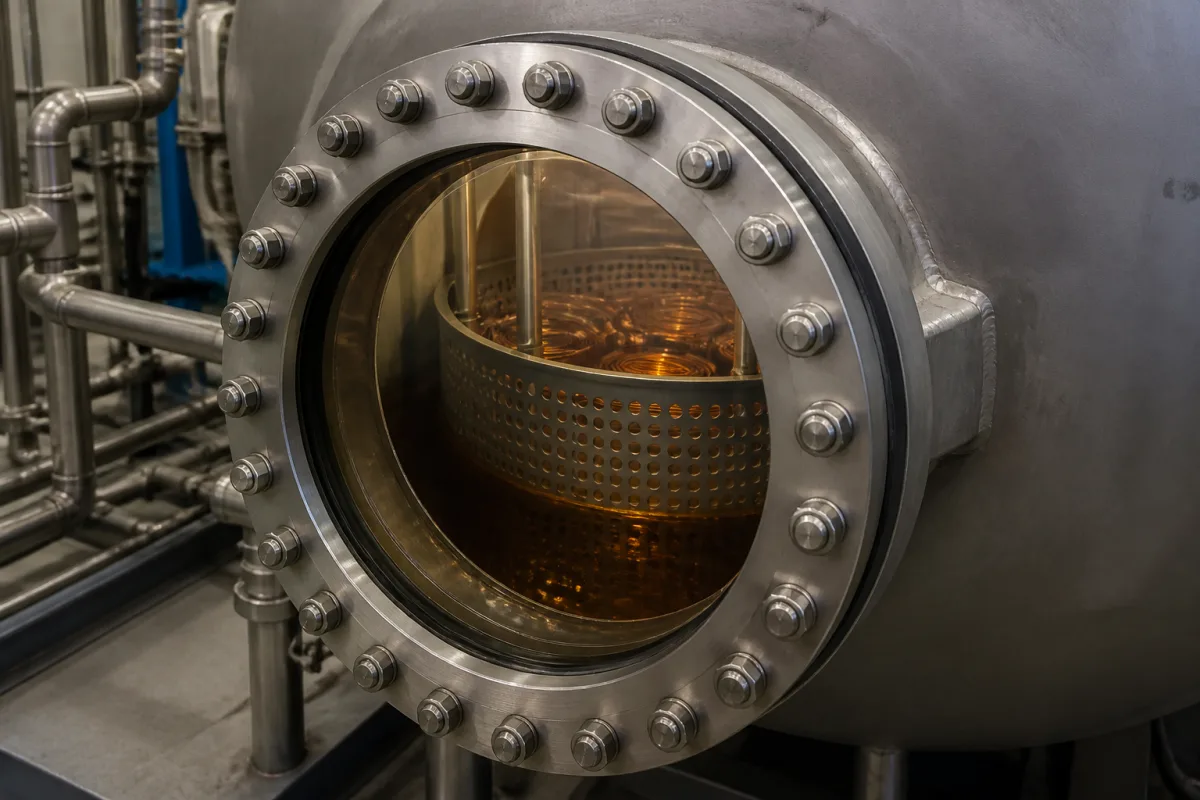
Pressure-vessel view port with a separately clamped sight-glass disc
Vessel observation · weld pad · gasketed glass disc
A weld-pad view port provides a viewing opening in a process vessel through a glass disc retained by a bolted cover. Specify the welded base, disc, gaskets and fasteners as an assembly, with the operating pressure and temperature tied to the selected construction.
Circular weld-pad and bolted-cover view ports in which a replaceable glass disc and gaskets are clamped on a process vessel, including pressure, vacuum and material conditions that must be specified for the assembled fitting. Viewing port, product 9533, covers the wider family; Sight glass assembly, product 3463, also covers clamp and fused-glass constructions. Viewport assembly for vacuum coating chambers, product 3009, covers bakeable CF windows and deposition protection; Observation window, product 1398, covers hot alkaline and steam attack.
CNFX editorial research · Sources checked October 16, 2026 · 4 sources
The welded base and the cover hold the disc through its gaskets
LJ Star’s weld-type fitting places the sight-glass disc between gaskets, a vessel-mounted weld pad and a removable cover flange. It requires the pad to be correctly welded into or onto the vessel wall to provide a distortion-free seat. [1]
DIN Media identifies DIN 28120 as a standard for circular sight-glass fittings and lists the 2021-04 edition as replacing the 2004-06 edition. Name the intended fitting standard and revision on the drawing; the public listing supplies its identity and scope, not a complete assembly pressure certificate. [2]
02
Nominal bore and clear viewing diameter are different drawing dimensions
The following example is the DN100, 235 psig column of LJ Star’s published dimensional table. Use the exact pressure column when selecting the disc and cover hardware. [1]
The torque value is tied to the cited fitting and lubrication condition. The manufacturer calls for progressive tightening in diametrically opposite pairs. Request the assembly-specific procedure for any different gasket, fastener or disc arrangement. [1]
30 N·m, with lubricant/friction factor µ = 0.1. [1]
03
Positive-pressure selection does not settle the vacuum connection
Herberts lists separate metal-fused vacuum sight-glass products for CF, ISO-K and KF connections. Its metal-fused construction bonds glass within a steel ring. That is a different interface selection from the welded-pad and cover arrangement on this page. [3]
For a vessel that alternates between vacuum and pressure, obtain both ratings for the complete offered view port, together with its glass and seal materials. Record the media, pressure direction, temperature and cycling duty. The positive-pressure table above is not a vacuum acceptance specification.
04
A fused-glass replacement still needs a defined mounting seal
LJ Star’s Metaglas manual describes a mechanically prestressed glass-and-metal disc mounted on a recessed flat-face or raised-face flange, with a suitable gasket or O-ring between the disc and the mounting surface. It says the required tightening torque varies with the sealing material. [4]
The manual requires pressure or vacuum to be relieved, the unit cooled to ambient and process fluid purged or drained before maintenance. Identify the supplied disc construction and replacement procedure on the assembly record; a fused replacement does not justify reusing an unrelated torque table. [4]
05
Send the vessel opening and the complete view-port duty
Paste it into your enquiry below or into an email to a maker, then replace every bracket.
Explore company information and manufacturing capabilities, then discuss the scope of your project with a relevant supplier.
Share this page
Compiled and source-reviewed by the CNFX editorial team.
Each manufacturer above links to the page on that company's own website where the product is listed, with the date we checked it. How we source and review
· Page last updated 16 October 2026
Buyer questions
Does nominal bore give the viewing aperture?
The cited fitting table labels nominal bore and viewing diameter separately. Select the dimension needed for the vessel opening and the observation task from the assembly drawing. [1]
Can a metal-fused vacuum window be installed on any weld pad?
Herberts identifies different vacuum connection families. Match the exact mounting interface and obtain the complete assembly rating and installation procedure. [3][4]
Sources and what still needs a direct check
Sources checked 2026-10-16. The weld-type fitting sheet supplies the dimensional example. DIN Media identifies the circular-fitting standard; the Metaglas sources distinguish vacuum interfaces and fused-disc mounting.