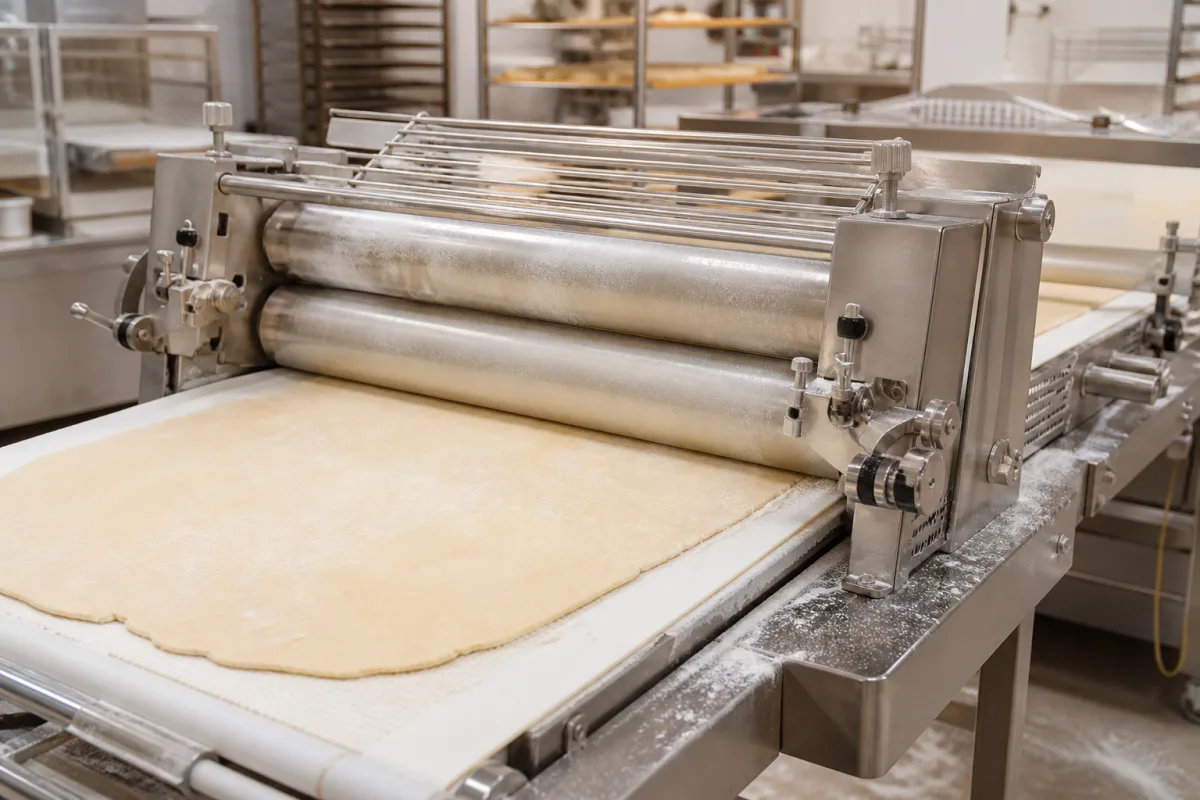
Dough sheeter roller assembly: the gauge-roll pair, its gap and the reduction it takes per station
The roll pair that sets dough thickness in a sheeter or gauging station · roll gap against finished sheet, reduction ratio per station, springback, roll diameter and working width
The roller assembly is the working heart of a dough sheeter or gauging station: two parallel rolls, mounted in bearings with an adjustable gap, driven at speeds matched to the infeed and discharge belts, with scrapers and guards around the nip. What a buyer specifies is not only roll size and finish but how much reduction the pair should take in one pass and how the gap relates to the thickness that actually leaves the rolls, because dough springs back after the nip.
Roll pairs and their mounting in dough sheeters, gauging stations and reduction stations for bread, cracker, biscuit, pizza and pastry dough: roll gap setting and control, reduction ratio per station, springback, roll diameter, working width, scrapers and guarding. Complete laminating lines and how they build fat layers are covered on the Industrial dough laminator page.
CNFX editorial research · Sources checked October 12, 2026 · 3 sources
The sheet comes out thicker than the gap: springback of 1.8 to 2.75 times at 6–12 mm
Researchers at the University of Huddersfield sheeted bread dough through a pair of 37 mm diameter rolls with a gap adjustable from 23 mm down to 1 mm, at gaps of 6, 9 and 12 mm, and measured the sheet thickness after the rolls. [1]
The authors explain that viscoelastic dough retracts after being stretched and squeezed between the rolls, so the sheeted dough emerges thicker than the gap. Because of springback, a folding-and-sheeting regime that would in principle give a constant reduction ratio of 2 gave about 3.8–4 at the 6 and 9 mm gaps and about 5.5 at 12 mm. Adding bran reduced springback, with fine bran giving the largest reduction. [1]
On roll size, they cite Engmann and co-workers' finding that springback is much less sensitive to the roll diameter-to-gap ratio than to the reduction ratio, and note that their 37 mm rolls were smaller than the 100 mm and 85 mm rolls in earlier studies, so diameter-to-gap may have mattered more in their tests. [1] Editorial calculation: in these tests the gap was 0.16 (6 mm) to 0.32 (12 mm) of the 37 mm roll diameter.
Roll gap
Springback after 12 passes, dough without bran (sheet thickness ÷ gap)
Specify the finished sheet thickness and dough type, not only the gap, and ask the sheeter maker for springback data or a trial on your dough to set the gap.
02
How much one roll pair should reduce: 3:1 from infeed to discharge, with the gap held automatically
Reading Bakery Systems, whose Thomas L. Green gauging stations serve cracker, biscuit, pizza and chip lines, gives the reduction a single parallel-roll station takes. [2]
RBS describes its parallel, hardened rolls as reducing dough sheet thickness by a 3:1 ratio from infeed to discharge as the typical case. The roll gap can be monitored by the control system and adjusted automatically to keep thickness constant, it can be adjusted on either side of the roll, rolls are mounted on precision bearings, and roll speeds, gap and the discharge conveyor are controlled automatically in a cascade synchronised with adjacent equipment. [2] Editorial calculation: at 3:1, a 12 mm infeed sheet leaves a station at about 4 mm, so a reduction from 30 mm to 1.1 mm needs three stations (30 → 10 → 3.3 → 1.1 mm).
For safety and sanitation RBS lists mechanically secured and electronically interlocked guards around the roll pinch points, guards designed for inspection during production, and integrated belt scrapers on discharge conveyors. [2]
Rademaker describes the same principle on pastry lines: dough blocks are reduced step by step through multiple reduction stations to the thickness the product requires, without damaging dough structure or layers. [3]
Fix the number of roll stations from the infeed and final thickness and the reduction each station may take for your dough; the 3:1 figure is one maker's description for its gauging stations.
03
Working width, throughput and hygienic design of the roll stand
Roll length follows the line's working width, and the stand must be cleanable.
Editorial note: none of the three sources gives roll diameter for industrial gauging stations; ask the maker for roll diameter, roll material and hardness, runout, surface finish and the maximum separating force the bearings and gap mechanism are designed for.
Explore company information and manufacturing capabilities, then discuss the scope of your project with a relevant supplier.
Share this page
Compiled and source-reviewed by the CNFX editorial team.
Each manufacturer above links to the page on that company's own website where the product is listed, with the date we checked it. How we source and review
· Page last updated 13 October 2026
Buyer questions
Why is the dough sheet thicker than the sheeter roll gap?
Dough springs back after the nip; Huddersfield tests measured sheets 1.86–2.75 times the 6–12 mm gap for bread dough without bran. [1]
How much can one pair of gauge rolls reduce a dough sheet?
Reading Bakery Systems describes its gauging stations as reducing thickness 3:1 from infeed to discharge. [2]
What working widths do industrial sheeting lines use?
Rademaker lists 600, 800, 1,000 and 1,200 mm, with wider widths as an option. [3]
Sources and what still needs a direct check
Sources checked 2026-10-12. Springback data come from a peer-reviewed University of Huddersfield study; station and line figures are from two equipment makers' own pages (Reading Bakery Systems, Rademaker).