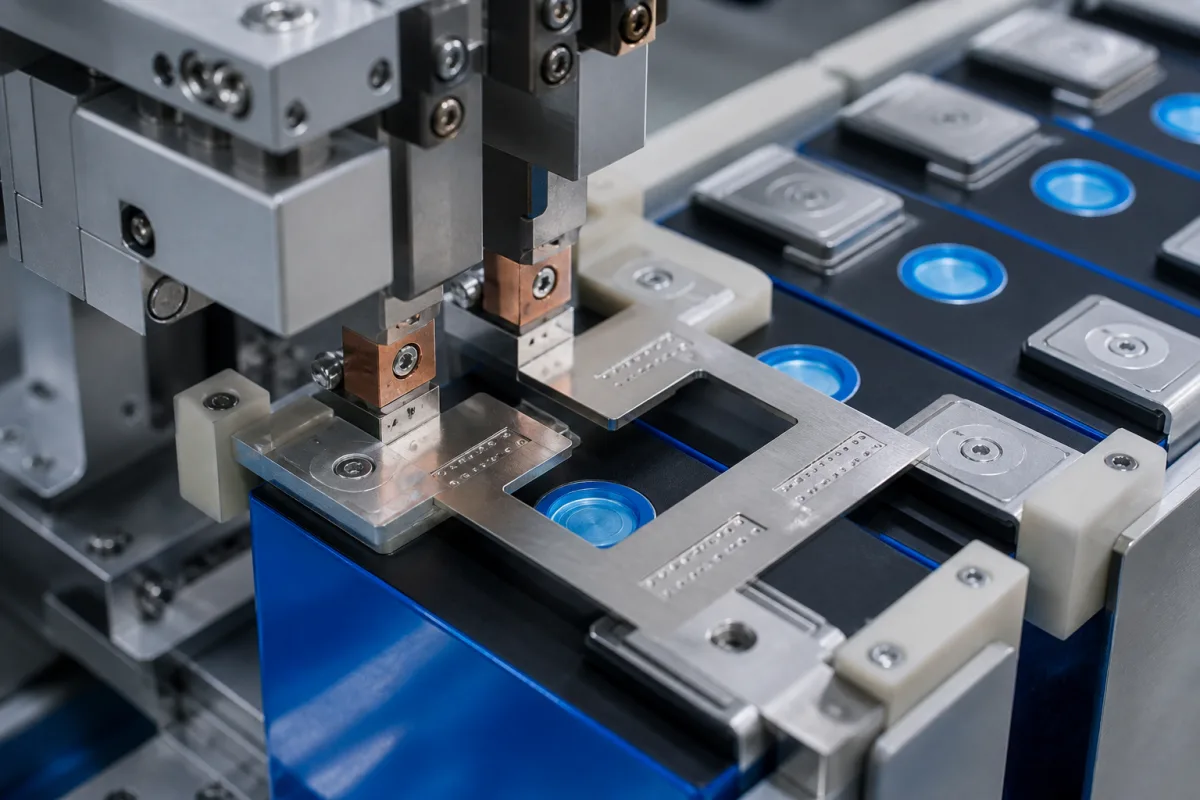
Tab-to-busbar interconnects for lithium-ion battery modules and packs · Tab and busbar materials (Al, Cu, nickel-plated Cu, Ni), thickness, laser, ultrasonic and resistance welding, joint strength, joint resistance and temperature rise under current
A battery cell tab connector is the busbar or interconnect plate that joins the tabs of cells in series or parallel inside a module, joined by laser, ultrasonic or resistance welding. Each joint carries the full cell current, so its resistance, strength and temperature rise matter for pack efficiency and safety. Ask three things first: which tab and busbar materials and thicknesses are being joined, which welding process will be used, and what joint strength, resistance and temperature rise the supplier has tested at your current.
Busbars and interconnect plates joined to the tabs or terminals of lithium-ion cells in modules and packs, with their materials, plating and joining by laser, ultrasonic or resistance welding. Cell manufacturing (electrode foil to tab welding inside the cell), general power busbars (see copper busbar) and battery management systems are outside this page except where compared.
CNFX editorial research · Sources checked October 12, 2026 · 4 sources
Choose tab and busbar materials and the joining process
A 2025 open-access review in Micromachines (Tab-to-Busbar Interconnections in EV Battery Packs) describes the tab as the cell's main terminal, carrying all energy into and out of the cell, and the busbar as a larger conductor connecting multiple tabs in series or parallel. A high-resistance joint causes I²R losses and local heating that can accelerate degradation of nearby cells and in extreme cases poses a thermal runaway risk, while a mechanically weak joint can fail under vibration and open the circuit. Typical materials are Al, Cu and Ni-plated Cu. [2]
The review compares the three dominant processes: ultrasonic welding is solid-state, suppressing porosity and limiting Al-Cu intermetallics, but is sensitive to thickness, stack geometry and tool wear; laser welding gives high-speed automated production but needs control of spatter, porosity and brittle intermetallics in dissimilar joints; resistance welding is cost-effective and flexible but suffers electrode wear and variability with highly conductive stacks. It concludes no single process is universally superior. [2]
The Warwick study laser-welded 0.3 mm Al, Cu, Cu[Ni] and Ni tabs to 1.5 mm Al and Cu busbars with a 150 W pulsed fibre laser and wobble head. Ni tab to Cu busbar joints gave the highest strength (about 1320 N) and Ni to Al about 930 N; Cu tab to Al busbar (about 560 N) was slightly stronger than Al tab to Cu busbar (about 520 N) because of more CuAl2 intermetallics in the latter. It concluded that Ni tabs make strong joints but perform poorly electrically and thermally and are expensive, while Cu and Cu[Ni] tabs perform well, and that Al busbars can cut busbar weight and cost by 75%. [1]
A 2026 study in Scientific Reports (16:28549) ultrasonically welded 0.5 mm aluminium (AA1100) to 0.3 mm cupro-nickel (UNS C71500) sheets, 75 × 20 mm with a 20 mm overlap, on a 3 kW, 20 kHz welder, varying vibration amplitude (54 and 68 µm), sonotrode pressure (0.22, 0.24 and 0.26 MPa) and weld energy (600–1,500 J). Sonotrode pressure and weld energy affected joint strength more than amplitude. Lap shear strength peaked at 942 N and T-peel strength at 236 N at 1,200 J, then fell sharply at higher energy; at 1,500 J the weld interface reached 375, 384 and 389 °C for the three pressures, and heat thinned the aluminium sheet. Joint resistance decreased as weld energy increased. [3]
Editorial note: because ultrasonic joint strength rises and then falls with weld energy, ask the supplier for the energy window it validated on your tab and busbar stack, with lap-shear, peel and resistance results at both ends of that window. [3]
Give the supplier the cell type and tab material, thickness and plating, cell arrangement (series and parallel counts), busbar material and thickness, current (continuous and peak) and duration, joining process and access (one-sided or both sides), weld pattern, strength and resistance acceptance values, temperature limits, insulation and holder design, and the inspection and test plan for each joint.
02
Check joint resistance and temperature rise at your current
The Warwick study passed 100 A, 150 A and 200 A through the joints for 180 s while measuring resistance and temperature. The lowest resistance was the Cu tab to Cu busbar weld: 0.044, 0.048 and 0.050 mΩ at 100, 150 and 200 A, the rise caused by resistive heating in a positive feedback loop. The highest temperatures were in Ni tab to Al busbar joints (89.9°C at 100 A, 157.8°C at 150 A, with the 200 A case overheating), and the lowest in Cu tab to Cu busbar joints (34°C at 100 A, 46.5°C at 150 A). [1]
Editorial calculation: at 200 A through a 0.050 mΩ joint, heating is I²R = 200² × 0.000050 = 2.0 W per joint; multiply by the number of joints in your module to estimate the joint heat the cooling must remove, and recalculate with the supplier's measured resistance for your materials. [1]
Editorial note: ask for joint resistance and temperature rise measured at your continuous and peak current and duration, not only lap-shear strength.
03
Check Cu–Al joint resistance against the base materials and the cell temperature limit
A 2023 study by the Bayerisches Laserzentrum, FAU Erlangen-Nürnberg and RWTH Aachen welded copper to aluminium in overlap, copper on top, with a 515 nm green laser, which the authors chose because copper absorbs green light far better than infrared. The coupons were 55 × 35 mm: 0.2 mm Cu-ETP with a 2.5 µm electrodeposited nickel coating (tolerance 0.6–3 µm) over 0.3 mm aluminium. Resistance was measured with Kelvin contacts over a 16 mm test length, and temperature with thermocouples 8 mm from the seam. [4]
The authors report that every parameter set gave a resistance between the two base-material values, so the weld did not significantly worsen electrical performance. The abstract reports a parameter window for every strategy, "with the stitched seam achieving the most stable results". Circular beam oscillation increased Cu–Al intermixing and intermetallic formation, and the vertical figure-eight oscillation (parameter set #6) showed the largest amount of intermetallic phases in their micrographs. They cite earlier work that a Cu–Al joint becomes very brittle once the intermetallic layer is thicker than 5 µm. [4]
Editorial calculation: 42.2 µΩ is about 1.5 times the copper reference (28 µΩ) and about 0.77 times the aluminium reference (55 µΩ). The γ1 phase's 14.2 µΩ·cm is about 7.9 times copper's 1.8 µΩ·cm. At 200 A, 42.2 µΩ dissipates about 1.7 W (200² × 0.0000422). Set this against the 0.050 mΩ Cu–Cu figure from the Warwick tests above, and remember that each study used its own test length and geometry. [4][1]
Ask a busbar supplier which welding strategy and wavelength it uses for Cu–Al joints, the measured joint resistance with its test length, the intermetallic layer thickness from cross-sections, and the temperature measured next to the cell terminal during welding. [4]
Measured or cited item
Value
Reference resistance, copper / aluminium base material
Fill the specification fields with values for your module
A tab connector quotation needs values for your cells and currents. The table explains each field, gives published values where a reviewed source states them, and says what to obtain from the supplier.
Field
What it means and published values
Ask the supplier for
Contact Resistance (mΩ)
E.g. 0.044–0.050 mΩ Cu–Cu laser welds at 100–200 A. [1]
Measured for your joint.
Current Rating (A)
Continuous and peak; 100–200 A tested in one study. [1]
Explore company information and manufacturing capabilities, then discuss the scope of your project with a relevant supplier.
Share this page
Compiled and source-reviewed by the CNFX editorial team.
Published product pages show what a company offers, not tested performance. Confirm the legal seller, factory and scope for your order. How we source and review
· Page last updated 13 October 2026
Buyer questions
Which tab and busbar materials give the lowest joint resistance?
In the Warwick laser-welding study, Cu tab to Cu busbar joints had the lowest resistance, 0.044–0.050 mΩ at 100–200 A. [1]
Laser, ultrasonic or resistance welding for tab connectors?
The Micromachines review finds no single best process: ultrasonic limits intermetallics, laser is fast and automated, resistance is cheap but variable. [2]
Why do weak tab joints matter?
High resistance causes I²R heating that can degrade nearby cells, and weak joints can open under vibration (review). [2]
Does more ultrasonic weld energy give a stronger tab joint?
Only up to a point: in a 2026 Al to CuNi study, lap shear strength peaked at 942 N at 1,200 J and then fell sharply as interface temperature rose. [3]
Sources and what still needs a direct check
Sources checked 2026-10-12. The Warwick paper (2021, author's accepted manuscript, CC BY-NC-ND) reports laboratory tests on one laser set-up; the Micromachines review (open access) summarises published research. A 2023 Bayerisches Laserzentrum, FAU and RWTH study adds measured resistances for green-laser Cu–Al tab welds.