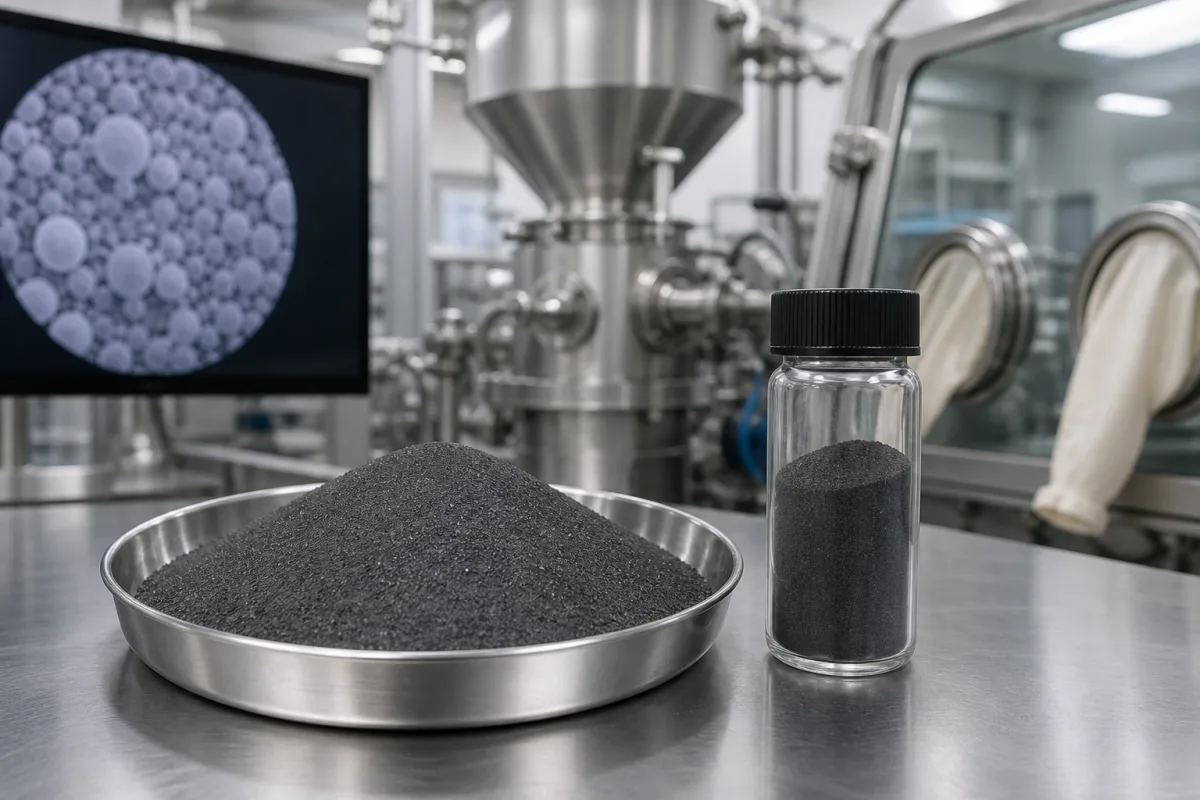
Lithium nickel manganese cobalt oxide (NMC) cathode active material
NMC (NCM) layered-oxide cathode powder · Ni:Mn:Co ratio from 523 to 811, capacity in a stated voltage window, residual LiOH and Li2CO3, slurry pH, single-crystal vs polycrystalline particles, D50, tap density, BET, trace metals
Lithium nickel manganese cobalt oxide (NMC, also written NCM) cathode active material is a layered-oxide powder that cell makers coat into the positive electrode of lithium-ion cells; the Ni:Mn:Co ratio, written as 111, 523, 622 or 811, trades capacity against surface reactivity. Ask three things first: what capacity the grade delivers in your voltage window and rate; how much residual LiOH and Li2CO3 sits on the surface, and at what pH; and whether the particles are polycrystalline agglomerates or single crystals, which changes D50, tap density, surface area and cracking behaviour.
NMC (NCM) layered-oxide cathode powders for lithium-ion cells across Ni:Mn:Co ratios from 111 to Ni-rich 811 and above, in polycrystalline and single-crystal forms, with or without surface coatings. Lithium iron phosphate, NCA, lithium cobalt oxide and manganese spinel cathodes, hydroxide precursors, coated electrode sheets and finished cells are outside this page except where compared.
CNFX editorial research · Sources checked October 11, 2026 · 5 sources
Match the Ni:Mn:Co ratio to capacity in a stated voltage window
A 2023 review in National Science Review gives NMC layered oxides a theoretical capacity of about 278 mAh/g and a working voltage of about 3.8 V. [1] Delivered capacity depends on nickel content and on the test window. MTI's NCM523 powder (Ni:Co:Mn = 5:2:3) lists 153–158 mAh/g in the first cycle at 0.2C between 4.2 and 2.7 V in a half cell, with first-cycle efficiency of at least 85%. [5] Its polycrystalline NCM811 powder lists half-cell discharge capacity above 210 mAh/g (215 measured) and charge capacity above 230 mAh/g (235) at 0.1C between 2.8 and 4.3 V, with first discharge efficiency above 90% (91.5%). [3]
Nominal ratio names are shorthand. MTI's single-crystal powder sold as Ni:Co:Mn = 8:1:1 lists Ni 83.0 ± 0.5, Co 11.0 ± 0.5 and Mn 6.0 ± 0.5 mol% in its composition table, and 195.8 mAh/g at 0.3C and 185.6 mAh/g at 1C between 3.0 and 4.25 V. [4] Put the target mol% with tolerances in the order, not only the ratio name.
The three MTI sheets state that MTI does not manufacture these powders and sells small research quantities, forwarding larger enquiries to the producer; values for production lots must come from the producer. [5][3][4]
Editorial calculation: 215 ÷ 278 ≈ 77% of the review's theoretical figure for the polycrystalline 811 at 4.3 V, and 158 ÷ 278 ≈ 57% for the 523 at 4.2 V; because the windows and rates differ, compare suppliers only at the same upper voltage, rate and cell type. [3][5][1]
Give the supplier the target Ni:Mn:Co mol% with tolerances, Li content, the capacity and first-cycle efficiency required with voltage window, rate and test cell, particle form (polycrystalline or single crystal) and D50, tap density and BET ranges, residual LiOH and Li2CO3 and pH limits, moisture, sulfur and trace-metal limits, any surface coating, packaging under dry atmosphere, and lot size.
02
Check residual lithium, slurry pH and particle form
A 2020 Frontiers in Energy Research review explains that residual lithium compounds, “mainly LiOH and Li2CO3” in its words, come from excess lithium added during sintering to reduce Li/Ni mixing and offset lithium volatilization, and from reaction of the surface with moisture and CO2 in air; Li2CO3 grows faster on higher-nickel cathodes. At pH about 11, Ni-rich powders degrade PVDF binder and gel the electrode slurry, and residual lithium compounds raise cell polarization, aggravate swelling and, by decomposing on first charge, release CO2 and lower initial Coulombic efficiency. Washing lowers residual lithium and pH, but leaves a more air-sensitive surface. [2]
MTI's single-crystal 811 sheet shows how these limits are written: residual Li2CO3 ≤ 0.20 wt% (0.177 measured), LiOH ≤ 0.25 wt% (0.150), pH 11.0 ± 0.50 (11.44), moisture ≤ 500 ppm (281) and S ≤ 2500 ppm (260). [4] The polycrystalline 811 sheet lists pH 11.5–12.0 and moisture ≤ 0.04%, and MTI advises vacuum storage and baking at 120–150 °C before slurry making. [3]
Particle form is the second decision. The National Science Review paper reports hydroxide precursor radii around 10 µm for polycrystalline NMC and 2–5 µm for single-crystal NMC. Polycrystalline agglomerates crack along grain boundaries as primary particles expand and shrink unevenly; single crystals have no interparticle boundaries, a lower specific surface area and improved cycling and thermal stability, but can suffer planar gliding and intragranular cracks at high voltage, temperature and nickel content, with almost no cracking below 4.5 V in one study and a sharp rise above it. Smaller particles also lower tap density. The review identifies reaction between released oxygen and electrolyte as the trigger of thermal runaway. [1]
The MTI sheets show the trade-off in numbers: polycrystalline 811 D50 9–15 µm (10.80), BET 0.25–0.65 m²/g (0.55) and tap density above 2.1 g/cm³ (2.3); single-crystal 811 D50 4.0 ± 0.5 µm (4.4), BET 0.70 ± 0.15 m²/g (0.79) and tap density ≥ 1.8 g/cm³ (2.22); NCM523 D50 10.0–14.0 µm and BET 0.20–0.40 m²/g. [3][4][5]
Editorial calculation: the single-crystal lot's measured residual lithium compounds total 0.177 + 0.150 = 0.327 wt%, against combined limits of 0.20 + 0.25 = 0.45 wt%. [4]
03
Lot certificate and cell data to request from each NMC producer
When requesting quotations, ask each supplier for the composition by ICP, a certificate of analysis per lot including residual LiOH and Li2CO3 by titration and pH, particle size, tap density, BET, trace metals and moisture, half-cell or full-cell capacity data in your window, and samples.
04
Ni, Mn and Co content, lithium, particle form, residual lithium, trace metals and moisture
Nominal ratio names hide the real composition: MTI's single-crystal powder sold as 8:1:1 lists Ni 83, Co 11 and Mn 6 mol%, so order by measured mol% with tolerances rather than by the name. [4]
Element
Role
Fix in the order
Ni, Mn, Co
Set capacity and stability; e.g. 83/11/6 mol%. [4]
Capacity window, tap density, D50, BET, residual lithium and pH for a cathode powder order
The capacity row is only comparable at one test condition: MTI's 523 figure is at 0.2C to 4.2 V and its polycrystalline 811 figure at 0.1C to 4.3 V, so name the rate, upper voltage and test cell in the enquiry. [5][3]
Not stated in reviewed sources; Fe ≤ 50 ppm, Cu ≤ 20 ppm (SC 811). [4]
Magnetic-particle limit and method.
06
Send the composition, window and surface limits together
Paste it into your enquiry below or into an email to a maker, then replace every bracket.
Composition: [Ni:Mn:Co mol%; Li wt%; coating]
Capacity: [mAh/g; rate; voltage window; test cell]
Particles: [polycrystalline or single crystal; D10/D50/D90; tap density; BET]
Surface: [LiOH; Li2CO3; pH]
Purity: [Fe; Cu; Na; Zn; S; magnetic particles; moisture]
Supply: [lot size; dry packaging; CoA per lot]
1 company lists this product among what they make. Company figures are quoted from each
company's own website; every card states where the relationship came from.
Longneng Technology (Nantong) Co., Ltd.
Manufacturing site to be confirmed for the order
Lists cathode materials, including LPNTN64A, a polycrystalline ternary (NCM) material with 65 mol% nickel.
Explore company information and manufacturing capabilities, then discuss the scope of your project with a relevant supplier.
Share this page
Compiled and source-reviewed by the CNFX editorial team.
Each manufacturer above links to the page on that company's own website where the product is listed, with the date we checked it. How we source and review
· Page last updated 13 October 2026
Buyer questions
Why do NMC buyers limit residual LiOH and Li2CO3?
A 2020 review links them to PVDF degradation and slurry gelation at pH about 11, higher polarization, swelling and CO2 release on first charge. [2]
Is single-crystal NMC better than polycrystalline?
Single crystals avoid grain-boundary cracking and have lower surface area, but can crack internally at high voltage, temperature and nickel content, and smaller particles lower tap density. [1]
How much capacity does NCM811 give compared with NCM523?
MTI lists over 210 mAh/g for polycrystalline 811 at 0.1C to 4.3 V and 153–158 mAh/g for 523 at 0.2C to 4.2 V; compare only at the same window. [3][5]
Sources and what still needs a direct check
Sources checked 2026-10-11. Sources are two open-access review articles and three research-supply data sheets from a distributor that does not make the powders; values for your order must come from the producer's certificate of analysis.