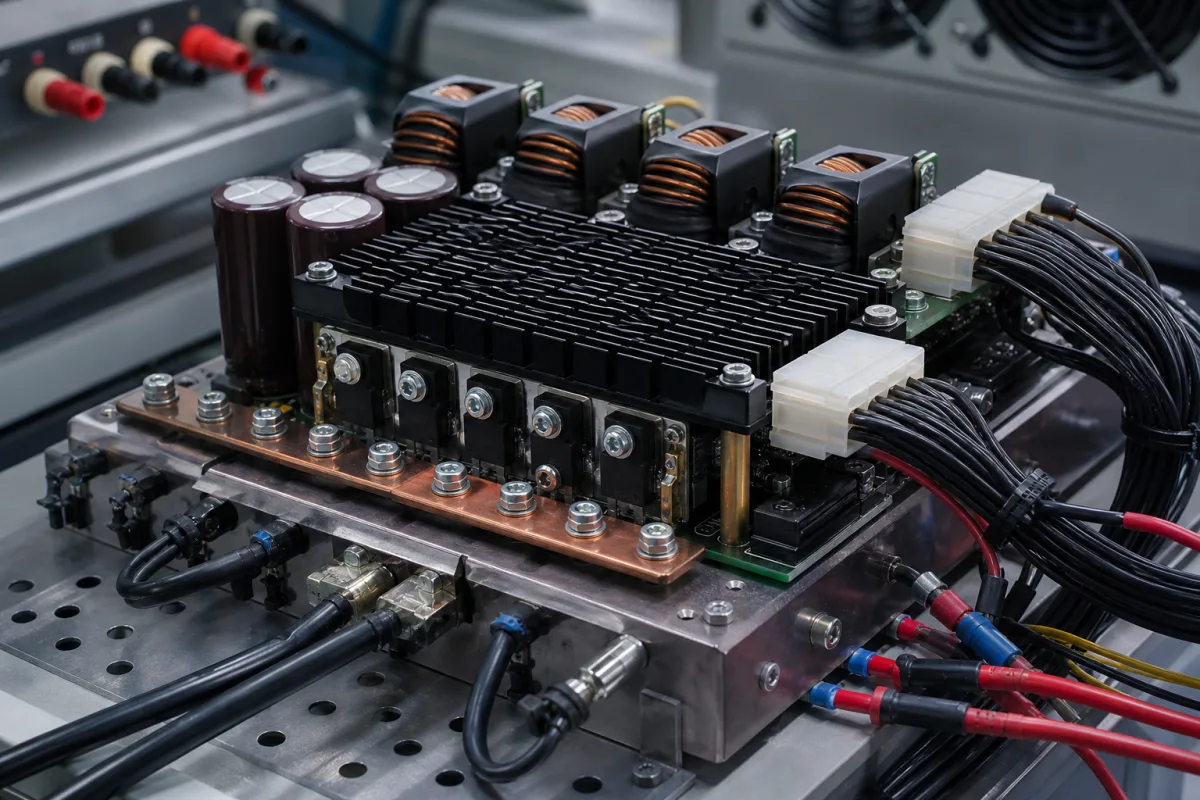
PSU voltage regulator module: DC-DC stages for the +5 V and +3.3 V rails of a computer power supply
Inside the desktop PSU · +5 V and +3.3 V DC-DC stages, ATX regulation and ripple limits, efficiency targets for the whole supply
This page covers the voltage regulator module inside a computer power supply unit: the DC-DC stage that turns the supply's +12 V into the regulated +5 V and +3.3 V rails delivered at the ATX connectors. It is judged by the PSU's output specification, not by a processor's needs. Ask three things first: what regulation and ripple the module holds at the connector, how much current each rail must carry, and how much loss the module may add to the whole supply's efficiency budget.
DC-DC voltage regulator modules and stages inside desktop and server power supply units that generate the +5 V and +3.3 V rails from +12 V. Multiphase VRM controllers, power stages and modules for processor, ASIC, FPGA and GPU core rails are covered on the Voltage regulator module (VRM) page. Complete AC-DC power supplies and isolated DC-DC bricks are outside this page.
CNFX editorial research · Sources checked October 12, 2026 · 5 sources
Hold the ATX regulation and ripple limits at the connector
Intel's ATX Version 3.x Multi Rail Desktop Platform Power Supply Design Guide (Table 4-2) requires +5 VDC within ±5% (4.75–5.25 V) and +3.3 VDC within ±5% (3.14–3.47 V), with tolerance required at all connectors. The +12 V rails are allowed +5%/−7% (11.20–12.60 V) to cover power excursions, and Intel notes that nominal 12 V may be set to 12.1 or 12.2 V for that reason. [1]
For ripple and noise (Table 4-6) the same guide sets 50 mV p-p maximum on +5 V, +3.3 V and +5 VSB and 120 mV p-p on the +12 V rails and −12 V, measured over 10 Hz to 20 MHz with a 20 MHz oscilloscope and with 0.1 µF ceramic and 10 µF electrolytic capacitors at the connector. [2]
Editorial calculation: 50 mV is about 1.5% of 3.3 V (0.05 ÷ 3.3) and 1.0% of 5 V, while the ±5% regulation window is ±165 mV on 3.3 V and ±250 mV on 5 V. A DC-DC module whose 12 V input sits anywhere from 11.20 to 12.60 V must hold both limits across that whole input range. [1][2]
Give the supplier the input range from the 12 V bus, each output voltage and current, regulation and ripple limits at the connector, transient load steps, power-sequencing and protection requirements, cooling airflow, and the PSU form factor.
02
Budget the module's loss within the supply's efficiency targets
Intel's guide (Table 4-14) gives required minimum efficiencies at 115 V AC input of 70% at full load, 72% at typical (50%) load and 65% at light (20%) load, and notes that idle DC load for mainstream computers is 10 W and could go lower. [3]
ENERGY STAR Computers Version 9.0 (2025) sets internal power supply minimums of 80% at 10% load, 82% at 20%, 85% at 50% and 82% at 100% for supplies rated 500 W and below, with power factor 0.90 at 50% load for supplies of 75 W and above; for supplies above 500 W it sets 80%, 87%, 90% and 87%. [4]
Editorial calculation: with an assumed 95% efficient DC-DC stage delivering 3.3 V at 20 A (66 W), the stage dissipates 66 ÷ 0.95 − 66 ≈ 3.5 W of heat. Because the whole supply must meet the ENERGY STAR figures measured at its output, every watt lost in the DC-DC stage counts against them. [4]
03
Mornsun non-isolated regulators from 0.3 A to 100 A, and the data to request
Mornsun lists non-isolated switching regulators in three current classes: the K78 series from 0.3 A to 3 A, high-current modules from 0 A to 50 A and POL modules from 6 A to 100 A. [5]
Ask each supplier for efficiency curves at your input voltage, output ripple measured to the ATX method, load-step response and thermal derating with your airflow.
04
PWM controller, MOSFETs, output inductor and capacitors, sensing and heatsink
1 company lists this product among what they make. Company figures are quoted from each
company's own website; every card states where the relationship came from.
MORNSUN Guangzhou Science & Technology Co., Ltd.
Manufacturing site to be confirmed for the order
Lists non-isolated switching regulators: K78 series (0.3–3 A), high-current (0–50 A) and POL (6–100 A) modules.
Explore company information and manufacturing capabilities, then discuss the scope of your project with a relevant supplier.
Share this page
Compiled and source-reviewed by the CNFX editorial team.
Each manufacturer above links to the page on that company's own website where the product is listed, with the date we checked it. How we source and review
· Page last updated 13 October 2026
Buyer questions
What regulation must the +3.3 V and +5 V rails hold?
Intel's ATX 3.x design guide requires ±5% at the connector: 3.14–3.47 V and 4.75–5.25 V. [1]
What ripple is allowed on the +3.3 V and +5 V rails?
50 mV p-p, measured from 10 Hz to 20 MHz with a 20 MHz oscilloscope. [2]
What efficiency does ENERGY STAR require of a computer power supply?
Version 9.0 sets 82%, 85% and 82% at 20%, 50% and 100% load for supplies of 500 W and below, and 87%, 90% and 87% above 500 W. [4]
Sources and what still needs a direct check
Sources checked 2026-10-12. Intel publishes the ATX power supply design guide that PSU makers design to; ENERGY STAR (US EPA) sets efficiency criteria for computer power supplies; Mornsun is a maker listing its own non-isolated DC-DC modules.