Selective conformal coating · Valve type for the coating, thickness windows by chemistry, build-up at components, robot repeatability
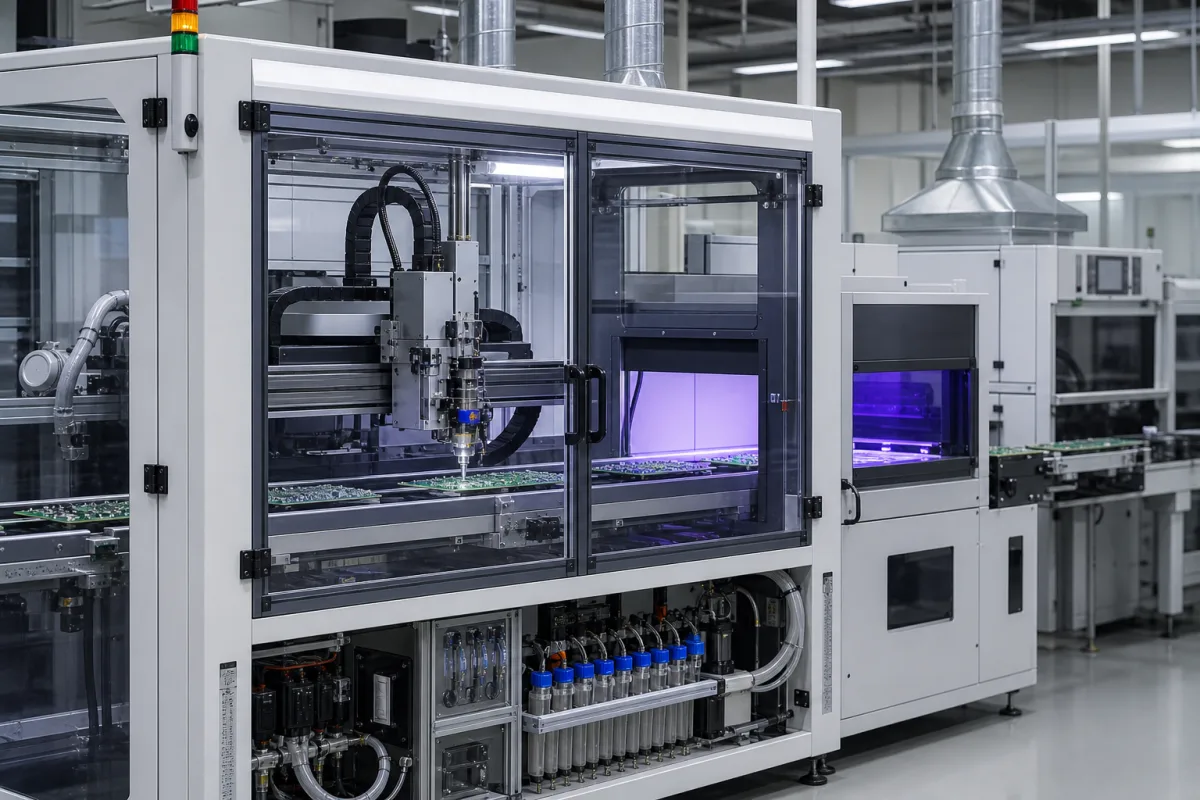
An automated conformal coating system is a robotic cell, which can sit inline with board conveyors, that moves spray, film or dispense valves over a printed circuit board assembly to coat selected areas while leaving connectors and keep-out zones bare, followed by a UV, heat or air cure. Ask three things first: which valve suits your coating's viscosity and solids, what dry thickness the coating maker's window allows and how the machine will hold it at edges and between components, and how repeatable the robot and fluid delivery are.
Selective robotic conformal coating machines and inline coating lines for PCB assemblies, with spray, film, jet or needle valves and optional curing. Dip and brush coating, parylene vapour deposition and the coating materials themselves are outside this page.
CNFX editorial research · Sources checked October 12, 2026 · 5 sources
SCH Technologies, a UK coating equipment and services company, names three main valve types: airless spray or 'film-coat' valves, LVLP (low volume, low pressure) atomising spray valves, and dispense valves, contactless or needle style. It recommends stainless steel fluid sections, a divorced design separating air and fluid, and a tip-seal closure to limit leaks and clogging. [1]
It says airless film valves work with low-viscosity solvent-based coatings below 100 cPs; they lay a thick wet film so the robot must move at about 300–450 mm/s, need at least 90° rotation for crossing stripes, and are sensitive to changes in viscosity, flow and air pressure, which can widen stripes into keep-out areas. LVLP valves atomise viscous liquids, and SCH discusses them for applying 100% solids coatings. [1]
Editorial calculation: if a solvent coating is 20% solids by volume (an assumption; take the real figure from the coating's data sheet), a 50 µm dry film needs about 250 µm wet (50 ÷ 0.20). Ask the machine supplier how it verifies wet film in production. [1]
Give the supplier board sizes, coating areas and keep-out zones, coating material with viscosity and solids, target dry thickness, cure method (UV, heat, moisture), cycle time, conveyor and line height, exhaust, inspection (UV fluorescence, thickness), and programming method.
02
Hold the dry thickness inside the coating's window
HumiSeal, a conformal coating maker, gives dry-film planning ranges by chemistry: acrylic (AR) and urethane (UR) 25–75 µm, silicone (SR) 25–100 µm and parylene (XY) 5–25 µm, UV-curable coatings 60–130 µm and automotive applications 80–110 µm. It states these are planning ranges, not specifications, to be set from the coating's data sheet and customer requirements. [2]
Another HumiSeal article lists the thicknesses used for standardised test methods (AR, UR and ER 25–75 µm, SR 50–200 µm, XY 12.5–50 µm) and states that below 25 µm properties were not tested. [3]
For UV-curable coatings, HumiSeal points to meniscus areas between adjacent SMT components, where coating builds up thicker than elsewhere, and identifies such thicker areas as failure zones in cycling test protocols, attributing this to inconsistent through-cure and micro-cracking. [4] Editorial note: ask the supplier to coat your board and map thickness at edges, tall parts and between close components, not only on flat areas.
03
Inline coating lines versus coaters sold beside glue dispensers
Listings include inline automatic conformal coating lines with curing, and conformal coating machines with glue dispensers among SMT equipment.
04
Robot, valves and fluid feed decide where the coating lands
Part
Role
Fix in the order
Robot gantry
Moves valves; repeatability ±25 µm in one maker's data. [5]
Board size, film thickness, valves and footprint, line by line
Repeatability, conveyor width, supply voltage and footprint here all come from one PVA machine; the thickness rows come from HumiSeal's planning ranges, not from any machine.
Explore company information and manufacturing capabilities, then discuss the scope of your project with a relevant supplier.
Share this page
Compiled and source-reviewed by the CNFX editorial team.
Each manufacturer above links to the page on that company's own website where the product is listed, with the date we checked it. How we source and review
· Page last updated 13 October 2026
Buyer questions
Which valve should I use for a solvent-based coating?
SCH describes airless film valves as working well with low-viscosity solvent coatings under 100 cPs. [1]
How thick should conformal coating be?
HumiSeal's planning ranges are 25–75 µm for acrylic and urethane and 60–130 µm for UV-curable coatings; set the target from the coating's data sheet. [2]
Why does coating crack between components?
HumiSeal reports that meniscus areas between SMT parts can exceed 125 µm and crack in thermal cycling. [4]
Sources and what still needs a direct check
Sources checked 2026-10-12. SCH Technologies sells coating equipment and services; HumiSeal (Chase Corporation) makes coatings and gives planning ranges, not specifications; PVA's figures are for one machine.