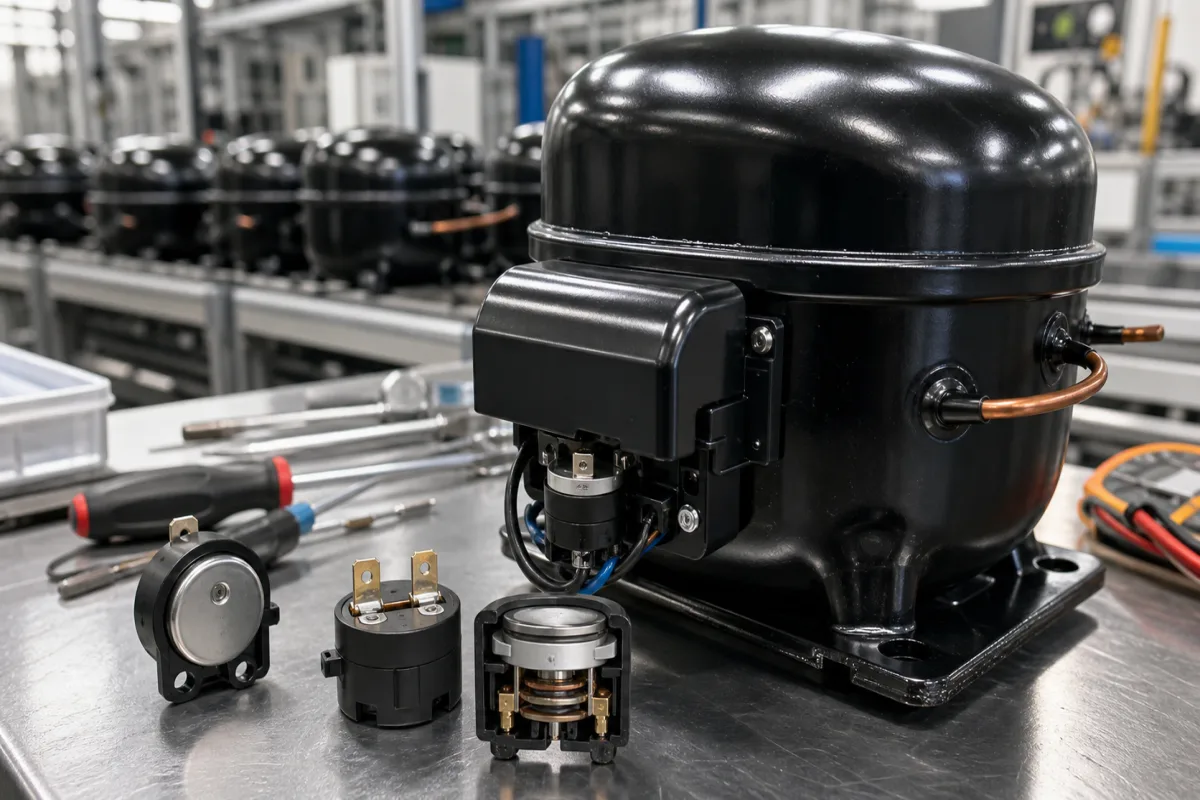
Refrigerator compressor thermal overload protector: the snap-disc motor protector mounted on a hermetic compressor
The snap-disc protector clipped onto a hermetic refrigeration compressor · current and heat open a bimetal disc at a calibrated 90–150 °C, it recloses as it cools, and it has to suit the compressor's locked-rotor current and 125 °C winding limit
A hermetic refrigeration compressor cannot be reached once it is sealed, so the device that stops it burning out is either fitted outside the shell, held in a holder under the terminal cover beside the starting device, or built inside onto the winding itself. The external version is a small round protector: a bimetal disc carrying the contacts, heated both by the motor current through it and by the compressor shell beneath. When it stalls at start or runs overloaded, the disc snaps open and the compressor stops; when the disc cools it snaps closed and the compressor tries again.
Thermal overload (motor) protectors for single-phase hermetic refrigeration compressors in refrigerators, freezers and similar cabinets: snap-disc external protectors fitted on the compressor, their open and reset temperatures, current ratings and matching to the compressor, with internal winding protectors compared. Bimetallic thermal overload relays fitted to contactors in motor starters are covered on the Thermal overload relay (motor overload relay) page; PTC and relay starting devices are only described where they share the terminal block.
CNFX editorial research · Sources checked October 12, 2026 · 5 sources
Current through the disc, heat from the shell: how the protector trips and recloses
Sensata describes its Klixon phenolic motor protectors as a bimetallic snap-acting disc on which the contacts are mounted and through which the motor current passes, normally closed and sensitive to both temperature and current. When the disc reaches its calibrated setpoint it opens and shuts the motor down, limiting winding and shell temperature; once the motor and protector have cooled to the reset temperature it recloses automatically and the motor can restart. Manual-reset versions exist where an automatic restart could be hazardous. [1]
Tecumseh, describing the conventional arrangement in a 1999 European patent application for an electronic alternative, explains that the snap disc is placed in series with the compressor motor windings and that “typically, a resistive heating element which heats the bimetallic layers is connected in series with the contact point”, so that excess current heats the bimetal until the disc bends and breaks the circuit; another arrangement places the disc close to the motor so it opens and closes on compressor temperature. [2]
The same filing lists what the snap disc does poorly: a long delay between the over-current event and the disc opening, imprecise set points, no dynamic response, no allowance for different environments or load conditions, and a long wait before the disc recloses. [2] Editorial note: those are the trade-offs a buyer accepts for a passive, self-powered device; they make the reset temperature and the time to reclose worth asking for, not only the trip temperature.
Ask for the open temperature with tolerance, the reset (close) temperature, whether reset is automatic or manual, and the trip-time curve at the compressor's locked-rotor current.
02
Klixon calibrations: open at 90 to 150 °C ±5 °C, reclose between 57 and 115 °C
In Sensata's single-phase phenolic protector table, automatic-reset discs open at 90, 105, 120, 135 or 150 °C with a ±5 °C tolerance and close again at lower temperatures with a ±9 °C tolerance; manual-reset types also open at 90 to 150 °C ±5 °C, with ±12 °C on the close value. Some combinations are marked as special temperatures. [1]
The same sheet sizes the protector by disc diameter: the 3/4-inch size is rated for up to 50 A at 120 V and 37 A at 240 V (32 A and 25 A in its lower-capacity combination), while the 1-1/2-inch size reaches 175 A at 120 V and 130 A at 240 V. A listing for 37 A maximum locked-rotor current at 230 VAC is given for the 3/4-inch motor protector only. Sensata presents these as inherent protectors for motors of about 1/2 to 5 hp, refrigerators and air conditioners among the listed uses. [1]
Editorial calculation: the gap between open and close temperature sets how long the compressor stays off. A 120 °C disc that recloses at 61 °C must cool about 59 K; one that recloses at 92 °C only about 28 K, so it will retry sooner on a stalled compressor.
Matching the protector to the compressor: locked-rotor amps at 4 s and a 125 °C winding limit
Secop's data for two light-commercial hermetic compressors show the two ways protection is supplied. The 115 V / 60 Hz SC18CLX.2 ships with an external overload protector, type T0761/46 (code 117U3212), pre-assembled on the compressor with its holder and cover; the 220–240 V SC12CLX.2 lists its motor protection as internal. [3][4]
Danfoss's quick reference for its R600a household refrigerator and freezer compressors (TL and NL series, 220–240 V) draws a winding protector inside the motor circuit in each wiring diagram, with a PTC starting device outside; it notes that the PTC needs a 5-minute standstill to cool before each start and dissipates about 2.5 W while running, cut to about 0.4 W by its electronic ePTC. [5] Editorial note: on such a compressor the external block holds only the starter, so a replacement 'overload' bought by shape may be the wrong part; check the compressor data sheet for external or internal protection first.
Sensata states that a protector cannot be applied from horsepower, amperage or nameplate data alone. Its application worksheet asks for locked-rotor current cold and hot, the time for the winding to rise from room temperature to the insulation class limit — its example is a class A motor going from 25 °C to 175 °C in 12.5 s — and the current at which the running winding stabilises about 10 °C below its maximum, for example 130 °C against 140 °C. [1] Editorial calculation: that example is a rise of 150 K in 12.5 s, about 12 K per second, which is the pace the locked-rotor trip has to beat.
Give the protector supplier the compressor model, voltage and frequency, locked-rotor current, maximum winding temperature, starting device, terminal pin layout and the cabinet's highest ambient temperature.
04
What to send when sourcing a compressor overload protector
Paste it into your enquiry below or into an email to a maker, then replace every bracket.
Compressor: [make, model, refrigerant, voltage / frequency]
Protection: [external snap-disc or internal winding protector per compressor data]
Currents: [locked-rotor amps at 4 s; running current at highest load]
Temperatures: [open temperature ± tolerance; reset temperature; max winding temperature]
Reset: [automatic or manual]
Mounting: [pin layout, holder, cover, starter combination]
Approvals: [UL / VDE / CCC as required]
Explore company information and manufacturing capabilities, then discuss the scope of your project with a relevant supplier.
Share this page
Compiled and source-reviewed by the CNFX editorial team.
Each manufacturer above links to the page on that company's own website where the product is listed, with the date we checked it. How we source and review
· Page last updated 13 October 2026
Buyer questions
How does a refrigerator compressor overload protector work?
Motor current flows through a bimetal snap disc that carries the contacts; heat from that current and from the compressor opens the disc at its setpoint and it recloses when cooled to its reset temperature. [1][2]
At what temperature does it open?
Sensata's Klixon single-phase protectors are calibrated to open at 90, 105, 120, 135 or 150 °C, ±5 °C, with lower reclose temperatures. [1]
Does every refrigeration compressor have an external protector?
No. Secop's 115 V SC18CLX.2 uses an external protector, while its 220–240 V SC12CLX.2 lists internal protection; Danfoss R600a TL/NL diagrams show an internal winding protector. [3][4][5]
What data are needed to choose one?
Sensata asks for locked-rotor current cold and hot, the time to reach the insulation limit, running-overload current and ambient conditions — not just horsepower or nameplate amps. [1]
Sources and what still needs a direct check
Sources checked 2026-10-12. Disc operation, calibration tables, current ratings and the application worksheet come from Sensata's Klixon single-phase phenolic protector catalogue; the series-heater arrangement and limits of snap discs from Tecumseh's European patent application EP 0 935 328; compressor protection type, locked-rotor current and winding limits from Secop single-pack data sheets; the household R600a winding protector and PTC data from Danfoss.