Industry-Verified Manufacturing Data (2026)

Contact Assembly

Based on aggregated insights from multiple verified factory profiles within the CNFX directory, the standard Contact Assembly used in the Electrical Equipment Manufacturing sector typically supports operational capacities ranging from standard industrial configurations to heavy-duty production requirements.

Technical Definition & Core Assembly

A canonical Contact Assembly is characterized by the integration of Movable Contact and Stationary Contact. In industrial production environments, manufacturers listed on CNFX commonly emphasize Silver Alloy (e.g., AgCdO, AgSnO2) construction to support stable, high-cycle operation across diverse manufacturing scenarios.

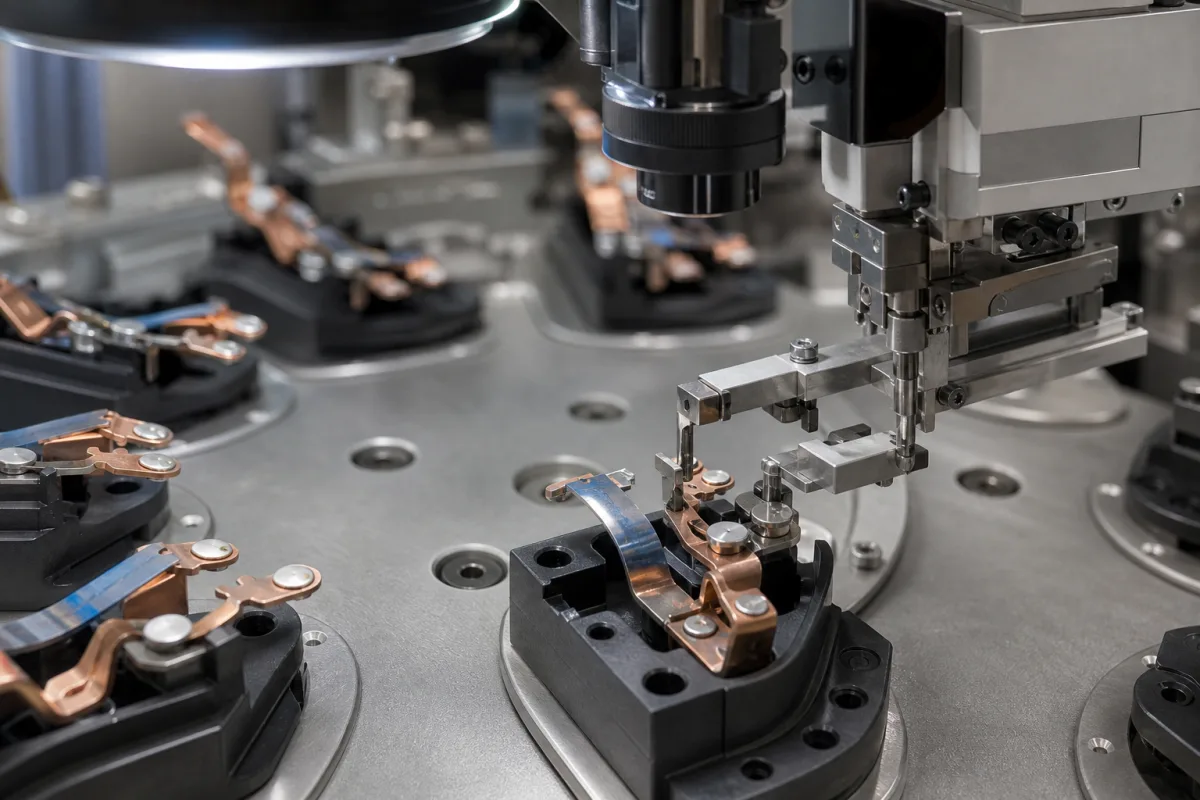
A critical electrical switching component within a thermal overload protector that makes or breaks the circuit to the compressor motor based on temperature conditions.
Product Specifications

Technical details and manufacturing context for Contact Assembly

Definition
The contact assembly is the core switching mechanism in a refrigerator compressor thermal overload protector. It consists of movable and stationary electrical contacts that physically connect or disconnect the power supply to the compressor motor. Its operation is directly controlled by a thermal sensing element (like a bimetal strip). When the compressor overheats, the thermal element actuates the assembly to open the contacts, cutting power to prevent motor damage. When the temperature normalizes, the contacts close again to restore operation.
Working Principle
The assembly operates as a thermally-actuated switch. A rise in temperature (due to compressor overload or locked rotor) causes a thermal sensing element to deform. This mechanical deformation is transferred to the movable contact via a linkage or spring mechanism, forcing it to separate from the stationary contact, thereby interrupting the electrical circuit. Upon cooling, the thermal element returns to its original shape, allowing a spring or the mechanism itself to return the movable contact, re-establishing electrical continuity.
Common Materials
Silver Alloy (e.g., AgCdO, AgSnO2), Copper Alloy, Thermoset Plastic (for housing/insulation), Spring Steel
Technical Parameters
  • Rated current and voltage for the electrical contacts. (A, V) Standard Spec
Components / BOM
  • Movable Contact
    The contact attached to an armature or spring-loaded mechanism that moves to open or close the circuit.
    Material: Silver Alloy
  • Stationary Contact
    The fixed contact terminal to which the movable contact mates to complete the circuit.
    Material: Silver Alloy on Copper Alloy
  • Contact Spring
    Provides the necessary force to ensure good electrical connection when closed and may assist in the opening action.
    Material: Spring Steel
  • Contact Arm / Carrier
    The insulating structure that holds the movable contact and connects it to the actuating mechanism.
    Material: Thermoset Plastic (e.g., Phenolic, PBT)
Engineering Reasoning
0-150°C ambient temperature, 0.1-30A current rating, 120-600V AC voltage rating
Contact welding occurs at 800°C contact interface temperature, contact erosion exceeds 0.5mm material loss, insulation breakdown at 2.5kV dielectric strength
Design Rationale: Thermal expansion mismatch between bimetallic elements (coefficient difference 15×10⁻⁶/°C) causes mechanical stress exceeding 350MPa yield strength, leading to contact misalignment and arcing
Risk Mitigation (FMEA)
Trigger Inrush current exceeding 10× rated current during compressor startup
Mode: Contact welding due to instantaneous temperature rise above 1200°C at contact interface
Strategy: Current-limiting NTC thermistor with 5Ω cold resistance placed in series with contact assembly
Trigger Ambient temperature cycling between -40°C and 125°C at 2 cycles/hour
Mode: Bimetallic element fatigue fracture after 100,000 cycles due to stress concentration at mounting points
Strategy: Finite element analysis-optimized bimetallic geometry with 0.2mm radius fillets at stress concentration points

Industry Taxonomies & Aliases

Commonly used trade names and technical identifiers for Contact Assembly.

Applied To / Applications

This component is essential for the following industrial systems and equipment:

Industrial Ecosystem & Supply Chain DNA

Complementary Systems
Downstream Applications
Specialized Tooling

Application Fit & Sizing Matrix

Operational Limits
pressure: Atmospheric to 2 bar (sealed environment)
temperature: -40°C to +150°C (operating), up to +180°C (intermittent)
switching life: 10,000 to 100,000 cycles depending on load
electrical rating: Up to 25A, 250V AC
Media Compatibility
✓ Clean air environments ✓ Hermetically sealed refrigerant systems ✓ Dry electrical enclosures
Unsuitable: Corrosive atmospheres with high moisture or chemical vapors
Sizing Data Required
  • Compressor motor full-load amperage (FLA)
  • System operating voltage and frequency
  • Required trip temperature and reset differential

Reliability & Engineering Risk Analysis

Failure Mode & Root Cause
Contact Pitting and Arcing
Cause: Electrical arcing due to poor contact alignment, contamination, or excessive current causing localized melting and material transfer between contacts.
Contact Welding
Cause: Excessive inrush current or fault conditions generating high temperatures that fuse mating contacts together, preventing proper opening.
Maintenance Indicators
  • Audible buzzing, crackling, or intermittent arcing sounds during operation
  • Visible discoloration, pitting, or melting on contact surfaces during inspection
Engineering Tips
  • Implement regular contact resistance testing and thermographic inspections to detect abnormal heating before failure occurs
  • Ensure proper contact alignment and apply appropriate contact lubricants to reduce friction and prevent material transfer

Compliance & Manufacturing Standards

Reference Standards
ISO 9001:2015 - Quality Management Systems IEC 60512 - Connectors for Electronic Equipment ASTM B117 - Salt Spray (Fog) Testing
Manufacturing Precision
  • Contact Pin Diameter: +/-0.01mm
  • Contact Alignment: 0.05mm Maximum Deviation
Quality Inspection
  • Electrical Continuity and Resistance Test
  • Visual Inspection for Surface Defects and Contamination

Factories Producing Contact Assembly

Verified manufacturers with capability to produce this product in China

✓ 96% Supplier Capability Match Found

P Procurement Specialist from Australia Jan 23, 2026
★★★★★
"Impressive build quality. Especially the technical reliability is very stable during long-term operation."
Technical Specifications Verified
T Technical Director from Singapore Jan 20, 2026
★★★★★
"As a professional in the Electrical Equipment Manufacturing sector, I confirm this Contact Assembly meets all ISO standards."
Technical Specifications Verified
P Project Engineer from Germany Jan 17, 2026
★★★★★
"Standard OEM quality for Electrical Equipment Manufacturing applications. The Contact Assembly arrived with full certification."
Technical Specifications Verified
Verification Protocol

“Feedback is collected from verified sourcing managers during RFQ (Request for Quote) and factory evaluation processes on CNFX. These reports represent historical performance data and technical audit summaries from our B2B manufacturing network.”

15 sourcing managers are analyzing this specification now. Last inquiry for Contact Assembly from Turkey (24m ago).

Supply Chain Compatible Machinery & Devices

Circuit Breaker Trip Unit

Protective control module for electrical circuit breakers

Explore Specs →
Circuit Breaker Arc Chute

Electrical component that extinguishes arcs in circuit breakers

Explore Specs →
Medium Voltage Switchgear Assembly Line

Automated production system for assembling medium voltage electrical switchgear.

Explore Specs →
Motor Terminal Block

Electrical connection interface for motor windings

Explore Specs →

Frequently Asked Questions

What materials are used in these contact assemblies for optimal performance?

Our contact assemblies feature silver alloy contacts (AgCdO or AgSnO2) for superior conductivity and arc resistance, copper alloy carriers, spring steel for consistent pressure, and thermoset plastic housings for insulation and durability in demanding electrical environments.

How does this contact assembly function within a thermal overload protector?

The contact assembly serves as the critical switching mechanism that opens or closes the circuit to the compressor motor based on temperature. When overheating occurs, the thermal element triggers the movable contact to separate from the stationary contact, breaking the circuit to prevent motor damage.

What are the key components in this contact assembly BOM?

The complete assembly includes: contact arm/carrier (supports movable contact), contact spring (provides consistent pressure), movable contact (attached to arm), and stationary contact (fixed position). These components work together to ensure reliable electrical switching throughout the protector's lifespan.

Can I contact factories directly on CNFX?

CNFX is an open directory, not a transaction platform. Each factory profile provides direct contact information and production details to help you initiate direct inquiries with Chinese suppliers.

Get Quote for Contact Assembly

Request technical pricing, lead times, or customized specifications for Contact Assembly directly from verified manufacturing units.

Your business information is encrypted and only shared with verified Contact Assembly suppliers.

Thank you! Your message has been sent. We'll respond within 1–3 business days.

Need to Manufacture Contact Assembly?

Connect with verified factories specializing in this product category

Add Your Factory Contact Us
Previous Product
Conservator Tank (Expansion Tank)
Next Product
Contact System