Industry-Verified Manufacturing Data (2026)

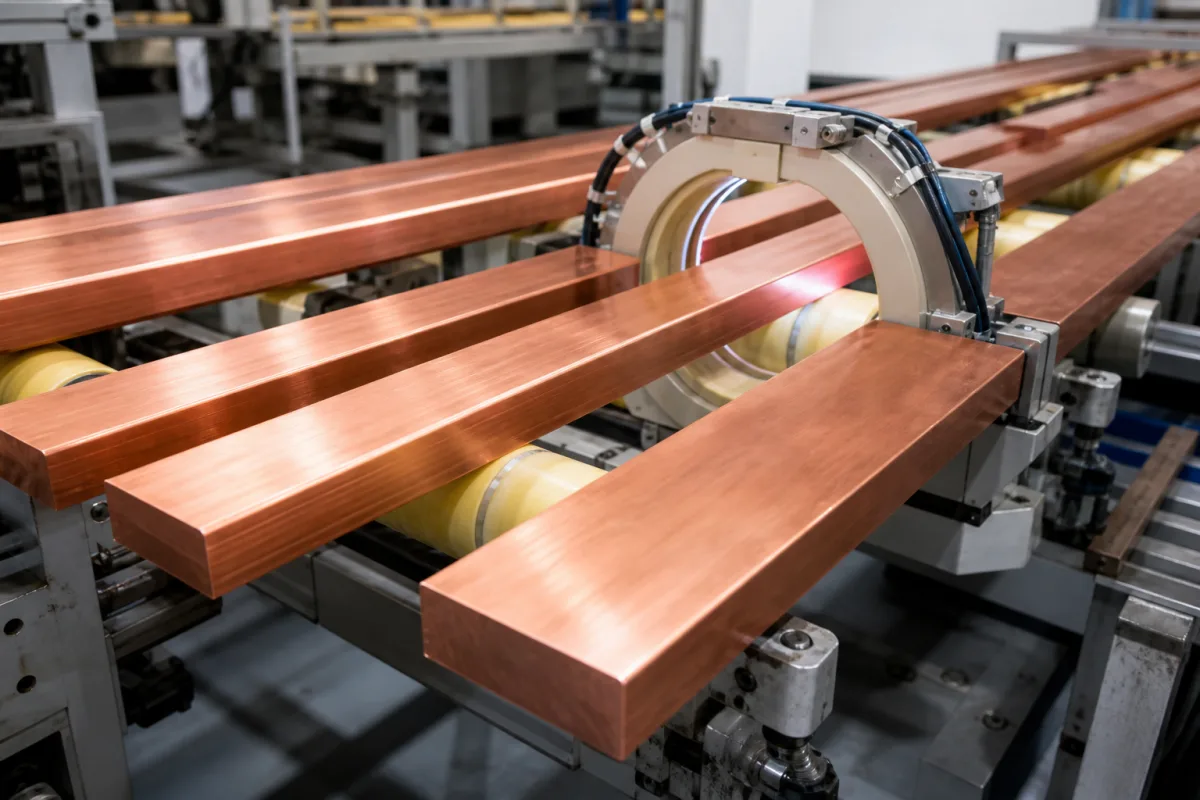
High-Purity Copper Busbar Alloy

Based on aggregated insights from multiple verified factory profiles within the CNFX directory, the standard High-Purity Copper Busbar Alloy used in the Manufacture of Electricity Distribution and Control Apparatus sector typically supports operational capacities ranging from standard industrial configurations to heavy-duty production requirements.

Technical Definition & Core Assembly

A canonical High-Purity Copper Busbar Alloy is characterized by the integration of Copper Matrix and Silver Trace Alloy. In industrial production environments, manufacturers listed on CNFX commonly emphasize Copper (Cu) construction to support stable, high-cycle operation across diverse manufacturing scenarios.

High-conductivity copper alloy for electricity distribution busbars in switchgear and control panels.

Product Specifications

Technical details and manufacturing context for High-Purity Copper Busbar Alloy

Definition
A semi-finished copper alloy specifically engineered for manufacturing electrical busbars, the primary current-carrying conductors in electricity distribution and control apparatus. This material provides the essential conductive pathway between circuit breakers, switches, and other components within switchgear assemblies, panelboards, and motor control centers. Its optimized metallurgical composition ensures minimal electrical losses while maintaining mechanical strength for structural support in industrial environments. As a raw material, it forms the foundation for fabricating busbar systems that safely route high currents in commercial and industrial power distribution networks.
Working Principle
Provides a low-resistance metallic pathway for electrical current flow through its crystalline lattice structure, with alloying elements enhancing mechanical properties without significantly compromising conductivity.
Common Materials
Copper (Cu), Silver (Ag) trace alloying, Phosphorus (P) deoxidizer
Technical Parameters
  • Minimum yield strength for structural integrity (MPa) Standard Spec
  • Percentage of International Annealed Copper Standard conductivity (% IACS) Standard Spec
Components / BOM
  • Copper Matrix
    Primary current-carrying metallic structure
    Material: High-purity copper with controlled impurities
  • Silver Trace Alloy Optional
    Enhances mechanical properties without significant conductivity loss
    Material: Silver particles in solid solution
  • Deoxidizing Agent
    Removes oxygen during manufacturing to prevent embrittlement
    Material: Phosphorus or other deoxidizing elements
Engineering Reasoning
20-105°C continuous operation, 0.1-6.0 kA/mm² current density
135°C sustained temperature (copper recrystallization threshold), 8.0 kA/mm² current density (electromigration onset)
Design Rationale: Thermal expansion mismatch with insulation (17.0×10⁻⁶/°C copper vs 50-100×10⁻⁶/°C polymer) causing mechanical stress; electromigration at 8.0 kA/mm² where electron wind force exceeds atomic binding energy
Risk Mitigation (FMEA)
Trigger Localized heating to 135°C from contact resistance >15 μΩ·cm
Mode: Grain boundary migration and void formation reducing cross-sectional area by >30%
Strategy: Silver-plated contact surfaces (2-5 μm thickness) maintaining resistance <5 μΩ·cm
Trigger Cyclic thermal loading ΔT>80°C at >1000 cycles
Mode: Fatigue cracking at bolt holes due to 207 MPa stress concentration exceeding copper's 69 MPa endurance limit
Strategy: Radiused hole design (r≥3t) and torque-controlled bolting at 25-30 N·m

Industry Taxonomies & Aliases

Commonly used trade names and technical identifiers for High-Purity Copper Busbar Alloy.

Industrial Ecosystem & Supply Chain DNA

Complementary Systems
Downstream Applications
Specialized Tooling

Application Fit & Sizing Matrix

Operational Limits
pressure: Atmospheric to 10 bar (mechanical stress dependent)
other spec: Current density: up to 4 A/mm² continuous, 8 A/mm² short-term
temperature: -40°C to 120°C continuous, 150°C short-term
Media Compatibility
✓ Dry air/indoor electrical environments ✓ Transformer oil (mineral-based) ✓ SF6 gas insulation systems
Unsuitable: Marine/coastal environments with high salt spray
Sizing Data Required
  • Maximum continuous current (Amps)
  • Available installation space (cross-sectional area constraints)
  • Ambient temperature and cooling conditions

Reliability & Engineering Risk Analysis

Failure Mode & Root Cause
Galvanic corrosion
Cause: Contact with dissimilar metals in presence of electrolyte (e.g., moisture, salts), creating electrochemical potential difference that accelerates copper degradation
Thermal fatigue cracking
Cause: Repeated thermal cycling from current load variations causing expansion/contraction stresses, leading to microcracks at stress concentration points like joints or bends
Maintenance Indicators
  • Visible greenish-blue patina (verdigris) or black oxide spots on surface indicating active corrosion
  • Audible buzzing or crackling sounds from joints during operation suggesting loose connections or arcing
Engineering Tips
  • Apply appropriate anti-oxidation coatings (e.g., tin plating, silver plating) at connection points and ensure proper galvanic isolation from dissimilar metals
  • Implement regular infrared thermography inspections to detect abnormal hot spots at connections, indicating poor contact resistance before thermal damage occurs

Compliance & Manufacturing Standards

Reference Standards
ISO 1337:2014 - Copper and copper alloys - Busbars and connectors ASTM B187/B187M-20 - Standard Specification for Copper, Bus Bar, Rod, and Shapes and General Purpose Rod, Bar, and Shapes DIN 43671-1:1985 - Copper busbars; dimensions, rated currents
Manufacturing Precision
  • Thickness: +/-0.05mm
  • Flatness: 0.1mm per 300mm length
Quality Inspection
  • Electrical Conductivity Test (IACS % measurement)
  • Chemical Composition Analysis (Spectrographic/OES)

Factories Producing High-Purity Copper Busbar Alloy

Verified manufacturers with capability to produce this product in China

✓ 94% Supplier Capability Match Found

P Project Engineer from United Arab Emirates Jan 29, 2026
★★★★★
"Great transparency on the High-Purity Copper Busbar Alloy components. Essential for our Manufacture of Electricity Distribution and Control Apparatus supply chain."
Technical Specifications Verified
S Sourcing Manager from Australia Jan 26, 2026
★★★★★
"The High-Purity Copper Busbar Alloy we sourced perfectly fits our Manufacture of Electricity Distribution and Control Apparatus production line requirements."
Technical Specifications Verified
P Procurement Specialist from Singapore Jan 23, 2026
★★★★★
"Found 41+ suppliers for High-Purity Copper Busbar Alloy on CNFX, but this spec remains the most cost-effective."
Technical Specifications Verified
Verification Protocol

“Feedback is collected from verified sourcing managers during RFQ (Request for Quote) and factory evaluation processes on CNFX. These reports represent historical performance data and technical audit summaries from our B2B manufacturing network.”

9 sourcing managers are analyzing this specification now. Last inquiry for High-Purity Copper Busbar Alloy from USA (27m ago).

Frequently Asked Questions

What makes this copper busbar alloy suitable for electricity distribution applications?

This high-purity copper alloy features silver trace alloying and phosphorus deoxidization, providing exceptional electrical conductivity, low oxygen content, and enhanced mechanical properties required for reliable performance in switchgear and control panels.

How does the silver trace alloying improve the busbar performance?

The silver trace alloying enhances the copper's thermal and electrical conductivity while improving mechanical strength and resistance to softening at elevated temperatures, ensuring long-term reliability in demanding electrical distribution environments.

What are the key specifications to consider when selecting this busbar alloy?

Critical specifications include copper purity (typically >99.9%), electrical conductivity (% IACS), maximum oxygen content (ppm), Rockwell hardness (HRB), tensile strength (MPa), and thermal conductivity (W/m·K) to ensure compatibility with specific electrical distribution requirements.

Can I contact factories directly on CNFX?

CNFX is an open directory, not a transaction platform. Each factory profile provides direct contact information and production details to help you initiate direct inquiries with Chinese suppliers.

Get Quote for High-Purity Copper Busbar Alloy

Request technical pricing, lead times, or customized specifications for High-Purity Copper Busbar Alloy directly from verified manufacturing units.

Your business information is encrypted and only shared with verified High-Purity Copper Busbar Alloy suppliers.

Thank you! Your message has been sent. We'll respond within 1–3 business days.

Need to Manufacture High-Purity Copper Busbar Alloy?

Connect with verified factories specializing in this product category

Add Your Factory Contact Us
Previous Product
Electrical Insulation Varnish Compound
Next Product
Industrial Power Distribution Test Bench