Industry-Verified Manufacturing Data (2026)

Starch Slurry Flow Control Orifice Plate

Based on aggregated insights from multiple verified factory profiles within the CNFX directory, the standard Starch Slurry Flow Control Orifice Plate used in the Manufacture of Grain Mill Products, Starches and Starch Products sector typically supports operational capacities ranging from standard industrial configurations to heavy-duty production requirements.

Technical Definition & Core Assembly

A canonical Starch Slurry Flow Control Orifice Plate is characterized by the integration of Orifice Plate Body and Sealing Gasket. In industrial production environments, manufacturers listed on CNFX commonly emphasize Stainless Steel 316L construction to support stable, high-cycle operation across diverse manufacturing scenarios.

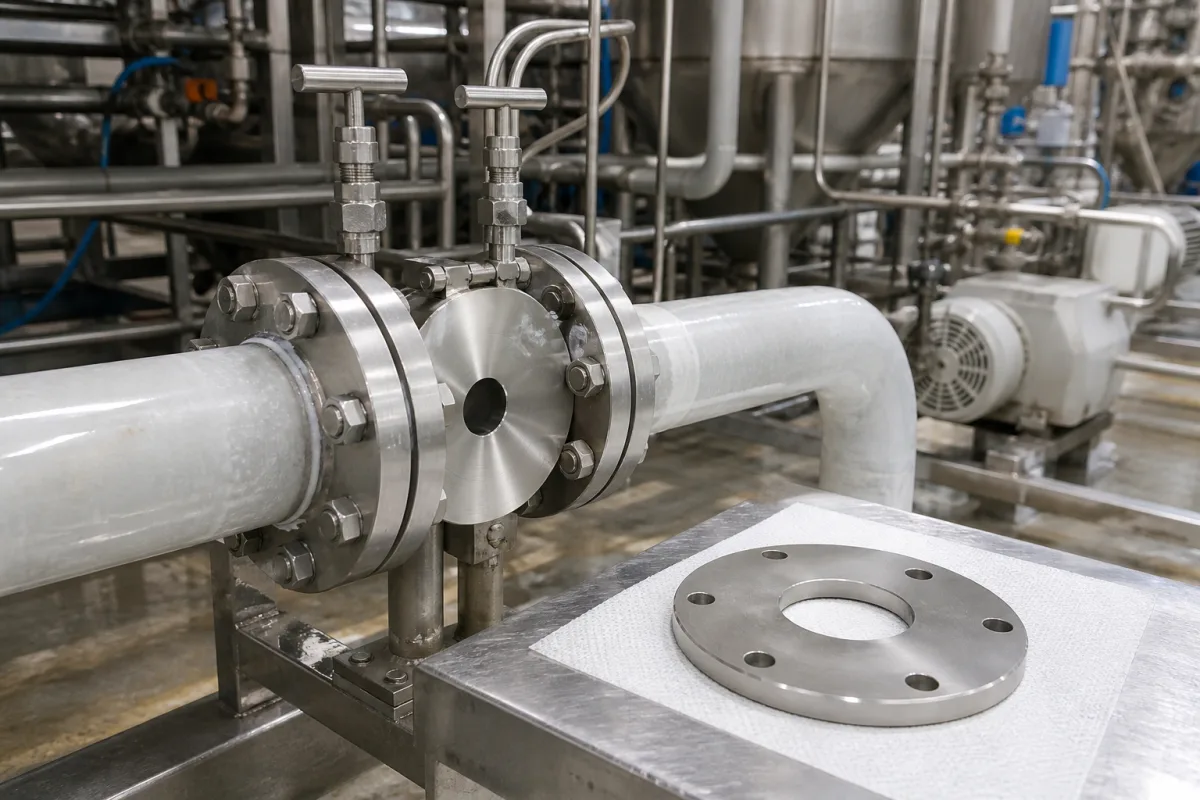
Precision-machined plate with calibrated orifice for regulating starch slurry flow in processing lines.
Product Specifications

Technical details and manufacturing context for Starch Slurry Flow Control Orifice Plate

Definition
A critical flow control component installed within starch processing pipelines to precisely regulate the volumetric flow rate of starch slurry. It ensures consistent feed to downstream separation, washing, and drying equipment, directly impacting product quality and process efficiency. This component is essential for maintaining optimal process conditions in starch extraction and modification plants, where flow stability prevents equipment overload and ensures uniform product characteristics. As a consumable wear part, it requires periodic replacement in high-volume B2B manufacturing operations.
Working Principle
Creates a controlled pressure drop across a precisely sized orifice, using the differential pressure to regulate flow rate according to the Bernoulli principle and continuity equation.
Common Materials
Stainless Steel 316L, Hardened Tool Steel, Food-Grade Polypropylene
Technical Parameters
  • Design differential pressure across the orifice (bar) Standard Spec
  • Precision bore diameter determining flow capacity (mm) Standard Spec
Components / BOM
  • Orifice Plate Body
    Primary flow restriction element with calibrated bore
    Material: Stainless Steel 316L
  • Sealing Gasket
    Prevents leakage between flange connections
    Material: Food-Grade EPDM
  • Identification Tag Optional
    Permanent marking with specifications and lot number
    Material: Stainless Steel
Engineering Reasoning
0.5-3.0 bar differential pressure, 0.1-2.0 m/s slurry velocity
Orifice edge erosion exceeding 0.2 mm radius deviation from calibrated profile
Design Rationale: Hydro-abrasive wear from starch particle impingement exceeding material yield strength (316L SS: 170 MPa) at fluid shear rates >500 s⁻¹
Risk Mitigation (FMEA)
Trigger Starch particle agglomeration exceeding 200 μm diameter
Mode: Orifice partial blockage causing flow coefficient deviation >5% from design value
Strategy: Upstream 150 μm mesh filter with differential pressure monitoring at 0.3 bar alarm threshold
Trigger pH excursion below 4.5 in starch slurry
Mode: Localized pitting corrosion at orifice throat reducing discharge coefficient by >8%
Strategy: Material upgrade to Hastelloy C-276 with electrochemical potential monitoring at -200 mV vs SCE

Industry Taxonomies & Aliases

Commonly used trade names and technical identifiers for Starch Slurry Flow Control Orifice Plate.

Industrial Ecosystem & Supply Chain DNA

Complementary Systems
Downstream Applications
Specialized Tooling

Application Fit & Sizing Matrix

Operational Limits
pressure: Up to 150 psi (10.3 bar)
flow rate: 0.5 to 50 m³/h (2.2 to 220 gpm)
temperature: 0°C to 100°C (32°F to 212°F)
slurry concentration: Up to 40% solids by weight
Media Compatibility
✓ Corn starch slurry ✓ Potato starch slurry ✓ Wheat starch slurry
Unsuitable: Abrasive slurries with high silica content
Sizing Data Required
  • Required flow rate (m³/h or gpm)
  • Slurry concentration (% solids by weight)
  • Upstream pressure (psi or bar)

Reliability & Engineering Risk Analysis

Failure Mode & Root Cause
Abrasive erosion
Cause: Starch particles in the slurry abrade the orifice plate material, especially at high velocities, leading to gradual material loss and altered flow characteristics.
Cavitation
Cause: Pressure drop across the orifice plate causes localized vaporization and implosion of bubbles, damaging the plate surface and edges, often due to excessive differential pressure or improper sizing.
Maintenance Indicators
  • Significant deviation in flow rate or pressure readings compared to baseline, indicating altered orifice geometry
  • Unusual audible hissing or rumbling noise from the orifice assembly, suggesting cavitation or severe erosion
Engineering Tips
  • Select erosion-resistant materials (e.g., hardened stainless steel, ceramic coatings) and design with a beveled or rounded orifice edge to reduce turbulence and particle impact
  • Implement regular ultrasonic thickness testing and flow calibration checks to monitor wear, and consider installing a spare orifice assembly for quick replacement during planned shutdowns

Compliance & Manufacturing Standards

Reference Standards
ISO 5167-2:2022 Measurement of fluid flow by means of pressure differential devices inserted in circular cross-section conduits running full - Part 2: Orifice plates ANSI/ASME MFC-3M Measurement of Fluid Flow in Pipes Using Orifice, Nozzle, and Venturi DIN 1952 Durchflussmessung mit Blenden, Düsen und Venturirohren in voll durchströmten Rohren mit Kreisquerschnitt
Manufacturing Precision
  • Bore diameter tolerance: ±0.05% of nominal bore for starch slurry applications
  • Flatness tolerance: 0.1 mm per 100 mm diameter for sealing surface
Quality Inspection
  • Dimensional verification with coordinate measuring machine (CMM) for bore and thickness
  • Surface roughness measurement (Ra ≤ 0.8 μm) for flow surfaces

Factories Producing Starch Slurry Flow Control Orifice Plate

Verified manufacturers with capability to produce this product in China

✓ 92% Supplier Capability Match Found

P Project Engineer from United States Feb 22, 2026
★★★★★
"The technical documentation for this Starch Slurry Flow Control Orifice Plate is very thorough, especially regarding Orifice Diameter (mm)."
Technical Specifications Verified
S Sourcing Manager from United Arab Emirates Feb 19, 2026
★★★★★
"Reliable performance in harsh Manufacture of Grain Mill Products, Starches and Starch Products environments. No issues with the Starch Slurry Flow Control Orifice Plate so far."
Technical Specifications Verified
P Procurement Specialist from Australia Feb 16, 2026
★★★★★
"Testing the Starch Slurry Flow Control Orifice Plate now; the Orifice Diameter (mm) results are within 1% of the laboratory datasheet."
Technical Specifications Verified
Verification Protocol

“Feedback is collected from verified sourcing managers during RFQ (Request for Quote) and factory evaluation processes on CNFX. These reports represent historical performance data and technical audit summaries from our B2B manufacturing network.”

15 sourcing managers are analyzing this specification now. Last inquiry for Starch Slurry Flow Control Orifice Plate from Turkey (1h ago).

Frequently Asked Questions

What materials are suitable for starch slurry orifice plates?

Our orifice plates are available in Stainless Steel 316L for corrosion resistance, Hardened Tool Steel for durability, and Food-Grade Polypropylene for chemical compatibility in starch processing applications.

How do I select the correct orifice diameter for my starch slurry application?

The orifice diameter should be selected based on your required flow rate (Cv value), slurry viscosity, and system pressure. Our technical team can help you calculate the optimal diameter for your specific starch processing line.

What maintenance is required for starch slurry orifice plates?

Regular inspection for wear, cleaning to prevent starch buildup, and gasket replacement are recommended. The low surface roughness (specified in μm) minimizes particle adhesion and simplifies maintenance in grain processing environments.

Can I contact factories directly on CNFX?

CNFX is an open directory, not a transaction platform. Each factory profile provides direct contact information and production details to help you initiate direct inquiries with Chinese suppliers.

Get Quote for Starch Slurry Flow Control Orifice Plate

Request technical pricing, lead times, or customized specifications for Starch Slurry Flow Control Orifice Plate directly from verified manufacturing units.

Your business information is encrypted and only shared with verified Starch Slurry Flow Control Orifice Plate suppliers.

Thank you! Your message has been sent. We'll respond within 1–3 business days.

Need to Manufacture Starch Slurry Flow Control Orifice Plate?

Connect with verified factories specializing in this product category

Add Your Factory Contact Us
Previous Product
Starch Hydrocyclone Separation Cone
Next Product
Starch Slurry Pressure Control Valve