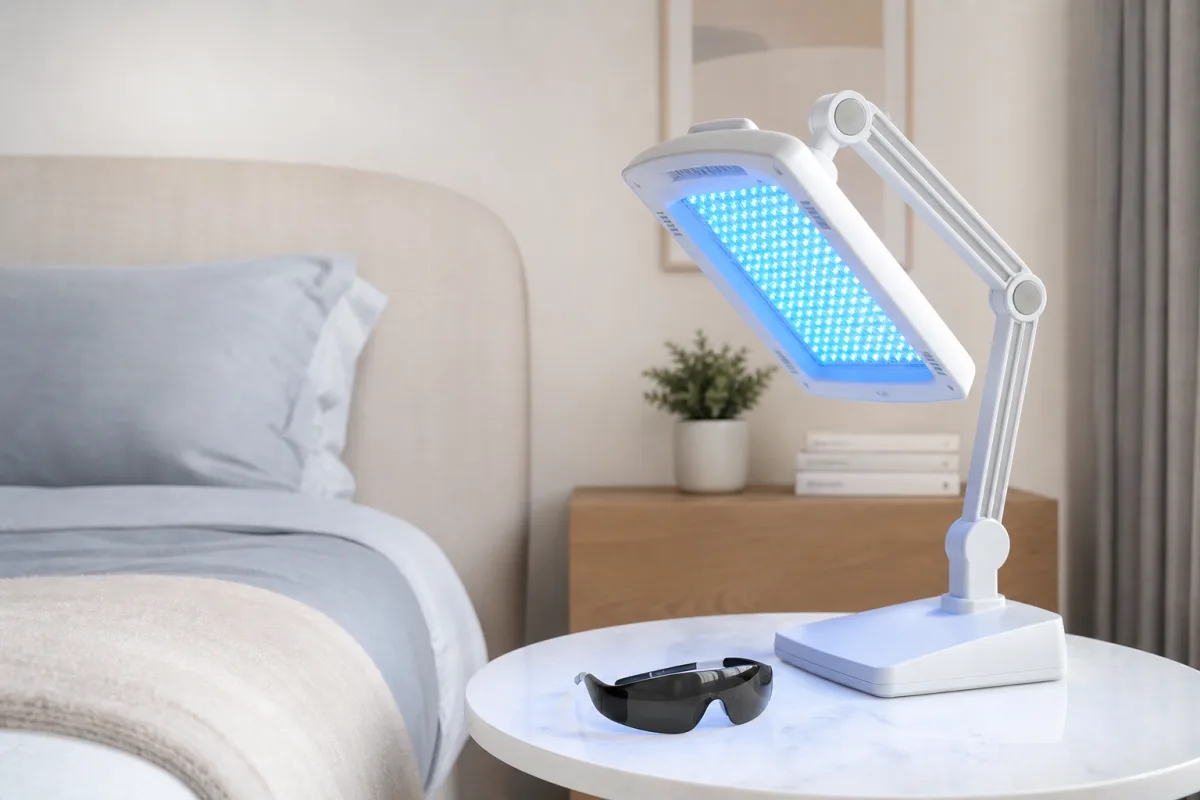
Portable home phototherapy devices (narrowband UVB)
Portable narrowband UVB (311 nm) phototherapy devices for prescribed home use · peak wavelength, irradiance in mW/cm², treatment area, timer and dose control, FDA Class II (21 CFR 878.4630, product code FTC), IEC 60601-1 / 60601-1-11 / 60601-2-57 test evidence
A portable home phototherapy device of this kind is a narrowband ultraviolet B (UVB) light source — LED or fluorescent — that a patient uses at home on localized skin areas under a physician's prescription. In the US it is a Class II medical device, and the FDA 510(k) summary for the handheld home-use unit reviewed here marks it Rx-only. This page covers what a buyer or distributor must specify and verify; treatment decisions belong to the prescribing physician. Ask three things first: the emission spectrum and irradiance at the stated working distance; how the device controls and limits dose; and which regulatory clearance and safety-test reports cover the exact model.
Prescription narrowband UVB devices for home use on localized areas — handheld LED applicators, hand-and-foot units and partial-body panels — and the regulatory and test evidence a buyer should obtain. Clinic cabinets, excimer lasers, PUVA (UVA) systems, blue-light acne devices, cosmetic tanning equipment and consumer LED masks are outside this page except where compared. Nothing on this page is medical advice.
CNFX editorial research · Sources checked October 11, 2026 · 5 sources
The FDA 510(k) summary for the Klär Lite (K253871), cleared in March 2026, describes a narrowband UVB LED phototherapy device with a handheld home-use applicator: emission 311 ± 2 nm (nominal peak within a UVB emission range of 295–320 nm), output irradiance 3.0–5.0 mW/cm², a treatment area of 5.08 cm × 5.08 cm, an optical filter, an integrated thermal sensor with auto-shutdown, and a medical-grade DC supply. Its predicate, the Skylit Phototherapy System (K170489), is listed at 300–320 nm, 3.0–15.0 mW/cm² and a 4.5 cm² treatment area, powered by rechargeable battery or DC supply. [2] A 2026 systematic review of home-based UVB for vitiligo reports that the Dermfix 1000MX handheld unit was independently measured at a mean irradiance of 3.8 mW/cm², with inter-device variation and reduced intensity with distance when not used in close contact, whereas an in-office cabinet (Waldmann UV 7002) can maintain an average irradiance exceeding 10 mW/cm²; one included trial used a Daavlin Dermapal handheld system at 5.5 mW/cm² and a 5 cm distance. [5]
Editorial calculation: fluence (J/cm²) equals irradiance (W/cm²) multiplied by time (s). At 3.0 mW/cm² a fluence of 1 J/cm² takes 1 ÷ 0.003 ≈ 333 s, at 5.0 mW/cm² 200 s, and at 10 mW/cm² 100 s — illustrating the review's point that lower-irradiance handheld devices need proportionally longer exposure for the same fluence. These figures are arithmetic only, not treatment doses. [2][5]
Editorial calculation: the Klär Lite window of 5.08 cm × 5.08 cm equals about 25.8 cm², against 4.5 cm² for its predicate. [2]
Ask for a measured spectral power distribution (peak and range in nm), irradiance in mW/cm² at the stated working distance with the meter and calibration used, uniformity across the treatment window, the window size in cm, light source type (LED or fluorescent lamp) and its rated life, and how output is monitored as the source ages.
02
Confirm dose control, prescription status and test evidence
21 CFR 878.4630 identifies an ultraviolet lamp for dermatologic disorders as a device, including a fixture, providing ultraviolet radiation of the body to photoactivate a drug in treating a dermatologic disorder, and classifies it as Class II. [1] The narrowband UVB devices reviewed here were cleared through 510(k) under that regulation with product code FTC. The Klär Lite controls exposure with a microcontroller algorithm using skin-type presets and real-time temperature feedback, offers preset and manual modes with temperature-compensated dose control, is marked Prescription Use (21 CFR 801 Subpart D), and was tested to IEC 60601-1 (electrical and mechanical safety), IEC 60601-1-11 (home healthcare environment), IEC 60601-1-2 (EMC), IEC 62471 (photobiological safety), IEC 62304 (software, Class B), ISO 14971, IEC 62366-1 and ISO 10993. [2] A 2026 510(k) for a professional UVA/UVB LED system (K254234) cites IEC 60601-2-57:2023, the particular standard for non-laser light source equipment intended for therapeutic, diagnostic, monitoring, cosmetic and aesthetic use, and lists a UVB energy-density range of 0.05–3.4 J/cm², a key lock that must be on before any emission, and real-time output sensors. [3] Daavlin's ClearLink 510(k) (K182215) describes physician-controlled lamp-based equipment where only operators authorized by the physician can program treatments, entered in joules according to the patient's skin type, condition, minimum erythemal dose (MED) and treatment frequency. [4]
Editorial note: the eCFR definition text refers to photoactivating a drug, while the 510(k) letters reviewed here clear narrowband UVB devices under the same regulation number and product code; confirm the exact clearance number, indications and prescription status for the model being bought, and the equivalent approvals (for example CE marking under the EU MDR) for other markets.
Ask for the 510(k) number or other market approval, the indications-for-use page, prescription or over-the-counter status, IEC 60601-1, 60601-1-11, 60601-1-2, 60601-2-57 and IEC 62471 test reports naming the model, the dose-control method (timer in seconds, dose in J/cm², or skin-type presets), lockout features (key lock, physician-set limits, session counters), and the instructions for use and eye-protection guidance.
03
Compare what suppliers offer
The companies in the manufacturer list below show this product on their own websites. Confirm the legal seller, factory and scope for your order.
Formats in the reviewed sources range from handheld LED applicators with treatment windows of 4.5 cm² and 5.08 cm × 5.08 cm to multi-size handpieces of 1.7 to 42.0 cm² and lamp-based panels treating skin from about 22.86 cm away. [2][3][4] When requesting quotations, ask each supplier for the clearance documents, test reports, measured spectra and irradiance data, replacement-source pricing and service terms.
04
Trace the device
This is a functional reference built from the sources cited; it is not one maker's design.
Fill the specification fields with values for your project
A quotation for a home phototherapy device needs values for the exact model. The table explains each field, gives published values where a reviewed source states them, and says what to obtain from the supplier.
Explore company information and manufacturing capabilities, then discuss the scope of your project with a relevant supplier.
Share this page
Compiled and source-reviewed by the CNFX editorial team.
Published product pages show what a company offers, not tested performance. Confirm the legal seller, factory, regulatory clearance and scope for your order. How we source and review
· Page last updated 13 October 2026
Buyer questions
How is a home narrowband UVB device classified by the FDA?
As an ultraviolet lamp for dermatologic disorders, Class II under 21 CFR 878.4630; the units reviewed here carry product code FTC. [1][2]
What irradiance do handheld units deliver?
One cleared handheld lists 3.0–5.0 mW/cm²; a review reports 3.8 mW/cm² measured for another, against over 10 mW/cm² for a clinic cabinet. [2][5]
Is a prescription needed?
The handheld home-use unit reviewed is Rx-only, and a lamp-based system is for use by or under the direction of a physician. [2][4]
Sources and what still needs a direct check
Sources checked 2026-10-11. Sources are the US eCFR regulation text, three FDA 510(k) clearance documents and an open-access systematic review in PubMed Central.