Editorial Technical Reference

High-Efficiency LED Driver Module

This page explains how High-Efficiency LED Driver Module is classified within Manufacture of Lighting Equipment. Technical values and manufacturer relationships are research references; confirm the current specification and supplier evidence for each order.

Technical Definition & Core Assembly

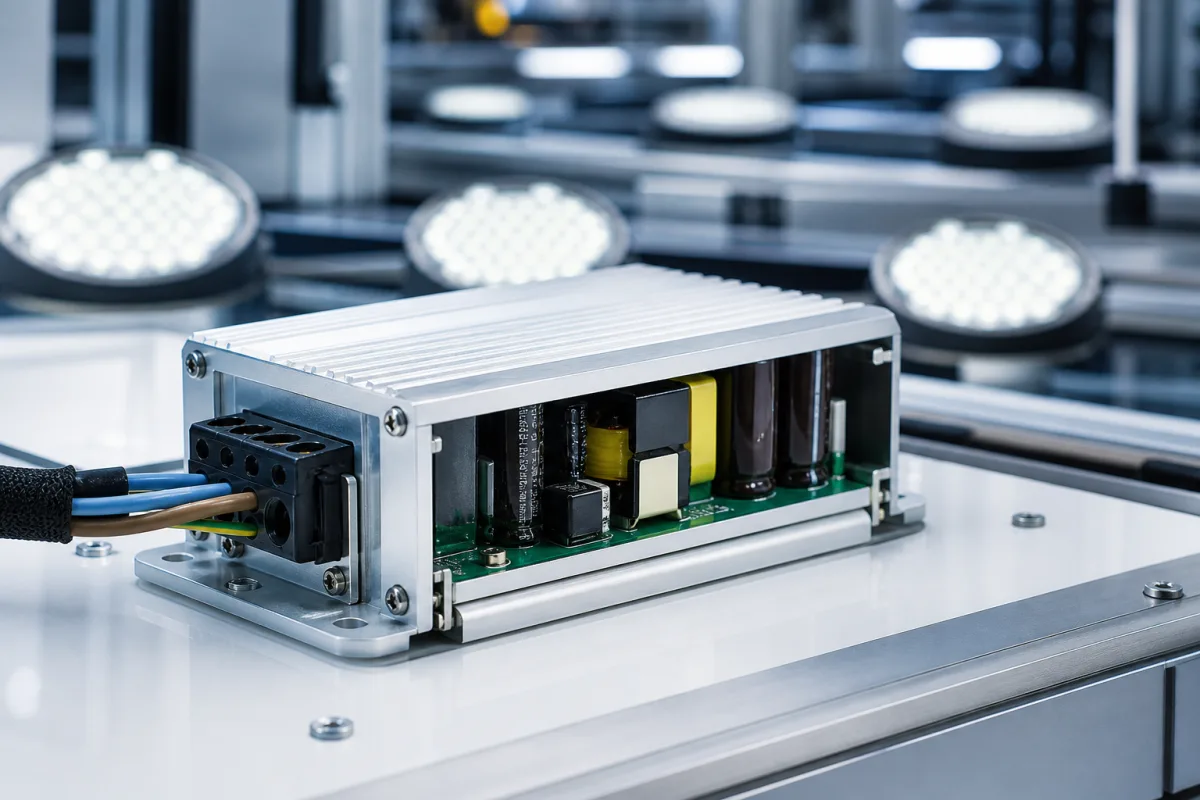
The High-Efficiency LED Driver Module is a compact electronic component that converts alternating current (AC) mains power into the regulated direct current (DC) required by LED lighting arrays.

Representative product image. Confirm appearance and specifications with the manufacturer.

Product Specifications

Technical details and manufacturing context for High-Efficiency LED Driver Module

Definition
The High-Efficiency LED Driver Module is a compact electronic component that converts alternating current (AC) mains power into the regulated direct current (DC) required by LED lighting arrays. It serves as the critical power interface in commercial and industrial lighting fixtures, ensuring stable operation and optimal energy efficiency. Manufacturers integrate these modules into luminaires during assembly, making them essential for B2B supply chains in architectural, retail, and industrial lighting sectors. The module's reliability directly impacts fixture lifespan and performance compliance.

This module accepts a wide input voltage range of 90–305 V AC, accommodating various global mains supplies, and operates at frequencies from 47 to 63 Hz. It provides a constant current output adjustable between 350 and 1050 mA, with a DC output voltage range of 27–54 V, suitable for a variety of LED string configurations. The power factor exceeds 0.95, and efficiency at full load is between 90% and 93%, contributing to reduced energy consumption. Total harmonic distortion is less than 10% at full load, meeting IEC 61000-3-2 requirements. The module is designed for an operating temperature range of -40°C to 85°C, and offers isolation voltage of 3750 V AC (input to output, 1 minute) per IEC 61347-2-13. Surge protection is rated at 4 kV line-to-line (1.2/50 µs) per IEC 61000-4-5. Depending on housing options, the IP rating ranges from IP20 to IP67, and typical dimensions for a 40W model are 120×45×30 mm, with weight varying from 150 to 200 g. Certifications such as CE, UL, and CCC may be required for target markets.

Constructed with an FR-4 PCB, an aluminum heat sink, and electronic components including ICs, capacitors, and resistors, the module is built for durability. However, all specifications are reference values and must be verified with the legal manufacturer or supplier for the specific model and application. Standards listed are procurement references, not guarantees of compliance.
Working Principle
The module first rectifies the incoming AC voltage using a bridge rectifier, converting it to pulsating DC. This is then filtered by capacitors to produce a smooth DC bus. A switching regulator, typically using a flyback or buck topology, then modulates the DC through high-frequency switching to control the output current and voltage. A feedback loop monitors the output and adjusts the duty cycle to maintain a constant current, ensuring stable LED operation. Power factor correction circuitry shapes the input current to improve power factor and reduce harmonic distortion. The module also includes protection features such as overvoltage, overcurrent, and thermal shutdown, safeguarding the LEDs and the module itself.
Common Materials
FR-4 PCB, Aluminum heat sink, Electronic components (ICs, capacitors, resistors)
Technical Parameters
ParameterTypical rangeNotes & selection driver
Input Voltage RangeRequired90–305 V ACOperating AC voltage range (e.g., 100-277V)IEC 61000-3-2
Output CurrentRequired350–1050 mAConstant current output for LED strings
Output Voltage RangeRequired27–54 V DCDC voltage output range
Power FactorRequired>0.95Power factor correction efficiency (0-1 scale)IEC 61000-3-2
EfficiencyRequired90–93 %Power conversion efficiency at full load
Operating Temperature-40–85 °CAmbient temperature operating range
Total Harmonic Distortion<10 %At full loadIEC 61000-3-2
Input Frequency47–63 HzCompatible with 50/60 Hz grids
Isolation Voltage3750 V ACInput to output, 1 minuteIEC 61347-2-13
IP RatingIP20–IP67Depends on housing optionIEC 60529
Dimensions120×45×30 mmL×W×H, typical for 40W model
Weight150–200 gDepends on power level
Surge Protection4 kVLine-to-line, 1.2/50 µsIEC 61000-4-5
CertificationsCE, UL, CCCRequired for target markets

Ranges are indicative industry figures for RFQ preparation, not a supplier commitment. Confirm every value and standard with the legal manufacturer before ordering.

Components / BOM

Industry Taxonomies & Aliases

Commonly used trade names and technical identifiers for High-Efficiency LED Driver Module.

Industrial Ecosystem & Supply Chain Structure

Complementary Systems
Downstream Applications
Specialized Tooling

Application Fit & Sizing Matrix

Operational Limits
efficiency: >90% typical, >92% at nominal load
temperature: -40°C to +85°C operating, -40°C to +105°C storage
power factor: >0.9 at full load
voltage input: 85-305V AC (universal input), 120-347V AC (high voltage)
current output: 350mA to 3000mA constant current, adjustable via DIP switches
ingress protection: IP67 rated for dust and temporary immersion
dimming compatibility: 0-10V, PWM, DALI, Triac dimmable versions available
Media Compatibility
✓ Indoor commercial lighting fixtures ✓ Outdoor street/area lighting ✓ Industrial high-bay lighting systems
Unsuitable: Submerged underwater applications beyond temporary immersion limits
Sizing Data Required
  • Total LED forward voltage (Vf) sum
  • Required constant current output (mA)
  • Maximum ambient temperature at installation location

Reliability & Engineering Risk Analysis

Failure Mode & Root Cause
Thermal runaway leading to component failure
Cause: Inadequate heat dissipation due to poor thermal design, dust accumulation on heatsinks, or operation in high ambient temperatures exceeding specifications, causing overheating of MOSFETs, capacitors, or ICs.
Electrolytic capacitor degradation
Cause: Extended operation at high temperatures or voltage stress beyond ratings, leading to electrolyte evaporation, increased ESR, reduced capacitance, and eventual open or short circuit failure.
Maintenance Indicators
  • Visible bulging or leaking of electrolytic capacitors on the PCB
  • Audible high-frequency buzzing or crackling sounds from the module, indicating potential transformer/core saturation or arcing
Engineering Tips
  • Ensure proper thermal management by maintaining clean heatsinks/fins, verifying adequate airflow in enclosures, and avoiding installation near heat sources to keep operating temperatures within manufacturer limits.
  • Implement periodic infrared thermography inspections to detect abnormal hot spots on components like MOSFETs, transformers, and capacitors, allowing proactive replacement before failure.

Indicative industry ranges for design and RFQ preparation. Confirm the exact figures and applicable standard with the manufacturer before specifying.

Compliance & Manufacturing Standards

Applicable Standards
IEC 62384:2006 (LED modules - DC or AC supplied electronic control gear) ANSI C82.77-10 (Harmonic emission limits - related power quality requirements) EN 61347-2-13 (Safety requirements for LED module control gear)

Quoted from the published standard.

Manufacturing Precision
  • Output current regulation: +/- 5% of rated value
  • Thermal resistance (junction-to-case): +/- 10%
Quality Inspection
  • Thermal cycling test (-40°C to +85°C, 1000 cycles)
  • Power factor and total harmonic distortion measurement

Manufacturers of High-Efficiency LED Driver Module

2 companies list this product among what they make. Company figures are quoted from each company's own website; every card states where the relationship came from.

Greenriy Technology Co., Ltd
Zhongshan, Guangdong, CN
Listed on the company's own website · profile compiled by CNFX from public sources
Shenzhen World Industrial Co.,Ltd
Guangdong, CN
Listed on the company's own website · profile compiled by CNFX from public sources

Manufacturer listings support early research and capability understanding. They are not certification, ranking, or transaction guarantees.

Technical documentation
Request current drawings, revision history, and a signed specification sheet.
Manufacturing capability
Verify equipment lists, process limits, capacity, and representative production evidence.
Inspection readiness
Confirm test methods, calibrated equipment, sampling plans, and traceable reports.
Supplier transparency
Check the legal entity, factory address, ownership, certifications, and direct contacts.

CNFX does not score or rank suppliers. Buyers must verify all claims and documents with the legal manufacturer before ordering.

Frequently Asked Questions

What is the input voltage range of this LED driver module?

The module accepts an input voltage range of 90–305 V AC, making it suitable for various global mains supplies. However, always verify the exact range for the specific model with the manufacturer.

Can this driver be used for outdoor lighting fixtures?

The IP rating ranges from IP20 to IP67 depending on the housing option. For outdoor use, select a version with an appropriate IP rating (e.g., IP65 or IP67) to ensure protection against dust and water ingress. Confirm the rating with the supplier.

What certifications does this module have?

The module may require certifications such as CE, UL, or CCC depending on the target market. These are listed as reference standards, but actual certification status must be confirmed with the legal manufacturer or supplier.

How does the driver maintain constant current output?

The driver uses a feedback control loop that monitors the output current and adjusts the switching duty cycle to maintain a constant current, even with variations in input voltage or LED load. This ensures stable LED brightness and extends LED lifespan.

Data Basis

Editorial classification, named public sources where available, and source-reviewed manufacturer records.

Preliminary Technical Classification
This page supports structured research, RFQ preparation, and supplier evaluation. It does not replace buyer-led supplier qualification, standards review, or technical approval.
Buyer enquiry

Request manufacturing insight for High-Efficiency LED Driver Module

Ask for use case, specification boundaries, supplier type, and RFQ preparation information for this product.

Where it goes
Straight to the CNFX editorial desk, and to the manufacturer if this product is linked to a claimed profile. Nothing is broadcast to a supplier list.
Your details stay here
We do not sell or rent enquiry data, and we do not add you to a mailing list. Used only to answer this request.
No commission, no middleman
CNFX is a directory. We take no cut of any order and never negotiate on a supplier's behalf.
What we don't claim
A listing is not an endorsement. Qualify every supplier and verify every figure yourself before ordering.

Your business information is used only to process this request.

Thank you! Your message has been sent. We'll respond within 1–3 business days.
Sorry, we couldn't send your message. Please try again, or email us at contact@cnfx.com.

Need to Manufacture High-Efficiency LED Driver Module?

Compare manufacturer profiles with relevant product and process capability.

Previous Product
Precision LED Lens Molding Machine
Last Product
Get QuotesChat