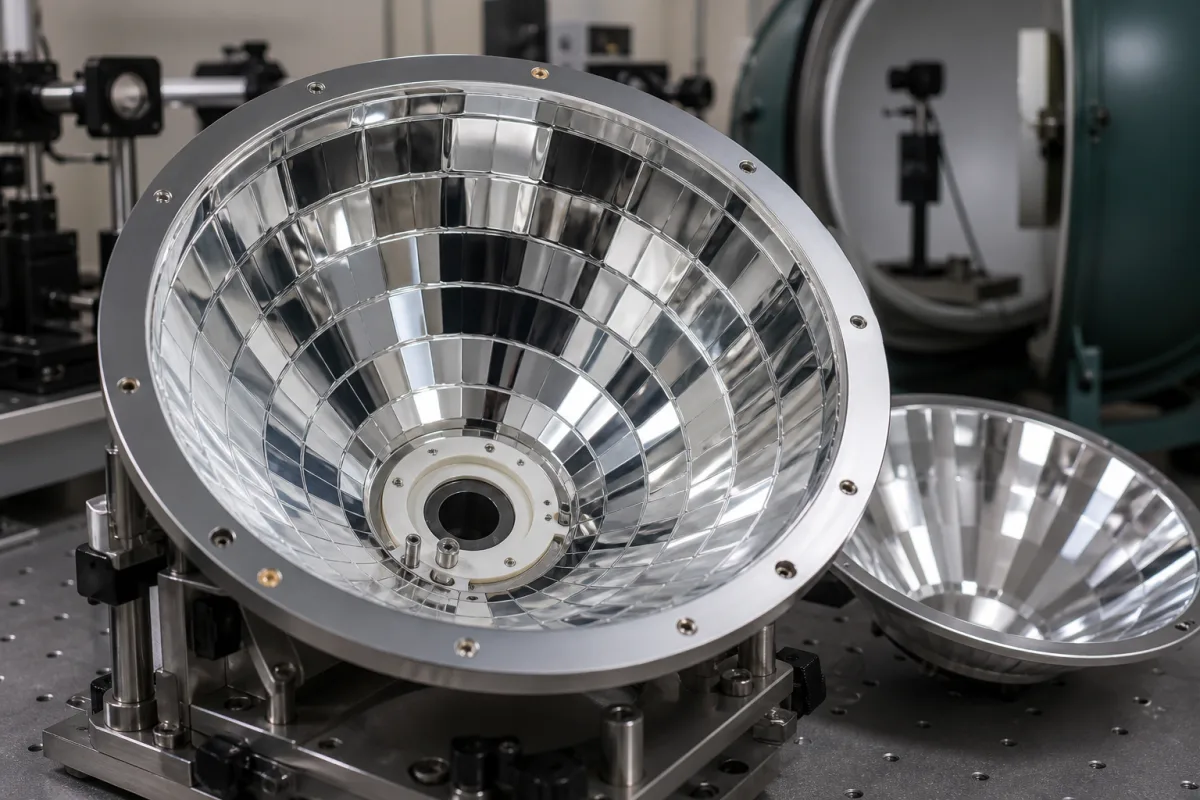
Precision reflector assembly for luminaires: faceted specular aluminium reflector in an outer carrier
Luminaire reflectors · Pre-coated aluminium at 95–98% total reflectance, specular versus diffuse grades, faceted segments set in a spun outer carrier
A precision reflector assembly is the bowl of mirrored metal that collects light from a lamp or LED and sends it out as a beam, together with the parts that hold it: an outer carrier or housing ring, the lamp opening and socket seat, and fixings for a front glass. How much light it delivers depends on the reflectance of the surface, smooth or faceted, and on whether that surface was coated before or after the bowl was formed.
Reflectors for luminaires made from specular or semi-specular aluminium and silver-coated aluminium sheet, smooth or faceted, including segmented reflector bodies held in a spun outer carrier, for downlights, spotlights, high-bay and projector luminaires. LED boards with their optics and heatsinks are covered on the LED light module page, and moulded multi-lens secondary optics on the Precision optical lens array page; complete luminaires such as LED high-bay lights have their own pages. LED ring, bar and dome lights for machine vision are covered on the LED lighting system for machine vision page. Mirror optics for lasers and instruments are outside this page.
CNFX editorial research · Sources checked October 12, 2026 · 4 sources
Total and diffuse reflection of the aluminium sheet: 94%, 95% and 98% grades
Reflector sheet is specified by two values measured to DIN 5036-3 (Ulbricht sphere, 8°): total light reflection and the diffuse share of it. ALANOD's data sheets show how far grades of the same base can differ. [1][2][3]
Editorial note: two sheets with nearly the same total can shape light very differently. With ≤10% diffuse reflection the surface returns light close to mirror-like, so the reflector contour controls the beam; at 80–90% diffuse, as on MIRO 5, the contour has far less control and the result is a softer, wider distribution. ALANOD's 60° gloss values for MIRO 5 differ along (60–75) and across (25–50) the rolling direction, so the orientation of the blank on the sheet matters when it is cut. [2][1]
Editorial calculation: light that reflects twice inside a reflector before leaving keeps 0.95² ≈ 90.3% of its flux on a 95% surface and 0.98² ≈ 96.0% on a 98% surface, a difference of about 5.8 percentage points for those rays. Rays leaving directly, without touching the reflector, are unaffected, so the gain for the whole luminaire is smaller and depends on the design. [1][3]
Mechanical limits come with the grade: MIRO 27 and MIRO-SILVER 17 list a bend radius of at least 1.5 times the sheet thickness, and the silver grade's thickness tolerance is +0.02 / −0.03 mm. [1][3]
PVD layer based on Ag 99.95 on Al 99.85; colour value 0 < b* < 2 [3]
State the beam you need (spot, flood, wide), the source size and position, the required total and diffuse reflection with the measurement standard, the sheet thickness, and the maximum surface temperature at the reflector.
02
Coating before forming: slit segments in a spun outer carrier
Jordan Reflektoren's European patent application EP 2 343 477 A1 (filed 2010) explains the manufacturing choice. A one-piece reflector spun from a flat circular blank can only be mirrored after forming, which the applicants say gives reflection efficiency that is as a rule not optimal; reflectors assembled from separate pre-coated flat pieces look non-symmetrical and are mechanically weak. [4]
Their answer is a reflector body cut in one piece from pre-coated, highly reflective sheet, naming ALANOD's MIRO as a suitable material, divided by slits into strip segments that stay joined at unslit bridges and are rolled, deep-drawn or embossed into a parabolic shape. The illustrated examples use fifteen segments, the slits are preferably 0 to 0.3 mm wide once formed, and the inner surface may be smooth or faceted while staying high-gloss. [4]
Because the slit body is less stiff, it is set into an outer reflector carrier spun from aluminium sheet that follows the parabolic shape. The carrier can hold a front protective glass and can be painted, sandblasted or metal-coated outside; the applicants note that it runs cooler than a one-piece reflector because heat passes to it only in part, which suits both LEDs and high-pressure discharge lamps. [4]
Editorial note: this is one patented construction, not a general specification. When comparing quotations, ask whether the mirror surface is coated sheet formed afterwards or a formed part coated afterwards, and ask for the measured total and diffuse reflection of the finished reflector rather than of the flat sheet.
Ask for the construction (spun and coated, pre-coated and formed, or segmented in a carrier), the number and geometry of facets or segments, the carrier material and finish, the front-glass fixing, and photometric data measured on the assembled reflector with your source.
03
Reflector data to send
Paste it into your enquiry below or into an email to a maker, then replace every bracket.
Luminaire: [type; source (LED, COB, discharge lamp); source size]
Beam: [target beam angle; distribution; cut-off]
Surface: [specular or diffuse; smooth or faceted; total and diffuse reflection]
Sheet: [grade; thickness; base and coating]
Construction: [spun; pre-coated and formed; segmented in carrier]
Interfaces: [lamp opening; socket seat; mounting holes; front glass]
Tests: [photometry on assembled reflector; temperature]
Explore company information and manufacturing capabilities, then discuss the scope of your project with a relevant supplier.
Share this page
Compiled and source-reviewed by the CNFX editorial team.
Each manufacturer above links to the page on that company's own website where the product is listed, with the date we checked it. How we source and review
· Page last updated 13 October 2026
Buyer questions
How reflective is luminaire reflector aluminium?
ALANOD lists ≥95% total light reflection for its MIRO 27 high-gloss grade and 98 ± 1% for MIRO-SILVER 17, both measured to DIN 5036-3. [1][3]
What is the difference between total and diffuse reflection?
Diffuse reflection is the scattered part of the total; MIRO 27 has ≤10% diffuse (mirror-like), MIRO 5 has 80–90% diffuse within ≥94% total. [1][2]
Why make reflectors from pre-coated sheet?
A Jordan Reflektoren patent application notes that spun reflectors can only be mirrored after forming, with reflection efficiency that is as a rule not optimal, and instead forms slit segments from pre-coated sheet held in an outer carrier. [4]
Can a faceted reflector be made this way?
Yes; the same application allows the inner surface to be smooth or faceted while remaining high-gloss. [4]
Sources and what still needs a direct check
Sources checked 2026-10-12. Sheet values are from ALANOD's German product data sheets (translated here); the construction is from a European patent application by a reflector maker, which describes its invention rather than market practice.