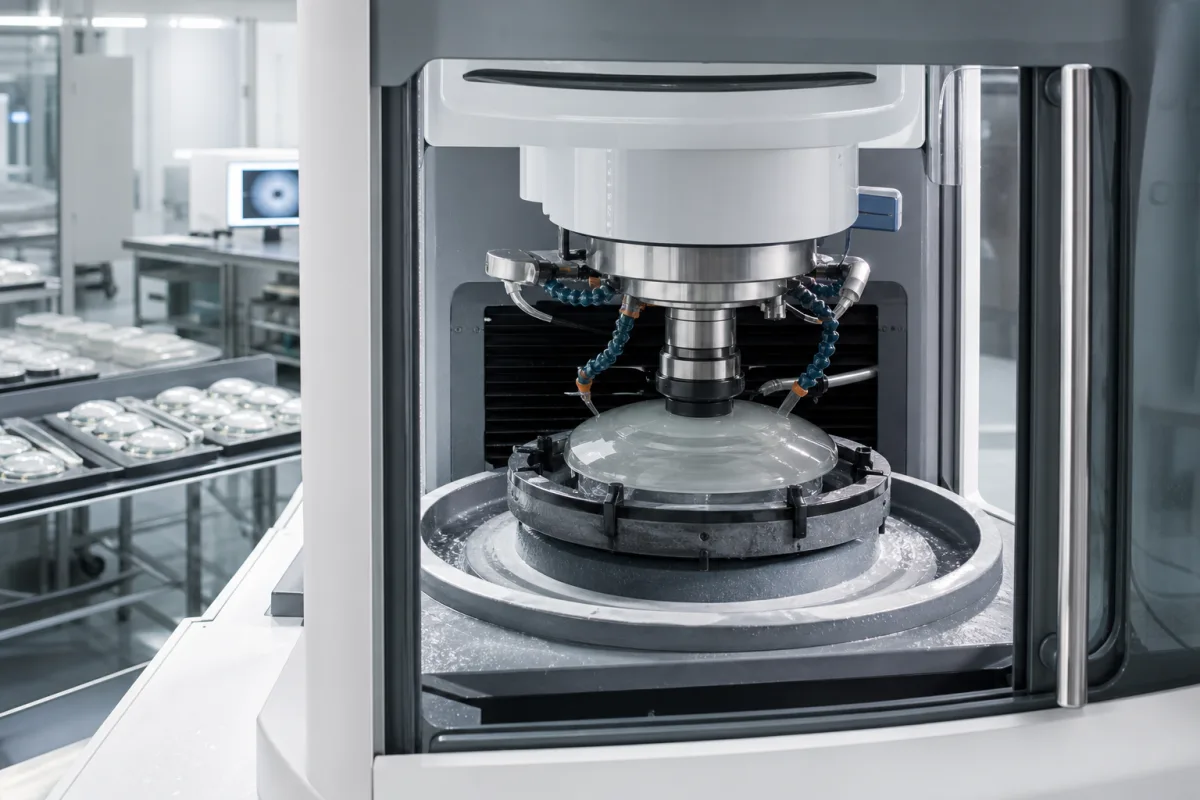
Optical lens polishing machines · Lens diameter, radius and aperture range, conventional versus CNC machines with tool correction, tool and workpiece spindle speeds, polishing pressure and the Preston relation, air, vacuum and power supplies
A precision optical lens polishing machine moves a polishing tool (pitch, polyurethane or other pad with slurry) against a lens surface under controlled pressure and speed to remove the damaged layer left by grinding and bring the surface to its final shape and finish; conventional machines use oscillating arms on spherical lenses, CNC machines control the motion and correct the tool. Ask three things first: what lens diameters, radii and aperture angles, and which surfaces (spherical, aspherical, flat), the machine must polish, what form and finish the lenses need and how the machine controls pressure and corrects the tool, and what cycle time, set-up and supplies the production needs.
Polishing machines for precision optical lenses and similar optics: conventional oscillating-arm polishers, multi-spindle high-speed polishers and CNC polishing machines for spherical and aspherical surfaces. Lens grinding (generating) machines (see precision optical lens grinding machine), centring and edging machines, magnetorheological and ion-beam figuring, ophthalmic prescription-lens polishers and polishing consumables are outside this page except where compared.
CNFX editorial research · Sources checked October 12, 2026 · 4 sources
OptoTech's SP 20.3 data sheet describes a conventional high-speed multi-spindle polishing machine for high-aperture optics: working radius 0.5–20 mm, workpiece aperture 85°–175°, tool spindle 10–1,200 rpm and workpiece spindle 0–350 rpm (infinitely variable), M10 DIN 58725 spindle interfaces, 5 bar air, 2.5 kW and about 350 kg. It fine-grinds and polishes spherical lenses singly or on multiple spot blocks, with pellets, plastic pre-polishing or pitch, and is aimed at rod, microscope and endoscope lenses. [1]
Its SPK 201 CNC data sheet describes a CNC polishing machine for spherical and aspherical optics with integrated polishing-tool correction: working diameter 50–200 mm, radius 40 mm to flat (∞), Siemens Sinumerik 840D sl control, tool spindles of 0–2,000 rpm (S1) and 0–650 rpm (S2), workpiece spindle 0–2,000 rpm, −0.7 bar vacuum, 6 bar air, 8 kW, about 1,750 × 2,300 × 2,580 mm and 2,800 kg. Listed features include form-error correction during the polishing cycle, a reverse arrangement that holds the lens in the upper spindle so it can be polished with applied pressure or under its own weight, a third spindle for dressing the tool without a tool change, and touch setting of the lens/tool contact point. [2]
Editorial note: compare machines on the lens range you will actually run; a machine for 0.5–20 mm radii and one for Ø 50–200 mm optics are different classes, so list part drawings, materials and tolerances when asking for offers.
Give the supplier the lens drawings: diameters, radii (convex, concave, flat), aperture angles, surface type (spherical, aspherical), materials, form and finish tolerances, surface quality requirement, batch sizes and cycle-time target, polishing method (pitch, pad, slurry type), metrology used, automation, control system, and site air, vacuum and power.
02
Set spindle speeds, pressure and supplies
An LLNL paper on colloidal-silica polishing (Shen et al., LLNL-JRNL-748089, 2018) states the macroscopic Preston equation: material removal rate dh/dt = kp·σ₀·Vr, where kp is the Preston coefficient, σ₀ the applied pressure and Vr the average relative velocity between polishing particle and workpiece. It notes that this form cannot describe the influence of abrasive size, particle size distribution, load, slurry concentration and pad topography, which more detailed models address. [3]
Editorial calculation: at 1,000 rpm, a point 50 mm from the spindle axis moves at about 2π × 0.05 m × 1,000 / 60 s ≈ 5.2 m/s; at 2,000 rpm that is about 10.5 m/s. Under the Preston relation, doubling relative velocity or pressure doubles the removal rate for the same coefficient, so ask how the machine sets and records pressure (or load) and spindle speeds for each step. [3][2]
Editorial note: also ask how the slurry is supplied, filtered and temperature-controlled, how the tool is dressed or corrected, and what form and roughness the supplier has achieved on your material, measured how.
03
Pick the machine size from a maker's diameter ranges
Satisloh's precision-optics polishing range shows how CNC polishers are split by workpiece diameter. The SPS-10 is a 5-axis machine with an integrated dressing spindle for micro-optics spheres and aspheres from Ø ≤ 1 mm to 10 mm; the SPS-50 is a 4-axis machine for spheres and aspheres from Ø 5 to 50 mm; the SPS-150 combines CNC with cost efficiency for spherical lenses from Ø 10 to 150 mm; the SPS-200 is a 5-axis machine for spheres, aspheres and freeform surfaces from Ø 5 to 200 mm with adaptive deterministic polishing; and the GI-AP polishes spheres, aspheres and other geometries up to Ø 500 mm. Satisloh lists its process modes as fast spherical polishing in Synchrospeed mode, Variospeed mode and aspherical methods, with basic corrective and deterministic adaptive polishing. [4]
Set these ranges beside the multi-spindle and CNC machines and the Preston-equation process notes above: diameter, geometry (sphere, asphere, freeform) and whether deterministic correction is needed decide the machine class. [1][2][3]
Editorial calculation: the five models span diameters from about 1 mm to 500 mm, a factor of 500; a Ø 120 mm asphere falls inside the SPS-200 range but outside the SPS-50 range.
Satisloh model
Axes
Workpiece diameter
Geometry
SPS-10
5 (with dressing spindle)
≤ 1–10 mm
Micro-optics spheres, aspheres
SPS-50
4
5–50 mm
Spheres, aspheres
SPS-150
CNC
10–150 mm
Spherical lenses
SPS-200
5
5–200 mm
Spheres, aspheres, freeform
GI-AP
CNC
Up to 500 mm
Spheres, aspheres, other geometries
Give the supplier the diameter range, geometry, material and form tolerance of your lenses, and ask which machine and polishing mode it proposes and whether corrective polishing is included.
04
What to ask a lens polishing machine builder
Ask a builder which diameter class the machine covers (Satisloh's range runs from Ø ≤ 1–10 mm on the SPS-10 to Ø 500 mm on the GI-AP), its tool and workpiece spindle speed ranges, and its air, vacuum and power needs. [4]
05
Spindles, CNC axes, pressure control, tool dressing and slurry supply
Pressure control and the spindles' relative speed are the two parts the Preston equation ties directly to removal rate (dh/dt = kp·σ₀·Vr). [3]
Lens diameter, radius, aperture, spindle speeds and utilities for a lens polisher
The two OptoTech sheets sit far apart: the SP 20.3 handles 0.5–20 mm radii at up to 175° aperture on 2.5 kW, while the CNC machine in the second sheet takes Ø 50–200 mm lenses on 8 kW. [1][2]
Explore company information and manufacturing capabilities, then discuss the scope of your project with a relevant supplier.
Share this page
Compiled and source-reviewed by the CNFX editorial team.
Each manufacturer above links to the page on that company's own website where the product is listed, with the date we checked it. How we source and review
· Page last updated 13 October 2026
Buyer questions
What controls removal rate in lens polishing?
The Preston equation makes removal rate proportional to applied pressure and relative velocity, with a coefficient for the material and process. [3]
What lens sizes can a CNC polishing machine handle?
One CNC machine for spherical and aspherical optics covers Ø 50–200 mm and radii from 40 mm to flat. [2]
Which machine suits very small, high-aperture lenses?
One conventional multi-spindle machine covers radii of 0.5–20 mm and apertures of 85°–175°, for rod, microscope and endoscope lenses. [1]
What lens diameters can CNC polishing machines handle?
Satisloh's range runs from micro-optics of Ø ≤ 1–10 mm (SPS-10) through Ø 5–200 mm spheres, aspheres and freeforms (SPS-200) to optics up to Ø 500 mm (GI-AP). [4]
Sources and what still needs a direct check
Sources checked 2026-10-12. The OptoTech data sheets describe one maker's machines and are used here to show what a specification covers; the LLNL paper explains the removal model. Results on your lenses must come from supplier trials and your own measurement.