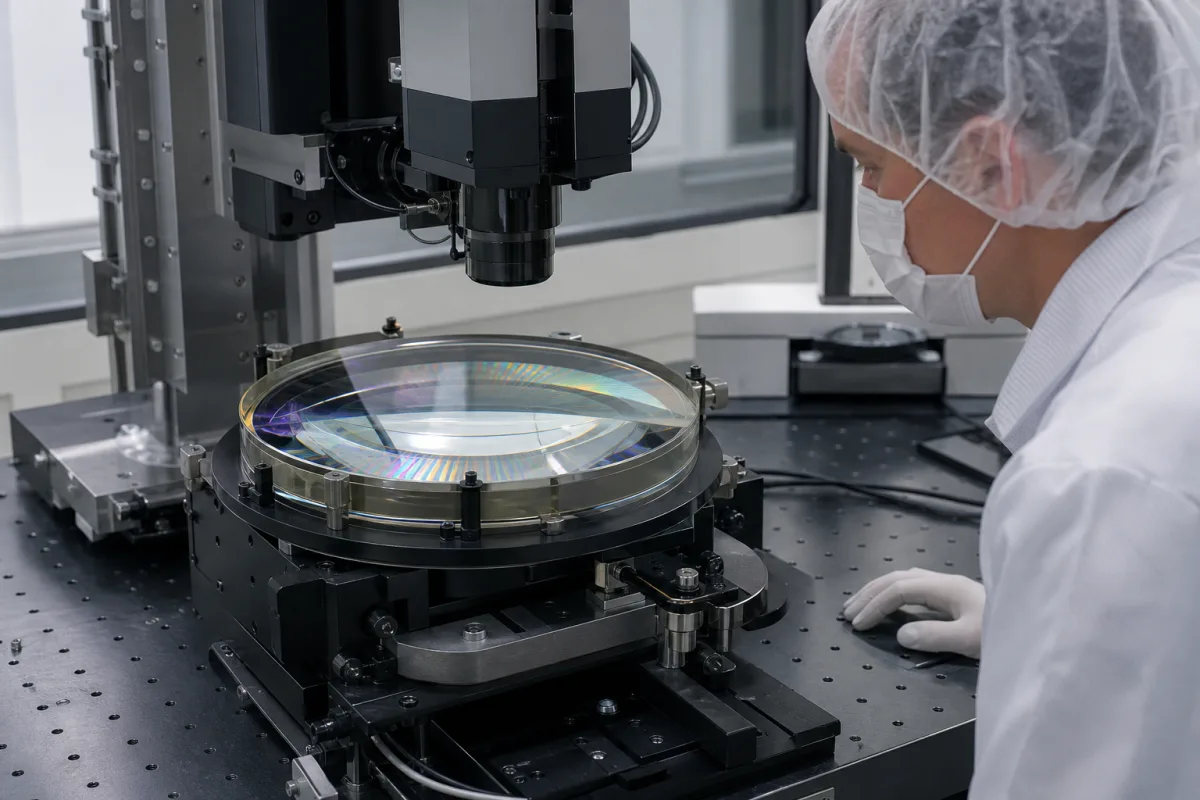
Precision optical lens inspection and measurement system
Optical lens metrology · Fizeau laser interferometers for surface form, radius of curvature, transmitted wavefront and aspheres, and autocollimator-based centration testers for single lenses and assemblies, chosen by what is measured, aperture, wavelength and environment
Lens inspection and measurement systems check whether optical surfaces and assemblies meet their drawings: interferometers measure surface form, radius of curvature and transmitted wavefront, and centration testers measure how well each lens surface is aligned to the optical axis. Ask three things first: which quantities must be measured, what diameters, shapes and wavelengths the parts have, and what accuracy, throughput and environment the measurement must handle.
Metrology systems for optical lenses and lens assemblies: laser interferometers and their references, and centration, alignment and thickness test systems. Automated optical inspection for PCBs (see automated optical inspection system), coordinate measuring machines (see coordinate measuring machine cmm) and lens grinding machines (see precision optical lens grinding machine) are outside this page.
CNFX editorial research · Sources checked October 12, 2026 · 5 sources
ZYGO says the main factors in choosing an interferometer are what it will measure and the environment it will operate in. Its range includes a cost-effective shop-floor Fizeau interferometer, a dynamic interferometer for difficult environments, an instrument for mid-spatial-frequency characterisation, and IR interferometers for testing at design wavelengths from NIR to SWIR, MWIR and LWIR. [1]
For specific parts, ZYGO lists a Fizeau system for full-aperture metrology of axisymmetric aspheres, computer-generated holograms as optical nulls for freeform and off-axis aspheric surfaces, a multiple-surface interferometer that separates parallel surfaces to qualify shape, inhomogeneity and thickness variation, a downward-looking 12 in aperture workstation for plano testing of windows, mirrors and wafers, upward- and downward-looking workstations for surface form and radius of curvature of spherical optics, and beam expanders of 12, 18, 24 and 32 in (300–800 mm). Transmission and reference flats and spheres, mounts and radius-of-curvature options configure the set-up. [1]
A Chinese maker's data for a large-aperture horizontal Fizeau interferometer (Nanjing Interfero, Hi-Marc300W) give the fields to compare: He-Ne laser at λ = 632.8 nm, 300 mm effective beam diameter, plane reference surface form λ/20, stated accuracy for flats of PV better than λ/20 and RMS better than λ/10000, 1–6× zoom, 220 V 50 Hz, air-flotation vibration isolation, and outputs including PV, RMS, gradient RMS, power spectral density, Zernike and Seidel coefficients, point spread function and MTF. It lists measurement of flat and spherical surface form, homogeneity, parallelism and laser rods. [3]
Editorial calculation: at 632.8 nm, λ/20 is about 31.6 nm PV; ask whether a quoted RMS figure is accuracy or repeatability, and on what reference and part it was measured. [3]
Give the supplier the part types (sphere, asphere, freeform, plano, prism, assembly), diameters and radii, materials and coatings, test wavelengths, quantities to report (form, radius, wavefront, centration, centre thickness, air gaps), tolerances, throughput, vibration and cleanliness of the measuring room, and data or MES connection needs.
02
Measure centration, thickness and assemblies
TRIOPTICS describes its OptiCentric systems for centration testing and for manual or automated cementing and bonding of lenses and assemblies, with absolute accuracy of 0.1 µm, measurement in UV, VIS and IR, and spherical, aspherical and cylindrical lenses and assemblies from Ø 0.5 to 800 mm; one model covers lens diameters of 0.5–225 mm. Alignment can reference the lens edge or the optical axis. [2]
The autocollimator measurement head sits on a height-adjustable stage; in a static set-up the autocollimator stays above the travel axis to reduce stage rolling errors, and in a moving set-up it travels on the axis to reduce vignetting. Configurations include air-bearing rotation, testing of lens systems with more than 20 surfaces, and centration testing combined with centre-thickness and air-gap measurement. [2]
Editorial calculation: 0.1 µm is 100 nm; TRIOPTICS' Ø 800 mm upper limit matches ZYGO's largest 32 in (800 mm) beam expander aperture. [2][1]
03
Write the drawing tolerances in the units the instrument reports
ISO 10110-5 specifies rules for indicating the tolerance for surface form deviation on optical drawings. Its current edition, edition 4 published on 22 May 2026, states that "nanometres are now the preferred and standard unit to express surface form deviations", because non-interferometric test methods have become more important; fringe spacings remain permitted "provided that the base wavelength is explicitly stated". It applies to plano, spherical, aspheric, cylindric and toric surfaces as well as surfaces defined by a general mathematical description. [4]
The rule on units matters when the drawing and the instrument disagree. A Fizeau interferometer such as ZYGO's or Interfero's Hi-Marc300W at 632.8 nm reports form against its test wavelength [1][3], while a drawing to the current ISO 10110-5 is expected to state nanometres. Ask the metrology supplier whether its software reports surface form in nanometres and in fringes at a stated wavelength, and which ISO 10110-5 edition its reports follow.
ISO 10110-6 sets the drawing indications for centring and tilt and applies to plano, spherical and aspherical, cylindrical and acylindrical, and general surfaces [5]. TRIOPTICS' OptiCentric systems measure centration on spherical, aspherical and cylindrical lenses with a stated absolute accuracy of 0.1 µm [2]; ask whether the instrument's output maps directly to the tolerance types in the 2025 edition of ISO 10110-6.
Editorial calculation: the 2015 edition of ISO 10110-5 was current from 23 July 2015 to 22 May 2026, just under 11 years, and the 2015 edition of ISO 10110-6 until 29 May 2025, just under 10 years; drawings and supplier procedures written in that period may still cite the older editions. [4][5]
ISO 10110 part
Covers
Current edition (Standard Norge catalogue)
Replaced
ISO 10110-5
Tolerance for surface form deviation; nanometres preferred, fringe spacings permitted with stated base wavelength
Edition 4, published 22 May 2026
ISO 10110-5:2015 (edition 3)
ISO 10110-6
Centring and tilt tolerances for elements, subassemblies and assemblies
Edition 3, published 29 May 2025
ISO 10110-6:2015 (edition 2)
Wavefront (referred to)
Transmitted or reflected wavefront specifications
ISO 10110-14 and ISO 10110-16
—
Values are from the Standard Norge catalogue pages for ISO 10110-5 and ISO 10110-6; the full standards were not reviewed.
04
Find optical lens inspection and measurement system manufacturers
Ask any supplier for measurement principle, aperture and part size range, wavelengths, accuracy and repeatability on your parts, reference optics needed, measurement time, environmental requirements (vibration, temperature), software outputs and data interfaces, footprint and calibration.
05
Interferometer side and centration side of a lens metrology set-up
Stabilises fringes; air-flotation module on one system. [3]
Isolation type.
06
Measurement range, wavelength and accuracy entries, with the gaps marked
Speed, footprint, resolution, room limits and weight are not stated in the reviewed ZYGO, TRIOPTICS or Interfero material; ask for them measured on your own part types.
Field
What it means and published values
Ask the supplier for
Measurement Wavelength (nm)
Visible and IR options; UV, VIS, IR for centration; e.g. 632.8 nm He-Ne. [1][2][3]
Wavelength.
Measurement Range (mm)
e.g. Ø 0.5–800 mm centration; 300–800 mm expanders; 300 mm Fizeau beam. [2][1][3]
Range.
Measurement Speed (seconds/measurement)
Not stated in the reviewed sources.
Cycle time.
Positioning Accuracy (μm)
Motorised positioning of the measurement head. [2]
Find optical lens inspection and measurement system manufacturers
Cheng Du Tyggo Photoelectricity and Nanjing Interfero Optoelectronic Technology each show lens inspection and measurement equipment on product pages of their own websites; Interfero's Hi-Marc300W interferometer data are used above.
Cheng Du TYGGO photoelectricity Co.,Ltd
Manufacturing site to be confirmed for the order
Its website has a product page for precision optical lens inspection and measurement system.
Product scope checked 2026-10-12
Product page on own website · profile compiled by CNFX from public sources
Explore company information and manufacturing capabilities, then discuss the scope of your project with a relevant supplier.
Share this page
Compiled and source-reviewed by the CNFX editorial team.
Each manufacturer above links to the page on that company's own website where the product is listed, with the date we checked it. How we source and review
· Page last updated 13 October 2026
Buyer questions
How do you choose an interferometer for lens testing?
ZYGO says by what it will measure and the environment it will operate in. [1]
How accurate is lens centration testing?
TRIOPTICS states an absolute accuracy of 0.1 µm for its OptiCentric systems. [2]
Can aspheres and freeforms be tested interferometrically?
ZYGO offers a Fizeau asphere system and computer-generated holograms as nulls for freeforms. [1]
What does a 300 mm Fizeau interferometer specification state?
One maker gives a 632.8 nm He-Ne source, 300 mm beam, λ/20 plane reference and PV better than λ/20 for flats. [3]
Should optical surface form tolerances be written in fringes or nanometres?
The current edition of ISO 10110-5 (2026) makes nanometres the preferred and standard unit for surface form deviation; fringe spacings are still permitted if the base wavelength is explicitly stated. [4]
Sources and what still needs a direct check
Sources checked 2026-10-12. ZYGO makes laser interferometers; TRIOPTICS makes centration test systems.