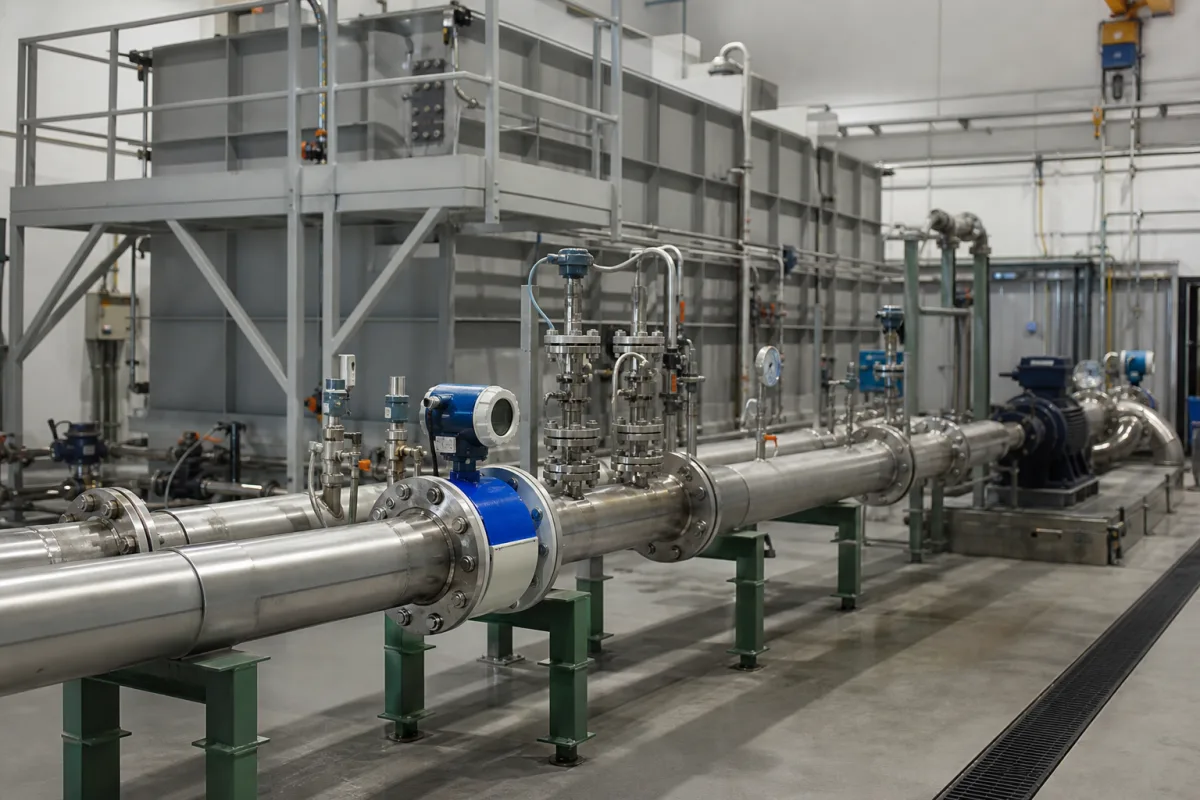
Water flow calibration rig for electromagnetic flowmeters: weighing tank or reference meter, and what a field verifier can and cannot replace
Wet calibration of magnetic flowmeters on a water test rig · weighing tanks and diverters against reference meters, head tank and straight pipe ahead of the meter, water-to-air temperature, and where a portable verifier fits
An electromagnetic flowmeter is calibrated wet: the meter is mounted in a pipe run, water is driven through it at set flowrates, and its output is compared with a reference, either water diverted into a weighing tank over a timed interval or a reference flowmeter already traced to such a tank. The rig decides the uncertainty, the largest bore and the highest flow a magmeter can be calibrated at. A portable verifier, by contrast, checks the converter and coils of an installed meter without moving any water.
Water calibration rigs and their parts used to calibrate electromagnetic flowmeters: weighing tanks with diverters, volumetric provers, reference (master) meters, head tanks, pumps, test sections and data systems, plus portable in-situ verifiers for magnetic flowmeters as a contrast to wet calibration. Flowmeters themselves of all measuring principles are covered on the Flow meter page and hygienic magmeters on the Sanitary flow meter page; batch calibration of pressure sensors in a temperature chamber on the Automated batch calibration system for pressure sensors page; reference instruments such as multifunction and dry-block calibrators on the Calibration equipment page; and portable 4–20 mA loop checkers on the Portable calibration module for load cells and 4–20 mA loops page. Gas flow calibration is outside this page.
CNFX editorial research · Sources checked October 12, 2026 · 3 sources
Japan's national metrology institute, NMIJ, gives the reference flowrate on four of its five water rigs by the static gravimetric method with weighing tanks, fed from an overflow head tank 30 m high holding 150 m³; the fifth, its high Reynolds number rig, is fed by four pumps and calibrates by comparison against reference meters. [1]
The Danish Technological Institute's rig, as designed in 2019, weighs with a diverter from 0.5 to 500 m³/h and above that measures through two DN200 Coriolis reference meters in parallel, 500 m³/h each, to 1,000 m³/h in pipes up to DN400 and water from 4 to 85 °C. Each Coriolis meter has a stated accuracy of 0.05% of actual flow from 800 down to 28 m³/h, and is calibrated in place against the gravimetric system without being removed. DTI gives 0.05% for its gravimetric system and expects about 0.2% for the reference-meter system; at writing, the rig was not finished and its capabilities not yet claimed. [2]
Driving 1,000 m³/h took three 55 kW pumps with frequency converters plus a smaller trim pump, because the Coriolis meters drop about 1 bar at 500 m³/h, the piping about 2.5 bar, and the rig keeps 1 bar available across the meter under test: 4.5 bar in total. [2]
Editorial calculation: at DTI's figures, moving from the gravimetric range to the reference-meter range quadruples the expected uncertainty (0.2 / 0.05 = 4). At NMIJ, the comparison rig's 0.081% is about 1.35 times the 0.060% of its 50 t weighing system (0.081 / 0.060). [2][1]
State the meter sizes (DN) and flowrates you need calibrated, the uncertainty required at each, and whether the lab calibrates by weighing or by reference meter at those points; ask for the coverage factor and accreditation scope.
02
Water-to-air temperature difference, straight pipe and what the accredited labs achieved
In NMIJ's 2013 comparison with the four Japanese JCSS-accredited water flow labs (Azbil, E+H Japan, Shimadzu and Yokogawa), water reached the test section from an overflow head tank with over 50 diameters of straight pipe upstream at every lab except E+H Japan, and reference flow came from static weighing tanks, apart from E+H Japan's low range, where a volumetric cylinder was used. [1]
Five electromagnetic transfer meters of 15 to 300 mm were circulated with turbine, Coriolis, orifice and ultrasonic meters; their reproducibility was 0.03% to 0.08%, against 0.01% to 0.03% for the Coriolis meters. Results between NMIJ and the labs agreed within about 0.1%, but the magmeters deviated more than the other transfer meters, about 0.05%. [1]
NMIJ identified the temperature difference between the water and the air around the meter under test as the likely dominant factor; it shifted the magmeters by about 0.1% across the air temperatures seen (water 11 to 31 °C, air 9 to 33 °C, pressure 0.1 to 0.5 MPa). Correcting for it reduced the average deviation to −0.015%, level with the other meters. [1]
Editorial note: for magmeter calibration, ask whether the rig controls or records both water and ambient air temperature at the test section, not water temperature alone.
Record water temperature, ambient temperature at the meter, line pressure and the upstream straight length in the calibration certificate.
03
Portable magmeter verifiers: converter and coil checks on the installed meter
KROHNE's MagCheck verifier, for its own IFC-series converters, connects at the installed meter without disconnecting cables, runs a fully automatic test and stores results for up to 70 measuring points; KROHNE presents it as an alternative to removing meters for calibration on external rigs. [3]
The data sheet gives the verifier's own uncertainty as under 0.1%, traceable to national standards, and says it confirms meters are within ±1% of their original factory calibration. Its acceptance limit for the converter's measuring channel is ±0.4% of measured value at 1 m/s and above, and ±(0.2% of measured value + 2 mm/s) below 1 m/s; at the primary head it checks coil resistance, coil insulation and electrode resistance with the tube full and empty. [3]
Editorial calculation: the ±1% window MagCheck confirms is about 12 times the 0.081% uncertainty of NMIJ's comparison rig and 25 times the 0.040% of its 5 t weighing system (1 / 0.081; 1 / 0.040). A verifier shows that a meter has not drifted outside that window; it does not replace a wet calibration where the flow error itself must be known to a tenth of a percent. [3][1]
04
Head tank, diverter, scale and reference meters on a magmeter rig
Part
Published detail
Specify
Flow source
Overflow head tank 30 m high, 150 m³ [1]; three 55 kW pumps plus trim pump on frequency converters [2]
Steady head or pumped, maximum flow, differential pressure across the meter
Test section
Over 50D straight pipe upstream at most JCSS labs [1]; DN400 maximum at DTI [2]
DN range, straight length, flange standards
Gravimetric reference
Weighing tanks 10 kg to 50 t [1]; each rig with its own diverter, tank and scale [2]
Tank capacities, diverter timing, scale calibration
Reference meters
Two DN200 Coriolis in parallel, 0.05% stated accuracy [2]
Type, range, in-place calibration against the scale
Data and control
PLC and SCADA, analogue and Modbus links to the meter under test, automatic certificates [2]
Signal interfaces, certificate content
Field verifier
Converter and coil checks, ±1% of factory calibration [3]
Compatible converters, verifier's own calibration
05
Meter sizes, flow points and uncertainty for a magmeter calibration rig
Paste it into your enquiry below or into an email to a maker, then replace every bracket.
Meters: [DN range; liner; converter outputs]
Flowrates: [minimum and maximum m³/h per size; number of points]
Uncertainty: [required at each point; coverage factor]
Reference: [weighing tank capacities; reference meters]
Water: [temperature range; ambient control]
Test section: [upstream and downstream straight length; flanges]
Data: [analogue, pulse, Modbus; certificate format; accreditation]
Explore company information and manufacturing capabilities, then discuss the scope of your project with a relevant supplier.
Share this page
Compiled and source-reviewed by the CNFX editorial team.
Each manufacturer above links to the page on that company's own website where the product is listed, with the date we checked it. How we source and review
· Page last updated 13 October 2026
Buyer questions
How accurate is a water calibration rig for magnetic flowmeters?
NMIJ's weighing rigs give 0.039% to 0.060% (k=2) and its comparison rig 0.081%; the four Japanese accredited labs in its 2013 comparison ran 0.050% to 0.23%. [1]
When does a rig switch from weighing to reference meters?
At DTI the gravimetric diverter system covers 0.5 to 500 m³/h and two parallel DN200 Coriolis meters take it to 1,000 m³/h; NMIJ weighs up to 3,000 m³/h and uses comparison from 750 to 12,000 m³/h. [2][1]
Can a portable verifier replace a wet calibration?
KROHNE's MagCheck confirms a fitted meter is within ±1% of its factory calibration; it checks the converter and coils, not the flow error against a reference. [3]
Sources and what still needs a direct check
Sources checked 2026-10-12. NMIJ's comparison paper gives rig data for Japan's national standard and four accredited manufacturer labs; DTI describes its own rig design; KROHNE's data sheet covers its field verifier.