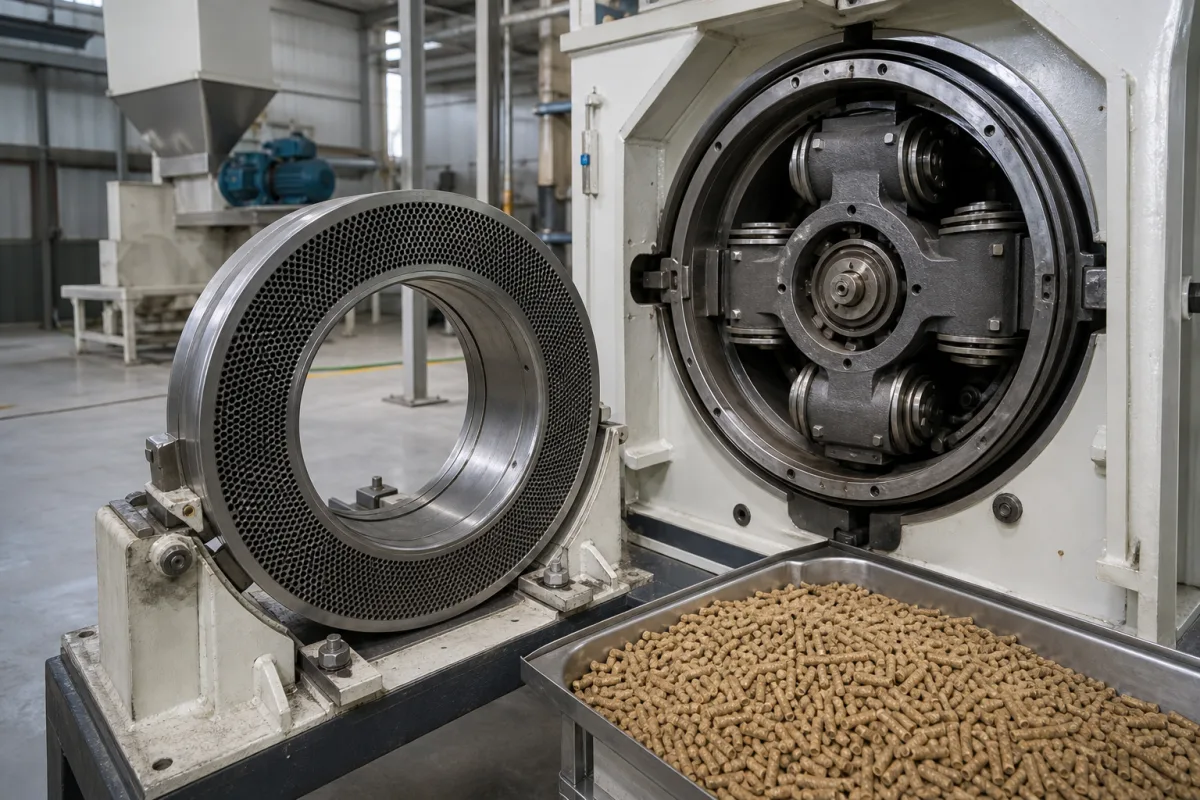
Pellet mill ring die · L:D ratio, durability versus throughput and energy, conditioning, pellet length and PDI testing
A feed pellet die is the perforated steel ring or plate of a pellet mill through which rollers force steam-conditioned mash to form pellets. Its hole diameter sets pellet size, and its effective thickness relative to hole diameter (the L:D ratio) sets how much friction and retention the feed sees. Ask three things first: what hole size and L:D the die has for your feed, how that trades pellet durability against throughput and energy, and how pellet quality will be measured.
Ring dies (and flat dies) for animal feed pellet mills. Complete pellet mills, roller shells, conditioners, coolers and biomass or wood pellet dies are outside this page.
CNFX editorial research · Sources checked October 12, 2026 · 5 sources
Choose the L:D ratio for durability, throughput and energy
The U.S. Grains Council's DDGS handbook chapter on pelleting poultry diets lists metal properties, hole design, hole pattern and number of holes as die characteristics that affect pellet durability, throughput and energy, and singles out the thickness (L) of die relative to hole diameter (D), the L:D ratio: as L:D increases, durability rises through more friction and die retention time, but throughput falls and energy use rises. Hole design may be straight bore or relief. [1]
The chapter reports a prediction model (R² = 0.92) in which reducing die thickness from an 8:1 L:D to 5.6:1 lowered the pellet durability index (PDI) by 10.9 units, more than any other factor; raising conditioning temperature from 65 °C to 85 °C added 7.0 units. In the companion energy model, the thinner 5.6:1 die cut energy use by 1.3 kWh/ton, while the hotter conditioning cut it by 2.7 kWh/ton. [1]
The chapter also attributes up to 72 percent of the energy used for pelleting to steam conditioning, and notes that pellets leave the die at 80–90 °C and 15–17% moisture before cooling. [1] Editorial calculation: L:D is effective thickness over hole diameter, so a 4 mm hole at 8:1 needs about 32 mm of effective thickness, and at 5.6:1 about 22 mm.
Give the supplier the pellet mill model and die dimensions (inside and outside diameter, width, mounting), hole diameter, effective thickness or L:D, inlet countersink and relief depth, hole pattern, steel grade and hardness, the feed formulation (fat, fibre, DDGS), target throughput and PDI, and the conditioning temperature used.
02
Measure pellet quality and set the knife
Kansas State University researchers define PDI as the percentage of intact pellets remaining after mechanical handling. In a 2019 trial on a CPM 1012-2 HD mill with a 0.19 × 1.25 in die (L:D 6.6) and 185 °F conditioning, moving the knife from 0.25 in to 0.75 in from the die lengthened pellets from 0.19 to 0.34 in and reduced fines; the 0.25 in setting gave lower PDI, while 0.50 and 0.75 in gave similar PDI. Halving production rate from 33 to 16 lb/min also lengthened pellets and tended to raise PDI. [2]
A second 2019 Kansas State trial on the same mill model, with a 3/16 × 1¼ in die (L:D 6.7), raised conditioning temperature through 130, 145 and 160 °F and found PDI and pellet hardness both increased, but were not strongly correlated with each other (r = 0.618). [3] The U.S. Grains Council chapter names ASAE S269.4 as "The standard pellet durability test used in the feed industry", and its tables use a Pfost tumbler for 10 min at 50 rpm. [1]
Editorial calculation: 1.25 in ÷ 0.1875 in = 6.7, matching the L:D Kansas State states; the same die in metric is a 4.8 mm hole with about 31.8 mm effective length. [3]
03
Ask how the die was drilled, finished and measured
CPM, a pellet mill maker that also supplies dies for other brands' mills, lists three manufacturing points for its pellet mill dies: "Gun-drilled and forged in-house", "Six-point inspections ensure exact fit" and "Hole surface finished to 1.2Ra for smoother flow". Its die one-pager adds that quality assurance includes assessing hole surface quality at 1.2Ra and grinding and measuring six different surfaces for fit to the machine, and that it offers "Chrome and Alloy dies" for all pellet mill applications and OEMs. [4][5]
These manufacturing points sit alongside the die geometry the U.S. Grains Council handbook ranks first. The handbook names metal properties, hole design, hole pattern and number of holes as die characteristics affecting durability, throughput and energy, and singles out L:D [1]. CPM's figures give a value to check on hole finish and fit, while L:D still has to be chosen for the feed. Ask any die supplier for the hole finish in Ra, the drilling method and the steel, as well as the L:D.
Treat the Lightning Technology figures as the maker's ranges, not test results for your feed: the one-pager gives approximate ranges of 5–20% fewer fines and 5–40% less energy per ton without stating the test conditions [5]. Kansas State University trials show how much pellet quality also moves with conditioning temperature and knife setting [3][2], so ask for a trial on your own formula before comparing dies on these numbers.
Editorial calculation: applied to the U.S. Grains Council energy figures, a 5–40% saving on the 1.3 kWh/ton difference between the 8:1 and 5.6:1 dies would be about 0.07–0.52 kWh/ton, but CPM does not state its baseline, so this is an illustration only. [5][1]
Item
CPM published statement
Use on the order
Hole drilling
Gun-drilled; dies forged in-house
Drilling method for the holes
Hole surface
Finished to 1.2Ra; assessed at 1.2Ra in QA
Hole finish value and how it is measured
Fit to the mill
Six different surfaces ground and measured; laser measurements for fit
Fit dimensions for your mill model
Material options
Chrome and Alloy dies
Steel grade and certificate
Lightning Technology™ (vendor claim)
Fines reduced by approximately 5–20%; energy use lowered by approximately 5–40% per ton
Test basis behind the claim
Rework
Die rework and roller refurbishment programmes
Rework option and cost
Values are from CPM's parts page and two CPM die one-pagers (PDF text extracted); the Ra unit is not stated on the pages.
04
Ring and flat dies with roller shells from the listed die shops
The suppliers reviewed make ring and flat dies with roller shells and other pellet mill spares; ask each for the steel grade, heat treatment, hole drilling and finishing method, and the L:D options for your mill.
05
Die body, holes, relief and flange: what each feature sets
Hole size, effective thickness and hardness to state for a ring die
Hole diameter and effective thickness together fix the L:D that the U.S. Grains Council chapter ranks first among die factors; hardness, tensile strength and hole tolerance have no published value here and come from the die maker's steel certificate.
Liyang Iklay and Sichuan Meishan Jinding list ring dies, flat dies and roller shells; New Harvest lists pellet mill dies and rollers among its feed processing machines.
Liyang Iklay Machinery Co., Ltd.
Manufacturing site to be confirmed for the order
Lists ring dies and flat dies for feed and wood pellet mills, with roller shells.
Explore company information and manufacturing capabilities, then discuss the scope of your project with a relevant supplier.
Share this page
Compiled and source-reviewed by the CNFX editorial team.
Each manufacturer above links to the page on that company's own website where the product is listed, with the date we checked it. How we source and review
· Page last updated 13 October 2026
Buyer questions
What L:D ratio should a feed pellet die have?
It depends on the feed; the U.S. Grains Council chapter reports that moving from 8:1 to 5.6:1 lowered PDI by 10.9 units while saving 1.3 kWh/ton. [1]
What is pellet durability index (PDI)?
The percentage of intact pellets remaining after mechanical handling, measured with tumbling or pneumatic testers. [2]
Does pellet length affect durability?
In a Kansas State trial, setting the knife at 0.25 in gave shorter pellets and lower PDI than 0.50 or 0.75 in. [2]
What hole finish should a pellet mill die have?
CPM states that its dies have the hole surface finished to 1.2Ra, are gun-drilled and forged in-house, and have six surfaces ground and measured for fit. Ask any supplier for the Ra value and how it is measured. [4][5]
Sources and what still needs a direct check
Sources checked 2026-10-12. The U.S. Grains Council chapter reviews published pelleting research; the Kansas State reports are university feed-mill trials. Your die choice should be confirmed in trials on your own feed.