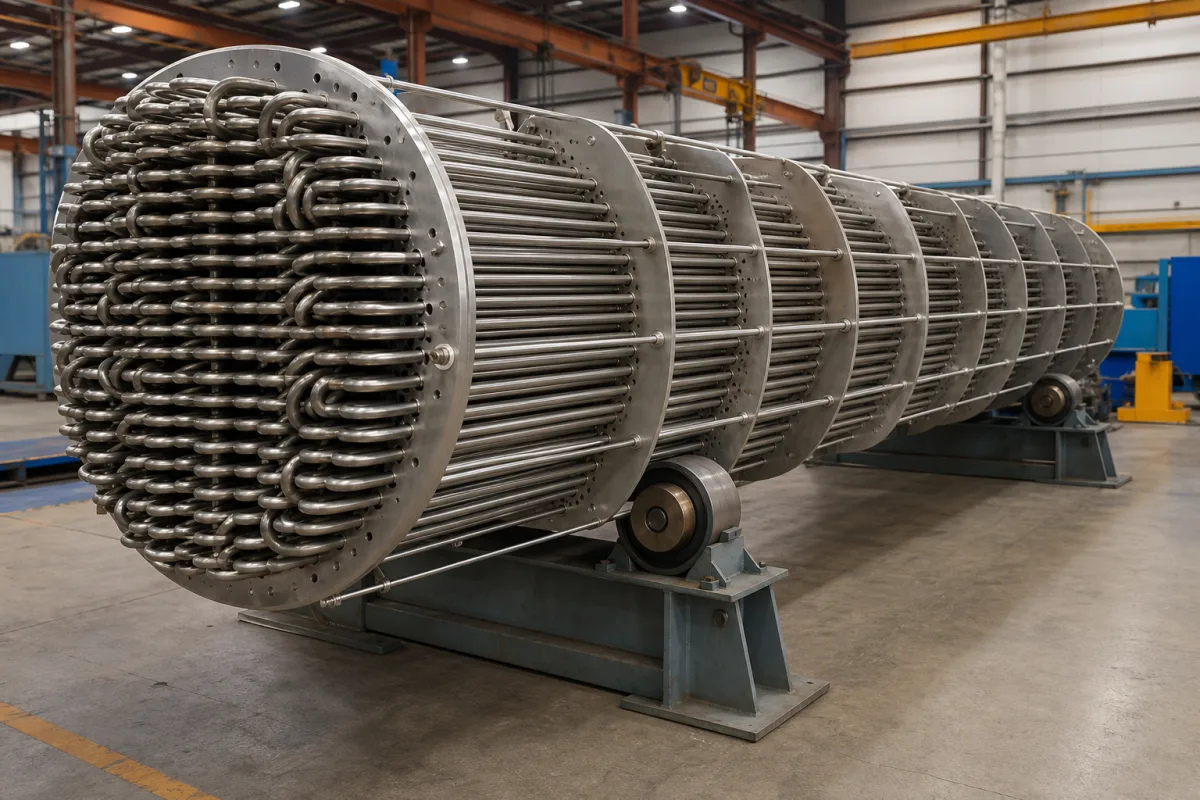
U-tube bundles for recirculating PWR steam generators · Alloy 690TT or Alloy 800 tubing, tube diameter and pitch, support plates and anti-vibration bars, replacement sizing
This page covers the U-tube bundle of a recirculating steam generator for pressurized water reactors: the nickel-alloy U-tubes, the tubesheet that holds their ends, the tube support plates and the anti-vibration bars in the U-bend. Ask three things first: which tube alloy, diameter, wall and pitch the bundle uses, how the supports are shaped to resist vibration and deposits, and how the surface area was sized against the original or required duty.
U-tube bundles for recirculating steam generators in pressurized water reactors, including replacement bundles, built from Alloy 690TT or Alloy 800 tubing with tube support plates and anti-vibration bars. Tube bundles for shell-and-tube heat exchangers, air coolers, boilers and fired heaters are covered on the Tube bundle page. Once-through and helical-coil steam generators, fossil boiler tube banks and complete steam generator vessels are outside this page.
CNFX editorial research · Sources checked October 12, 2026 · 3 sources
Specify the tubing: alloy, diameter, wall and inspection
Alleima states that its steam generator tubing production is focused on outer diameters of 10–25.4 mm (0.3937–1.000"), with Alloy 690 (Sanicro 69, UNS N06690) and Alloy 800 (Sanicro 30, UNS N08800) as the main materials, produced to ASME and RCC-M standards. It describes Sanicro 69 as used in PWRs in the thermally treated condition for resistance to stress corrosion cracking in PWR primary water, reports an eddy-current signal-to-noise ratio of 15:1 or better, and says it has supplied more than 400 tube bundles, about 2,600,000 tubes, to nuclear steam generators in 20 countries. [1]
The Ulchin replacement study gives primary water stress corrosion cracking, estimated to weaken the original steam generators' integrity and increase maintenance cost, as the reason for replacement, and chose Alloy 690 for its strong resistance to corrosion; Kyushu Electric Power's replacement of the Genkai Unit 2 steam generator likewise adopted an upgraded tube material. [2][3]
Editorial calculation: the 0.875 inch and 0.750 inch tube sizes considered for the Ulchin replacement are 22.2 mm and 19.05 mm, both inside Alleima's 10–25.4 mm production range. [2][1]
Give the supplier the tube alloy and thermal treatment, outer diameter and wall per row, the code (ASME or RCC-M), the eddy-current inspection requirement, the number of tubes and the U-bend radii, plus the tubesheet and support plate materials.
02
Size the bundle and its supports
Kim and co-authors from Korea Power Engineering Company and Korea Hydro and Nuclear Power (KNS, 2008) describe sizing the replacement steam generators for Ulchin Units 1 and 2, Framatome Model 51B units in service since 1988, to match the original performance at 2,785 MWt NSSS power, 34 × 10⁶ lb/h primary flow, 614.7 °F inlet, 545.5 °F outlet, 837 psia steam pressure at 0% plugging and 36 psi primary pressure drop. Two options used Alloy 690 tubes of 0.875 inch and 0.750 inch on a triangular array to fit more tubes, and both needed a larger tube surface area than the original, up to about 20% for the thicker tubes. [2]
The paper attributes the extra area to Alloy 690's lower thermal conductivity than Alloy 600, lower primary flow per tube with more tubes, and lower heat flux reducing boiling heat transfer. It reports that thinner, smaller tubes allow a smaller area but raise pressure drop and shorten the bundle, requiring the cone location of the shell to be adjusted, and that a triangular pitch allows more tubes without enlarging the bundle diameter. [2] Editorial calculation: 614.7 − 545.5 = 69.2 °F, about 38.4 K, across the primary side.
For supports, Kyushu Electric Power states that the replacement Genkai Unit 2 steam generator featured anti-vibration bars, upgraded tube material and a modified tube hole shape for the tube support plate, to reduce worker radiation dose during repairs and avoid extending periodic inspections. [3]
03
Alloy 690 tube sizes and anti-vibration bar replacement options
The options below come from one replacement study and one utility description; they illustrate choices, not a product range.
Option
What the source states
Trade-off
Alloy 690, 0.875 in tubes, triangular pitch
Envelope very similar to the original; more tubes and surface in the same envelope. [2]
Explore company information and manufacturing capabilities, then discuss the scope of your project with a relevant supplier.
Share this page
Compiled and source-reviewed by the CNFX editorial team.
Each manufacturer above links to the page on that company's own website where the product is listed, with the date we checked it. How we source and review
· Page last updated 13 October 2026
Buyer questions
What tube materials are used in PWR steam generator bundles?
Alleima lists Alloy 690 (Sanicro 69, used thermally treated in PWRs) and Alloy 800 (Sanicro 30) tubing of 10–25.4 mm OD produced to ASME and RCC-M. [1]
Why do replacement bundles need more tube surface?
In a KOPEC/KHNP study for Ulchin 1 and 2, Alloy 690's lower thermal conductivity, lower flow per tube and lower heat flux meant up to about 20% more area for the thicker-tube option. [2]
What support changes do replacement steam generators make?
Kyushu Electric's Genkai Unit 2 replacement added anti-vibration bars, upgraded tube material and a modified tube hole shape in the support plates. [3]
Sources and what still needs a direct check
Sources checked 2026-10-12. Alleima describes its own tubing; the KNS paper is a utility-support engineering study; Kyushu Electric describes its own plant work.