Structured Manufacturing Data (2026)

Expansion Joints

Based on aggregated insights from structured factory profiles within the CNFX directory, the standard Expansion Joints used in the Machinery and Equipment Manufacturing sector typically supports operational capacities ranging from standard industrial configurations to heavy-duty production requirements.

Technical Definition & Core Assembly

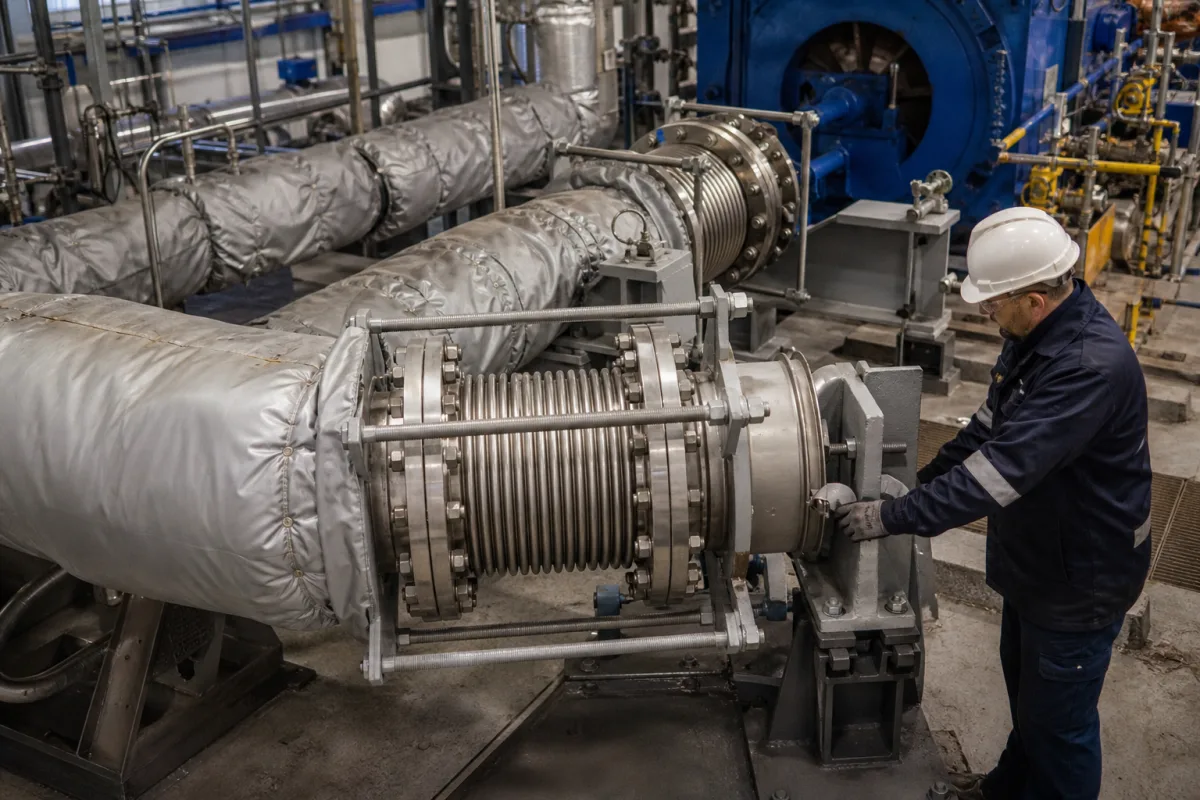
A canonical Expansion Joints is characterized by the integration of Bellows and End Connections. In industrial production environments, manufacturers listed on CNFX commonly emphasize Stainless Steel construction to support stable, high-cycle operation across diverse manufacturing scenarios.

Flexible connectors that accommodate thermal expansion, vibration, and misalignment in steam generator tube bundle assemblies
Product Specifications

Technical details and manufacturing context for Expansion Joints

Definition
Expansion joints are critical components within steam generator tube bundle assemblies that absorb thermal expansion and contraction, dampen vibrations, and compensate for misalignment between connected tubes or sections. They prevent stress buildup, reduce fatigue, and maintain system integrity under varying temperature and pressure conditions.
Working Principle
Expansion joints function through flexible bellows or corrugated sections that compress, extend, or flex in response to thermal changes and mechanical movements. This flexibility accommodates dimensional changes without transferring excessive forces to adjacent components, thereby protecting the tube bundle from damage.
Common Materials
Stainless Steel, Inconel, Hastelloy
Technical Parameters
  • Nominal diameter matching tube bundle dimensions (mm) Per Request
Components / BOM
  • Bellows Part
    Flexible corrugated section that absorbs movement
    Material: Stainless Steel
  • End Connections Part
    Flanges or weld ends for attachment to tubes
    Material: Carbon Steel
  • Internal Liner Part
    Protects bellows from flow erosion and turbulence
    Material: Stainless Steel

Industry Taxonomies & Aliases

Commonly used trade names and technical identifiers for Expansion Joints.

Applied To / Applications

This component is essential for the following industrial systems and equipment:

Industrial Ecosystem & Supply Chain Structure

Complementary Systems
Downstream Applications
Specialized Tooling

Application Fit & Sizing Matrix

Operational Limits
pressure: Up to 25 bar (standard), higher with special designs
other spec: Axial movement: ±10-50mm, Lateral movement: ±5-25mm, Angular deflection: ±4-15°
temperature: -40°C to +400°C
Media Compatibility
✓ Steam/condensate systems ✓ Hot water circuits ✓ Chemical process fluids (compatible with lining material)
Unsuitable: Chloride-rich environments above 60°C (risk of stress corrosion cracking)
Sizing Data Required
  • Maximum expected axial movement (mm)
  • Operating pressure and temperature
  • Pipe diameter and connection type

Reliability & Engineering Risk Analysis

Failure Mode & Root Cause
Fatigue cracking
Cause: Cyclic thermal expansion/contraction or vibration exceeding design limits, leading to material fatigue and crack propagation in bellows or flanges.
Corrosion/erosion
Cause: Exposure to aggressive chemicals, moisture, or abrasive particulates in the media, degrading bellows material or internal liners over time.
Maintenance Indicators
  • Visible fluid leakage or weeping from bellows or flange connections
  • Audible metallic creaking, popping, or abnormal vibration during thermal cycles
Engineering Tips
  • Implement regular visual inspections and thermal imaging to detect early signs of misalignment, corrosion, or stress concentrations
  • Ensure proper anchoring, guiding, and alignment during installation to prevent over-extension, compression, or torsional stresses beyond design limits

Compliance & Manufacturing Standards

Reference Standards
ISO 15348:2002 - Metallic bellows expansion joints ANSI/AWWA C219:2018 - Bolted, Sleeve-Type Expansion Joints DIN 8606:2019-08 - Expansion joints for pipelines
Manufacturing Precision
  • Bore diameter: +/- 0.5% of nominal diameter
  • Bellows pitch length: +/- 1.5mm per convolution
Quality Inspection
  • Hydrostatic pressure test at 1.5x design pressure
  • Dye penetrant test on all welds and critical joints

Factories Producing Expansion Joints

Manufacturer profiles with relevant production capability in China

Manufacturer listings support early research and capability understanding. They are not certification, ranking, or transaction guarantees.

Technical documentation
4/5
Manufacturing capability
4/5
Inspection readiness
5/5
Supplier transparency
3/5

These scores are example evaluation dimensions, not real customer ratings, country-specific buyer feedback, or live inquiry activity.

Supply Chain Compatible Machinery & Devices

Automated Assembly Line System

Integrated production system for sequential component assembly operations

Explore Specs →
Automated Powder Coating System

Integrated industrial system for applying dry powder coatings to metal substrates.

Explore Specs →
Centrifugal Pump Impeller

Rotating component that transfers energy to fluid in centrifugal pumps.

Explore Specs →
High-Precision CNC Laser Cutting Machine

Computer-controlled industrial machine using focused laser beams to cut sheet metal with micron-level accuracy.

Explore Specs →

Frequently Asked Questions

What materials are best for high-temperature steam generator expansion joints?

For high-temperature applications in steam generators, Inconel and Hastelloy alloys offer superior corrosion resistance and thermal stability compared to standard stainless steel, making them ideal for demanding environments.

How do expansion joints accommodate misalignment in tube bundle assemblies?

Expansion joints with flexible bellows design can absorb axial, lateral, and angular movements, compensating for installation misalignments and thermal growth in steam generator tube bundles without transferring stress to connected components.

What maintenance is required for expansion joints in machinery manufacturing?

Regular inspection for wear, corrosion, or leakage is recommended. Internal liners should be checked for erosion, and bellows for fatigue cracks. Proper installation and alignment during initial setup minimize maintenance needs.

Can I contact factories directly on CNFX?

CNFX is an open directory, not a transaction platform. Each factory profile provides direct contact information and production details to help you initiate direct inquiries with Chinese suppliers.

Data Basis

CNFX manufacturer profiles, technical classification, publicly available product information, and ongoing plausibility checks.

Preliminary Technical Classification
This page supports structured research, RFQ preparation, and supplier evaluation. It does not replace buyer-led supplier qualification, standards review, or technical approval.

Request Manufacturing Insight for Expansion Joints

Ask for use case, specification boundaries, supplier type, and RFQ preparation information for Expansion Joints.

Your business information is used only to process this request.

Thank you! Your message has been sent. We'll respond within 1–3 business days.

Need to Manufacture Expansion Joints?

Compare manufacturer profiles with relevant product and process capability.

Create Manufacturer Profile Contact Us
Previous Product
Expanding Mandrel
Next Product
Expansion Segments