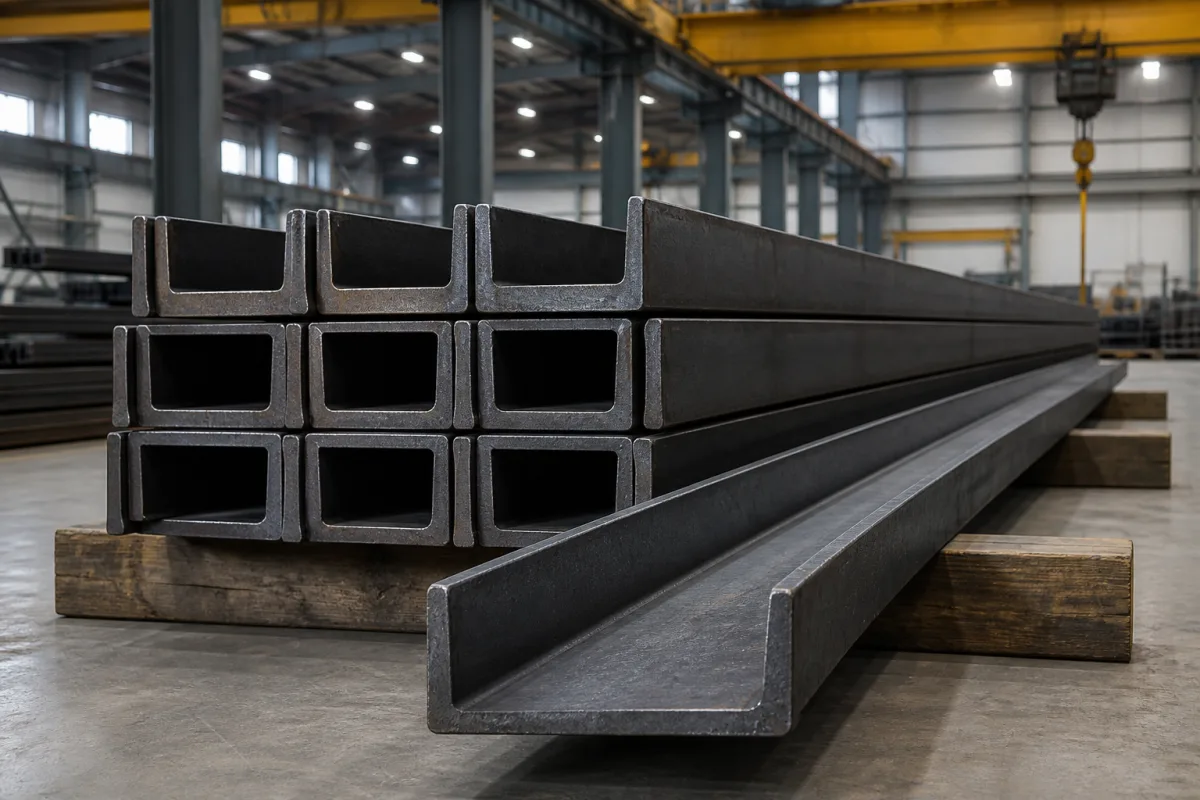
Hot-rolled channels · Taper versus parallel flanges, rolling tolerances to EN 10279, steel grade, mass per metre and length
A structural steel channel is a hot-rolled U-shaped section with a web and two flanges on one side, used for purlins, bracing, frames, trimmers and machine bases. Decide three things before asking for a price: whether you need taper-flange (UPN type) or parallel-flange (UPE or PFC type) channels and which designation, the standard that sets the rolling tolerances, and the steel grade with its thickness-dependent yield strength.
Hot-rolled channels with tapered or parallel flanges, sold in mill or cut lengths. Cold-formed C and U profiles, strut channel, I-beams and angles are outside this page; I-beams have their own page.
CNFX editorial research · Sources checked October 11, 2026 · 5 sources
ArcelorMittal lists UPN European standard channels from UPN 50 to 400 and UPE parallel-flange channels from UPE 80 to 400, both with dimensions to EN 10365:2017. [2] Its sales programme gives the UPN flange slope as 8% up to 300 mm depth and 5% above, and lists taper and parallel flange channels with tolerances to EN 10279:2000 and surface condition to EN 10163-3, class C, subclass 1. [1]
The section tables give, for example, UPN 300 at 46.2 kg/m with h = 300 mm, b = 100 mm, tw = 10.0 mm, tf = 16.0 mm and root radius r1 = 16.0 mm; UPN 200 at 25.3 kg/m (200 × 75 mm, tw 8.5, tf 11.5); and UPE 300 at 44.4 kg/m (300 × 100 mm, tw 9.5, tf 15.0). [1]
Editorial note: name the series together with the size, since UPN 300 and UPE 300 share depth and flange width but differ in thickness and mass in the tables above.
Give the supplier the series and designation, dimension and tolerance standards, steel grade and quality, lengths and length tolerance, quantity per size, surface condition and any coating, inspection document type, and any cutting, punching or bending.
02
Read the EN 10279 rolling tolerances
ArcelorMittal's channel tolerance table under EN 10279:2000 sets depth at ±1.5 mm up to 65 mm, ±2 mm above 65 to 200 mm, ±3 mm above 200 to 400 mm and ±4 mm above 400 mm. Flange width, graded by depth, runs from ±1.5 mm up to 50 mm deep to ±3 mm above 125 mm. Web thickness is ±0.5 mm up to 10 mm, ±0.7 mm above 10 to 15 mm and ±1.0 mm above 15 mm. [1]
Flange thickness is given as a minus limit only — −0.5 mm up to 10 mm, −1.0 mm above 10 to 15 mm and −1.5 mm above 15 mm — with the plus side limited by the mass tolerance. Mass is ±6% for depths up to 125 mm and ±4% above; length is −0/+100 mm; and straightness is given about each axis, for example 0.0020L and 0.0030L for depths above 150 to 300 mm. [1] The programme adds that its usual rolling tolerances can be reduced after agreement and that maximum lengths run from 18 to 33 m depending on the shape. [1]
Editorial calculation: the programme gives steel density as 7,850 kg/m³. UPN 300 has a listed area of 58.8 cm², and 0.00588 m² × 7,850 kg/m³ ≈ 46.2 kg/m, matching the tabulated mass. A 12 m length is a nominal 554.4 kg, and ±4% allows about ±22 kg. [1]
For S355 under EN 10025-2:2019, the programme lists minimum yield of 355 MPa up to 16 mm and 345 MPa above 16 to 40 mm, tensile strength 470–630 MPa and minimum elongation 22% up to 40 mm; S235 is 235/225 MPa, 360–510 MPa and 26%. [1]
03
Order to ASTM when the project is specified in US units
Channels for projects specified to US standards are ordered under ASTM rather than EN 10279. ASTM A6/A6M sets the general requirements, including permitted variations in dimensions and mass, for rolled structural shapes supplied under product specifications such as A36/A36M carbon structural steel, A572/A572M high-strength low-alloy columbium-vanadium steel, A588/A588M weathering steel up to 50 ksi [345 MPa] minimum yield point, and A992/A992M structural shapes. Its Annex A1 lists the permitted variations in SI units; conformance to Annex A1 is mandatory when the 'M' designation is used, and unless the order names the 'M' specification the product is furnished to inch-pound units. Where A6 and the product specification conflict, the product specification prevails. Finished products are to be marked with designation, grade, heat number, size and thickness, and the maker's name, brand or trademark. [4] A36/A36M covers carbon steel shapes, plates and bars for riveted, bolted or welded bridges and buildings, with heat analysis for carbon, manganese, phosphorus, sulfur, silicon and copper. [5]
Editorial note: UPN and UPE sizes are rolled to EN 10365 and checked against EN 10279, so a project that names ASTM A6 and A36 or A572 needs sections and certificates to those documents; state one system in the enquiry rather than mixing tolerance tables. [2][4]
Order item
ASTM rule
EN counterpart on this page
Tolerances
A6 permitted variations; Annex A1 in SI when 'M' is ordered. [4]
Hot-rolled U channels from Minjie and Yuantai Derun
Minjie lists channels to JIS, GB, EN and ASTM in sizes 8# to 40# with galvanizing, cutting, bending and punching; Yuantai Derun lists U channel for building frames, platforms and machinery bases. Ask either which standard and tolerance table a given size is rolled to.
One listing gives a size range by Chinese channel number with S235JR, S355JR, SS400 and Q235B grades, galvanizing, processing and material test certificates; the other describes hot-rolled U channels without a size table. Ask both for the section table, the mill and the mill certificate.
05
Web, flanges, root radius, grade and surface of a channel
Flange form is the first split: UPN flanges slope 8% up to 300 mm depth and 5% above, while UPE flanges are parallel. [1][2]
Class C subclass 1 to EN 10163-3; galvanizing offered. [1][3]
Class; coating.
06
Depth, flange and web sizes, S355 strength and mass per metre for UPN and UPE
UPN 300 is the worked size across these rows: 100 mm flange width, 10.0 mm web, 16.0 mm flange thickness and 46.2 kg/m, against 44.4 kg/m for UPE 300. [1]
2 companies list this product among what they make. Company figures are quoted from each
company's own website; every card states where the relationship came from.
Tianjin Minjie steel Co.,Ltd
Manufacturing site to be confirmed for the order
Lists hot-rolled U channels to JIS, GB, EN and ASTM in sizes 8# to 40#, grades including S235JR, S355JR, SS400 and Q235B, with hot-dip galvanizing, cutting, bending, punching and welding.
Explore company information and manufacturing capabilities, then discuss the scope of your project with a relevant supplier.
Share this page
Compiled and source-reviewed by the CNFX editorial team.
Each manufacturer above links to the page on that company's own website where the product is listed, with the date we checked it. How we source and review
· Page last updated 13 October 2026
Buyer questions
What is the difference between UPN and UPE channels?
ArcelorMittal lists UPN with tapered flanges (8% up to 300 mm, 5% above) and UPE with parallel flanges. [1][2]
Which standard sets channel rolling tolerances?
ArcelorMittal lists its UPN and UPE channels with tolerances to EN 10279:2000. [1]
What mass tolerance applies to a steel channel?
ArcelorMittal's EN 10279 table gives ±6% up to 125 mm deep and ±4% above. [1]
Which ASTM standard sets tolerances for hot-rolled channels?
ASTM A6/A6M gives the permitted variations in dimensions and mass for rolled structural shapes; its SI Annex A1 is mandatory when the 'M' designation is ordered. [4]
Sources and what still needs a direct check
Sources checked 2026-10-11. ArcelorMittal is a section producer publishing its sales programme with section, tolerance and grade tables, and a U-sections page; ASTM A6 and A36 are read from their published abstracts and scopes; Minjie and Yuantai Derun are linked suppliers.