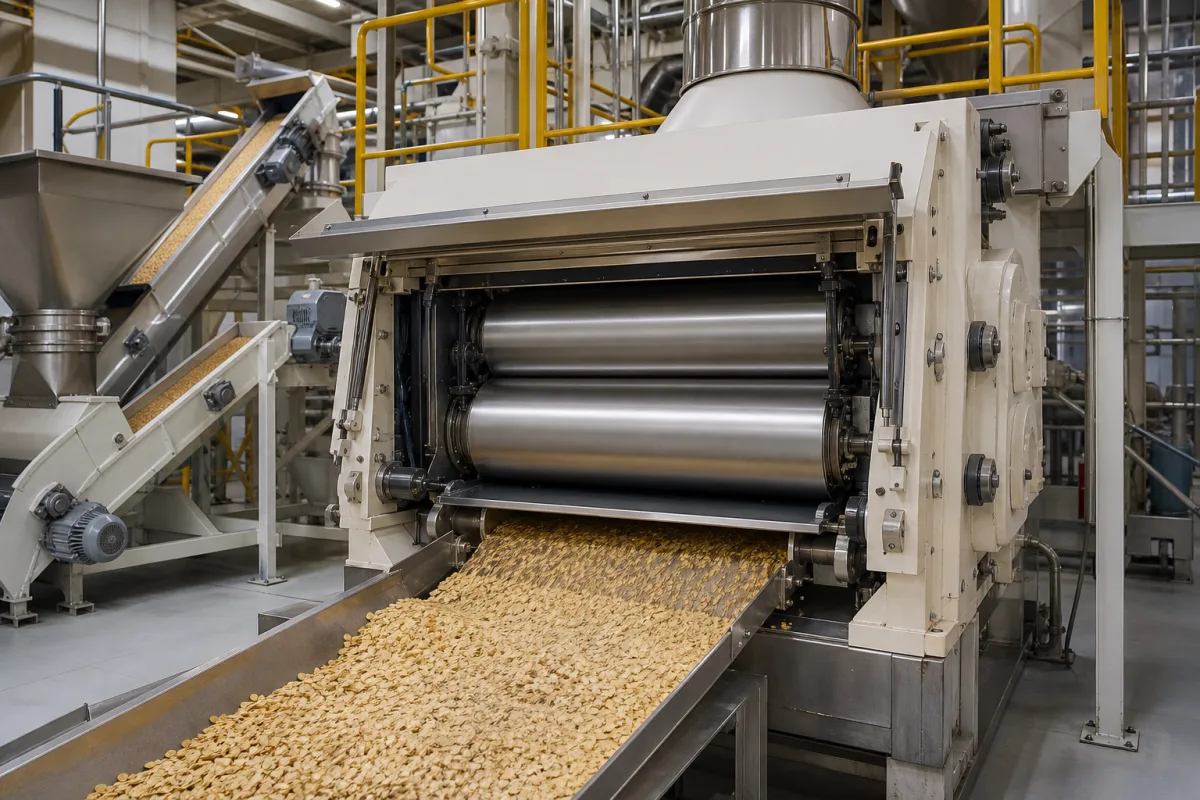
Oilseed flakers · Cracking and conditioning before flaking, flake thickness, roll size, constant feed and bulk density, extraction targets
An oilseed flaking mill passes conditioned, cracked oilseed between a pair of counter-rotating rolls set to a fixed gap, pressing each particle into a thin flake whose ruptured oil cells give up oil readily in a solvent extractor or press. Ask three things first: what flake thickness your extraction needs, how the seed is cracked and conditioned before the flaker, and how the feed is kept constant across the roll length.
Two-roll flaking mills for soybeans, rapeseed, sunflower and similar oilseeds ahead of solvent extraction or pressing, with feeders and roll gap adjustment. Cracking mills, conditioners and cookers, cereal flaking mills and screw presses are outside this page.
CNFX editorial research · Sources checked October 12, 2026 · 5 sources
The American Oil Chemists' Society (AOCS) guide to soybean seed preparation describes cracking beans on two pairs of corrugated rolls to a quarter to a third of bean size, checked on a 2.25 mm screen where about 75% should be retained; granulation after cracking affects flake size and so the product volume in the extractor. [1]
EPA's AP-42 chapter on vegetable oil processing describes soybean preparation as cracking, dehulling and hull removal, conditioning and flaking. Cracked beans and chips are heated in a rotary steam-tube device or a stacked cooker to make them pliable and keep them hydrated. AP-42 states that conditioning is necessary to permit flaking and to prevent the chips breaking into smaller particles. [2]
Conditioning before flaking reduces flaker power, gives fewer fines and more stable flakes in extraction, and brings the flakes to a temperature suited to solvent extraction; the guide names bundle-tube conditioners, with live steam to adjust moisture, and the seed should reach about 50–60 °C (122–140 °F) at 11% moisture. The guide's process description also gives conditioning to 85 °C before flaking in its standard soybean process. [1]
Editorial calculation: raising 1,000 kg of cracked seed from 10% to 11% moisture means keeping 900 kg of dry matter at 89%, so 900 ÷ 0.89 ≈ 1,011 kg, adding about 11 kg of water through steam or sprays.
Give the supplier the seeds and capacity in tonnes per day, extraction route (solvent or press), target flake thickness, conditioned temperature and moisture, cracked particle size, roll diameter and length preference, feeder type, roll surface and hardness, gap setting and adjustment method, motors and supply, and dust aspiration.
02
Hold flake thickness with steady feed and fixed gap
The AOCS guide states that flaking deforms seed particles so press and shear forces rupture the oil cells, that flake thickness may vary between 0.25 and 0.3 mm, and that flaking machine rolls range from 600 to 800 mm in diameter and 1,000 to 2,200 mm in length. [1]
Because flakers run at constant roll speed and constant gap, the guide says they must be fed at constant capacity and constant bulk density; any deviation shows as varying flake thickness. It recommends a chain conveyor above the flakers to avoid de-mixing and spread feed evenly, ending at an overflow surge bin, aspiration at the outlet chute to keep the rolls clean, and slow chain conveyors to carry flakes to extraction. [1]
AP-42 gives a slightly wider range than the AOCS guide: smooth cylindrical rolls press the conditioned particles into flakes about 0.25 to 0.51 mm (0.010 to 0.020 in) thick, which exposes the oil cells for hexane extraction. Its emission-factor table lists flaking rolls with a cyclone at 0.037 lb of particulate per ton of soybeans processed. [2]
Machine features show how the gap is held in practice. CPM Roskamp describes its SP Series flaking mill with 28 or 32 inch diameter centrifugally cast chilled iron rolls. Listed features include double-acting hydraulic cylinders, hydraulic accumulators to damp vibration, spring stacks that protect the rolls from uncrushable material, and a hydraulically operated feed gate integrated with roll pressure. They also include adjustable cheek plates to seal the roll ends and scrapers with adjustable counterweights. Options include a swing-out magnet for tramp metal, fixator roll stops against roll-to-roll contact and an in-place roll surface grinder. [3]
Its target for the resulting extraction meal is 0.8% residual oil (AOCS Ba 3-38), 12.5% maximum moisture after the dryer-cooler and 20 °C maximum temperature. [1] Editorial note: ask flaker suppliers how gap is set and held across the roll length, and how roll wear is measured and corrected.
03
Size capacity and adjustment from published machine data
Two more makers' pages show the capacity range and the adjustment features to ask about. Bühler states that its OLFB flaking mill produces consistent flakes at throughputs of more than 500 tons per 24 hours. It is driven by a single overhead drive with a friction-optimized main and serpentine drive system, which Bühler says reduces power consumption and gives a 25% smaller footprint than conventional flaking mills. Flake thickness can be changed during operation by mechanical and hydraulic adjustment, and a PLC panel on the door shows hydraulic pressures, motor amps, percentage of full-load amps, operating hours and alarms. Its rolls are centrifugally cast with an outer chilled-iron alloy over a tough cast-alloy core. [4]
At the smaller end, Farmet lists its FP 4010 flaking mill at 4,000 kg per hour for rapeseed, sunflower seed and soya. The pressing force on the seed is regulated through pre-set hydraulic components so that it can be set for each seed type; the rolls are a wear-resistant alloy, and the machine has an integrated magnetic separator and integrated cleaning brushes that keep the rolls clean. [5]
Editorial calculation: 4,000 kg per hour × 24 h = 96 t per day, about one-fifth of the 500 t per 24 hours stated for the OLFB, so a plant of 500 t/day would need either one large flaker or about five machines of the smaller size, each with its own feeder. [5][4]
Editorial note: the AOCS guidance that flakers must be fed at constant capacity and bulk density applies to every size; ask each supplier how its feeder spreads seed across the full roll length. [1]
Fill the specification fields with values for your plant
A flaker quotation needs values for your plant. The table explains each field, gives published values where a reviewed source states them, and says what to obtain from the supplier.
Explore company information and manufacturing capabilities, then discuss the scope of your project with a relevant supplier.
Share this page
Compiled and source-reviewed by the CNFX editorial team.
Published product pages show what a company offers, not tested performance. Confirm the legal seller, factory and scope for your order. How we source and review
· Page last updated 13 October 2026
Buyer questions
How thin should soybean flakes be?
The AOCS guide gives 0.25–0.3 mm for soybean flakes ahead of solvent extraction. [1]
Why condition seed before flaking?
To cut flaker power and make flakes with fewer fines that stay stable in extraction, at about 50–60 °C and 11% moisture. [1]
Why does flake thickness vary?
Flakers run at constant speed and gap, so changes in feed rate or bulk density show up as thickness variation. [1]
How thick are soybean flakes?
The AOCS guide gives 0.25–0.3 mm and EPA AP-42 gives about 0.25–0.51 mm (0.010–0.020 in). [1][2]
What capacity do oilseed flaking mills have?
Published examples range from 4,000 kg per hour (Farmet FP 4010, about 96 t a day) to more than 500 tons per 24 hours (Bühler OLFB). [5][4]
Sources and what still needs a direct check
Sources checked 2026-10-12. The AOCS guide describes standard soybean preparation; other oilseeds and plants use their own targets, so confirm flake specification with your extraction supplier. EPA AP-42 section 9.11.1 describes the soybean preparation process and its emission factors; the CPM Roskamp page is a maker's own product description. Bühler's and Farmet's product pages are makers' own descriptions, cited as examples of published capacity and adjustment features.