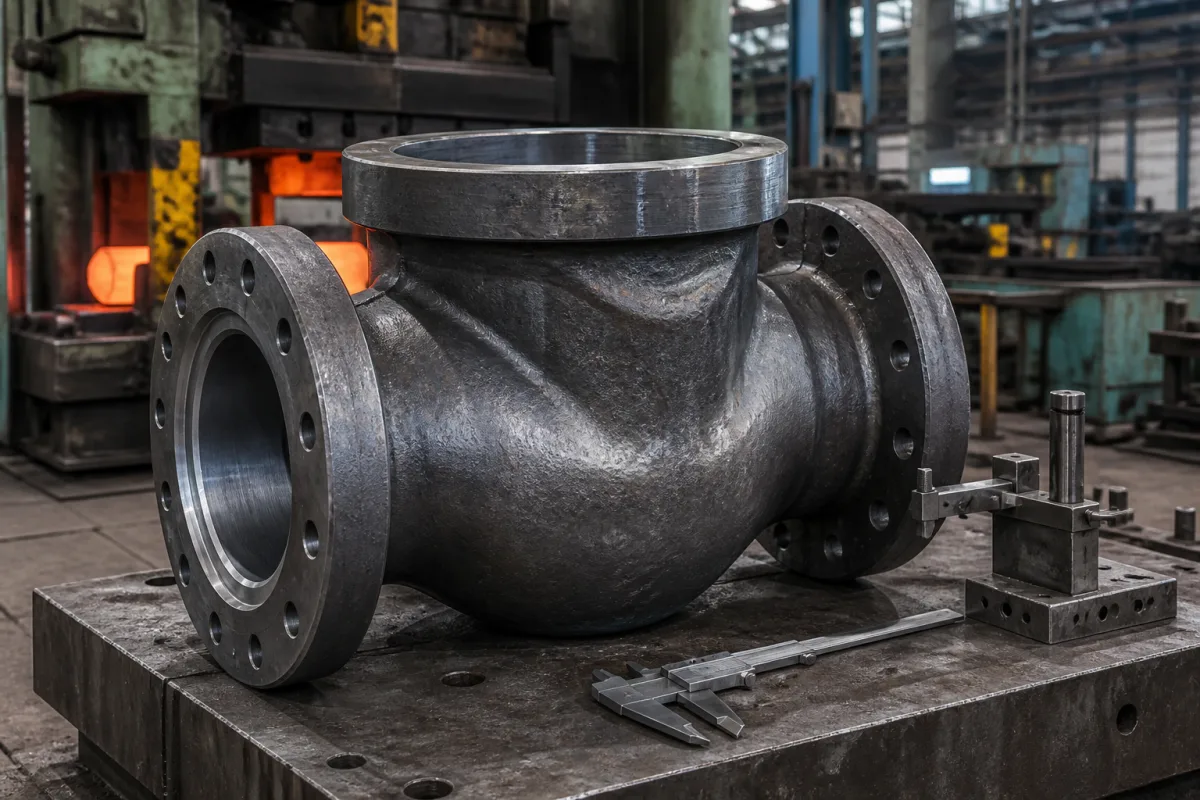
Forged steel bodies for gate, globe, ball and check valves · Forged versus cast bodies, die forging versus block forging, machining the gate cavity and flow bore, seat support and encapsulation, pressure-temperature ratings and shell testing
A forged steel valve body is the pressure-retaining housing of a valve, made from a steel forging and then machined to form the flow bore, the cavity for the gate, ball or disc, and the seat and bonnet faces. Forging is chosen for soundness; the cost is in machining. Ask three things first: which valve type, size, rating and code the body is for, whether it is die forged or block forged and how the cavity and seats are machined, and what material certificates and pressure tests come with it.
Forged steel bodies (and bonnets where supplied with them) for industrial and pipeline valves, die forged or block forged and machined, supplied as components or in finished valves. Cast valve bodies, complete valve assemblies and their trim, and valves of iron or plastic are outside this page except where compared.
CNFX editorial research · Sources checked October 12, 2026 · 4 sources
US patent 4,443,920 (Method of manufacturing a gate valve body, 1984) explains that "gate valve bodies are often cast" because the cavity can be made close to the gate's size and shape, minimising metal removal and the span the seats must bridge; "wrought or forged bodies normally have less defects, and thus require a minimum of testing", but forming a "generally rectangular cavity" for the gate in a forging by milling or shaping takes considerable time and expense, while a simpler cylindrical cavity would need seat supports spanning the gap to the rectangular gate. [1]
US patent 11,047,487 B2 (Method for manufacturing a block forged valve body with a fully encapsulated seat ring, 2021) adds that bodies made by casting or die forging need expensive, unique moulds and dies that are not easily reconfigured, for example for a larger gate or through opening, and that bodies bolted together from separate parts need more fasteners and sealing interfaces and are more prone to leakage than a one-piece body. Its method block-forges a one-piece body and machines the through hole and the chamber from the top. [2]
Editorial note: ask the supplier whether the body is die forged or block forged, how much machining that implies for your size, and what defect testing it applies to the forging.
Give the supplier the valve type, size, pressure class and design code, service fluid and temperature range, body material grade, forging route (die or block) and any limits on welding, drawings of the bore, cavity, seat pockets and end connections, required non-destructive examination, material certificates, shell and seat test requirements, coating, and quantities.
02
Machine the cavity and support the seats
US 4,443,920 forms a substantially rectangular gate cavity in a forging by drilling a first hole and then at least one more hole parallel to and overlapping it, before forming the flowway openings that connect opposite sides of the cavity to the outside; the cavity is the pressure chamber in which the gate moves, and the seats sit in recesses where the flowway meets the cavity. [1] US 11,047,487 explains that seats not fully encapsulated around their periphery can deflect or deform, which may delaminate a hard-faced seat surface, contaminate the media or reduce sealing; its block-forged body has a chamber shelf overlying an annular shoulder that fully encapsulates the seat. [2]
For US gas pipelines, 49 CFR 192.145 requires each valve other than cast iron and plastic valves to meet API Spec 6D or an equivalent standard, not to be used beyond the applicable pressure-temperature ratings, and to meet anticipated operating conditions; valves with ductile iron shell components are limited to 80% of comparable steel valve ratings and barred from compressor station gas piping. [3]
Editorial note: ask the supplier to show the seat pocket design and support, and the shell and seat test pressures it will apply to the finished body.
03
Ask how the forger prevents folds in die-forged bodies
A 2025 PLOS ONE study by researchers at Shanghai Dianji University simulated multi-directional die forging of AISI 4130 steel valve bodies and reported that under the unoptimized process nearly all forged parts showed fold defects, more than 50% of them severe; the simulated fold reached about 10 mm deep. Friction at the billet-die interface had the strongest influence on folds and damage, followed by billet temperature, with main punch speed least. [4]
The baseline simulation used a 1,100 °C billet, 250 °C dies, a friction coefficient of 0.15 (water and graphite) and a 20 mm/s main punch speed. Raising the billet from 1,000 °C to 1,200 °C cut the internal temperature gradient in the fold-initiation regions from 180 °C to 60 °C. The optimized combination was a friction coefficient of 0.1, a 1,200 °C billet and 30 mm/s; production trials with fluorescent magnetic particle inspection found no fold or crack defects, meeting the acceptance criteria of ASTM E709. [4]
Editorial note: ask a die-forging supplier which defects it has found on your body shape, how it controls billet temperature, die lubrication and press speed, and which magnetic particle method and acceptance criteria it applies to the finished forging.
Parameter
Baseline simulation
Optimized process
Billet initial temperature
1,100 °C
1,200 °C
Billet-die friction coefficient
0.15 (water + graphite)
0.1
Main punch speed
20 mm/s
30 mm/s
Die initial temperature
250 °C
Not reported as changed
Fold result
About 10 mm deep (simulated)
No fold or crack defects in production trials (MPI)
04
Forging, flow bore, gate cavity, seat pockets and bonnet face on a forged body
The gate cavity and the seat pockets are the two features both patents treat in detail: US 4,443,920 drills the cavity as overlapping holes, and US 11,047,487 holds the seat ring under a chamber shelf over an annular shoulder. [1][2]
Size, class, wall, face-to-face, grade, hardness and seat leakage for a forged valve body
Pressure class and the operating temperature and pressure rows are tied to a published rule: 49 CFR 192.145 bars use beyond the applicable pressure-temperature ratings. Wall thickness, roughness, hardness and leakage come from the design code and the supplier's test plan. [3]
Explore company information and manufacturing capabilities, then discuss the scope of your project with a relevant supplier.
Share this page
Compiled and source-reviewed by the CNFX editorial team.
Each manufacturer above links to the page on that company's own website where the product is listed, with the date we checked it. How we source and review
· Page last updated 13 October 2026
Buyer questions
Why choose a forged valve body over a cast one?
US 4,443,920 says "wrought or forged bodies normally have less defects, and thus require a minimum of testing", but forming the gate cavity takes more machining. [1]
What is a block forged valve body?
A one-piece forging machined to form the bore and chamber, avoiding costly dedicated dies (US 11,047,487). [2]
What rules apply to valves on US gas pipelines?
49 CFR 192.145 requires valves other than cast iron and plastic to meet API Spec 6D or equivalent and stay within their ratings. [3]
What causes folds in a die-forged valve body?
A 2025 PLOS ONE study traced folds to inward flow of surface material and found billet-die friction the strongest factor, then billet temperature, then punch speed. [4]
Sources and what still needs a direct check
Sources checked 2026-10-12. The two US patents (1984, 2021) describe valve body manufacture in their own terms; 49 CFR 192.145 is a US federal pipeline safety rule. Design codes such as API 6D are referenced but not reproduced here.