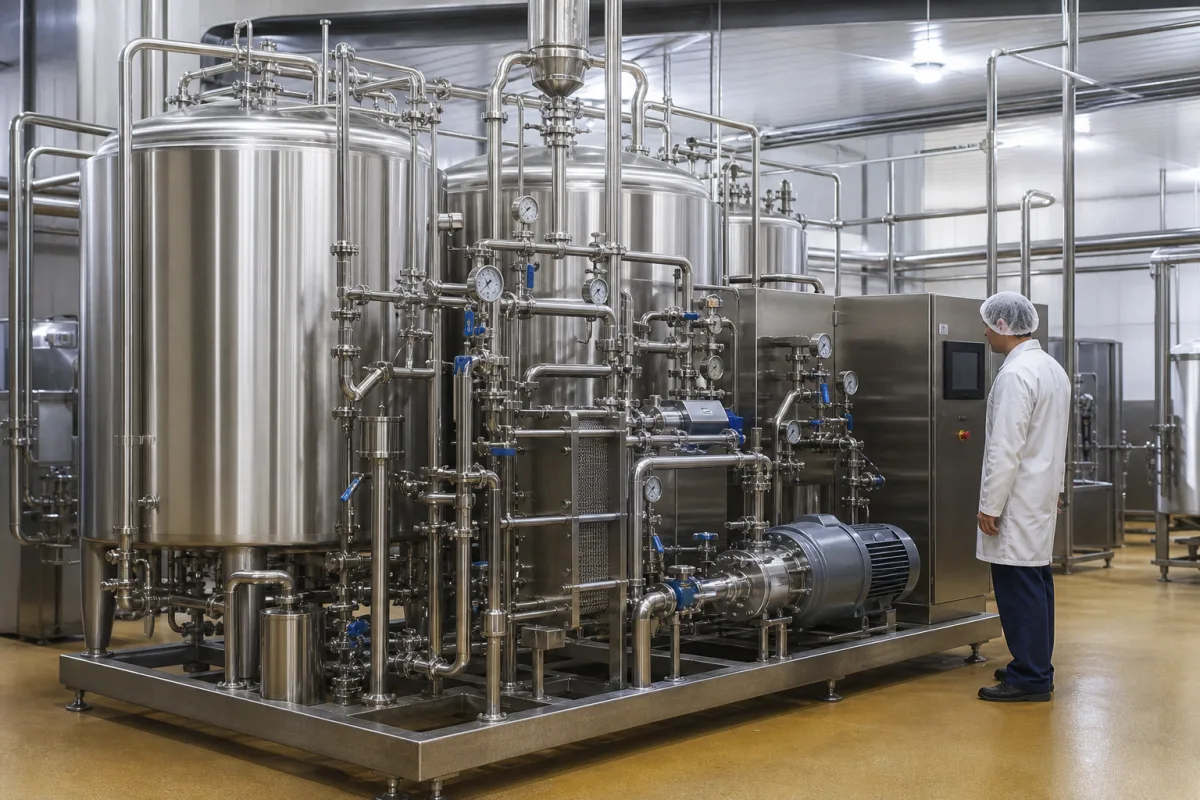
Beverage emulsion mixing and homogenizing system: premix tank and two-stage homogenizer for flavour and cloud emulsion concentrates
Making flavour and cloud emulsion concentrates for soft drinks · gum hydration and premix, a two-stage valve at 3,000–5,000 psi with repeat passes, and weighting agents held to FDA limits in the finished drink
Orange-flavoured and cloudy soft drinks get their flavour and turbidity from a small dose of concentrated oil-in-water emulsion, diluted about 1 to 1000 into the drink. The emulsion is made in a dedicated mixing and homogenizing system: a tank where the gum or starch is hydrated in water, a premix step where the weighted oil phase is sheared in, and a valve homogenizer that the batch passes through more than once until the oil droplets are small and even enough not to float up and leave a ring in the bottle neck. What has to be specified is the droplet size the line must reach, how the premix is made, the homogenizing pressure split and number of passes, and how much weighting agent the recipe can carry.
Batch systems that prepare beverage flavour and cloud emulsion concentrates — hydration and premix tanks, a high-shear premix stage, a two-stage valve homogenizer with recirculation, and cooling — for citrus-oil and vegetable-oil emulsions stabilized with gum arabic or modified starch. The rotor–stator mixer on its own is covered on the In-line homogenizer (high-shear rotor–stator mixer) page and the piston-pump machine on the High-pressure homogenizer page; recipe blending of syrups and finished drinks is covered on the Automated beverage batch blending system page and plain agitated tanks on the Mixing vessel (agitated mixing tank) for liquids page. Dairy and plant-based milk homogenization is outside this page.
CNFX editorial research · Sources checked October 12, 2026 · 5 sources
Below 2 µm, but not so fine that the cloud disappears
SPX FLOW's process bulletin for orange oil emulsions sets the target: the flavouring and cloud oils must be emulsified so that the oil droplets are smaller than 2.0 µm. Droplets that are too large cream and form an oil ring in the neck of the diluted drink; droplets that are too small scatter less light, so the cloud the emulsion is meant to give is lost. [1]
The bulletin describes two products a system of this kind makes. An orange oil emulsion is a concentrate of orange oil in water that gives both flavour and cloud when diluted about 1 to 1000; a flavour cloud emulsion carries less flavour oil and adds vegetable oil — weighted coconut oil, for example — to produce the cloud. [1] A typical gum arabic formulation it gives is 10% orange oil, 10–20% gum arabic, 0.3% citric acid and 0.1% sodium benzoate, the rest water; a modified-starch alternative uses 11.0% starch with 11.0% orange or flavour oil, and the pH of the emulsion should be below 4.5. [1]
Nasrolahi and co-workers, studying cloud emulsions made with corn oil, gum rosin and modified starch, note that an emulsion looks milky when its droplets are larger than 1 µm and becomes transparent below 0.05 µm, and that food emulsions span droplet diameters of 0.1–100 µm. [5] Their optimum for stability in model juices was 12% modified starch, 5% corn oil and 1% gum rosin. [5]
02
Hydrating the gum and sizing the premix for the 10 µm target
SPX FLOW ties the uniformity of each batch to the premix as much as to the homogenizer. It says gum arabic works best when hydrated in the water for hours, and that a good premix should have “most emulsion droplets less than 10 micrometers”, with a narrow distribution and the smallest average size possible, so that homogenizing removes the oversized droplets and batches stay uniform. [1]
In the laboratory version of the same sequence, Cheong and co-workers stirred the aqueous phase with the dissolved preservatives and modified starch for 2 h to hydrate it, added the flavour oil gradually while mixing to form a coarse emulsion, pre-homogenized it with a rotor–stator mixer for 1 min at 6,000 rpm, and then passed it twice through a valve homogenizer at 200 bar to reach an average droplet size below 1 µm. [4]
SPX FLOW also warns about the gum itself: some low-quality gum arabic has contained impurities such as sand that abrade homogenizer valve parts, sediment after hydration should not be carried into the batch, and a change of gum source may need the formulation adjusted. [1] Editorial note: on a production skid this is the case for a hydration tank with enough residence time, and a filter or settling step between the gum solution and the premix tank.
Editorial note: ask the system supplier how long the hydration tank can hold a batch, how the oil phase is dosed into the premix (rate and point of addition), and what droplet size the premix stage reaches on your recipe before the homogenizer.
03
Two-stage valve at 3,000–5,000 psi total, second stage at 10–15%, and repeat passes
SPX FLOW gives the homogenizing condition for orange oil emulsions as a total pressure of 3,000–5,000 psi through a two-stage homogenizing valve, with the second stage at 10–15% of the total. It says “it is usually necessary to homogenize the emulsion more than once to obtain a uniform size distribution”, because multiple passes cut the population of oversized droplets and with it the risk of ringing. [1]
Editorial calculation: 1 psi = 0.0689 bar, so 3,000 psi ≈ 207 bar and 5,000 psi ≈ 345 bar; the second-stage values are 10% and 15% of those totals and the first stage is the difference. These are conversions of SPX FLOW's figures, not separate recommendations.
Raising the pressure is not a substitute for extra passes: SPX FLOW says that “simply going to higher pressure does not usually eliminate the necessity of multipassing” and can overwork the emulsion, creating an excess of submicron droplets whose surface area the stabilizer cannot cover, so the droplets cluster and the emulsion deteriorates. Too little or poor-quality stabilizer can cause the same clustering in an emulsion that was not overworked. [1] For a skid, that makes the recirculation line back to the premix tank, or a second holding tank for alternate passes, part of the design rather than an option.
Same homogenizing, different stabilizer: droplet size after two months
Cheong and co-workers' recipes held 10% soursop flavour oil and 3% vegetable oil and differed only in the emulsifier; every batch was pre-homogenized at 6,000 rpm and passed twice through the valve homogenizer at 200 bar. [4] The table shows why a system trial should be run on the actual recipe: the same machine settings gave droplets from about a quarter of a micrometre to over 8 µm.
The authors attribute the growth in the sucrose-ester emulsions to hydrolysis of the sucrose head group at low pH, and found 6% modified starch alone gave emulsions with the smallest droplets and good creaming stability. [4] Editorial note: against SPX FLOW's 2 µm target, only the two starch-based recipes stayed below it after two months in this study.
Weighting the oil phase: ester gum at 100 ppm and SAIB at 300 mg/kg of the finished drink
Citrus and other flavour oils have a specific gravity of 0.845–0.890, well below the sugar solution of the drink, so they are weighted to slow creaming. SPX FLOW names ester gum (glycerol ester of wood rosin), damar gum and sucrose acetate isobutyrate (SAIB); ester gum, with a specific gravity of about 1.08, is dissolved in the oil in an amount that brings the oil phase close to the specific gravity of the sugar solution it will be dispersed in, but no more than the law allows. [1]
In the United States, 21 CFR 172.735 allows glycerol ester of wood, gum or tall oil rosin to adjust the density of citrus oils used in beverages at no more than 100 parts per million of the finished beverage, and specifies an acid number of 3 to 9 and a drop-softening point of 88–96 °C. [2] 21 CFR 172.833 allows SAIB as a stabilizer of flavouring-oil emulsions in non-alcoholic beverages, with total SAIB not above 300 mg/kg of the finished beverage. [3]
Editorial calculation: if the emulsion is the only source of the weighting agent and is diluted 1 to 1000 into the drink, as in SPX FLOW's description, 100 ppm in the drink corresponds to at most 100 × 1000 = 100,000 ppm, or 10%, ester gum in the emulsion concentrate; the SAIB limit of 300 mg/kg corresponds to 30% in the concentrate. A higher dilution ratio raises these ceilings and a lower one reduces them, so the limit has to be checked against the actual dosing rate of the emulsion in the final drink.
Editorial note: the weighting agent is dissolved in the oil phase before the premix, so the oil-phase tank, its heating if the agent is solid at room temperature, and the dosing accuracy belong in the system specification.
06
What to send for a beverage emulsion system quotation
Paste it into your enquiry below or into an email to a maker, then replace every bracket.
Product: [orange oil emulsion or flavour cloud emulsion; oil type and %; stabilizer and %; weighting agent and %]
Target: [droplet size and distribution; turbidity; shelf life]
Batch: [batch volume; batches per shift; hydration time]
Premix: [rotor–stator or other premix; oil addition method]
Homogenizer: [capacity; total and second-stage pressure; number of passes; recirculation or two-tank operation]
Utilities and hygiene: [cooling water; CIP; materials in contact]
Documents: [droplet-size results on our recipe; weighting-agent compliance at our dilution ratio]
Explore company information and manufacturing capabilities, then discuss the scope of your project with a relevant supplier.
Share this page
Compiled and source-reviewed by the CNFX editorial team.
Each manufacturer above links to the page on that company's own website where the product is listed, with the date we checked it. How we source and review
· Page last updated 13 October 2026
Buyer questions
What droplet size should a beverage cloud emulsion reach?
SPX FLOW's bulletin sets less than 2.0 µm, noting that droplets that are too small reduce the cloud and droplets that are too large cause creaming and oil rings. [1]
What homogenizing pressure is used for orange oil emulsions?
SPX FLOW gives 3,000–5,000 psi total through a two-stage valve, with the second stage at 10–15% of the total, and says a second pass is “usually necessary”. [1]
How much ester gum or SAIB can a soft drink contain in the US?
21 CFR 172.735 limits glycerol ester of rosin to 100 ppm of the finished beverage; 21 CFR 172.833 limits SAIB to 300 mg/kg of the finished non-alcoholic beverage. [2][3]
Does the stabilizer change the droplet size?
Yes. In one study with identical homogenizing (two passes at 200 bar), 6% modified starch gave 0.245 µm and 1% sucrose laurate 8.356 µm. [4]
Sources and what still needs a direct check
Sources checked 2026-10-12. Droplet target, formulations, premix, homogenizing pressures and weighting practice come from SPX FLOW's APV process bulletin on orange oil emulsions; the US limits for ester gum and SAIB from 21 CFR 172.735 and 172.833; the laboratory preparation sequence and stabilizer comparison from Cheong et al. (Molecules, 2014); droplet size and appearance and an optimized cloud-emulsion recipe from Nasrolahi et al. (Food Science & Nutrition, 2023).