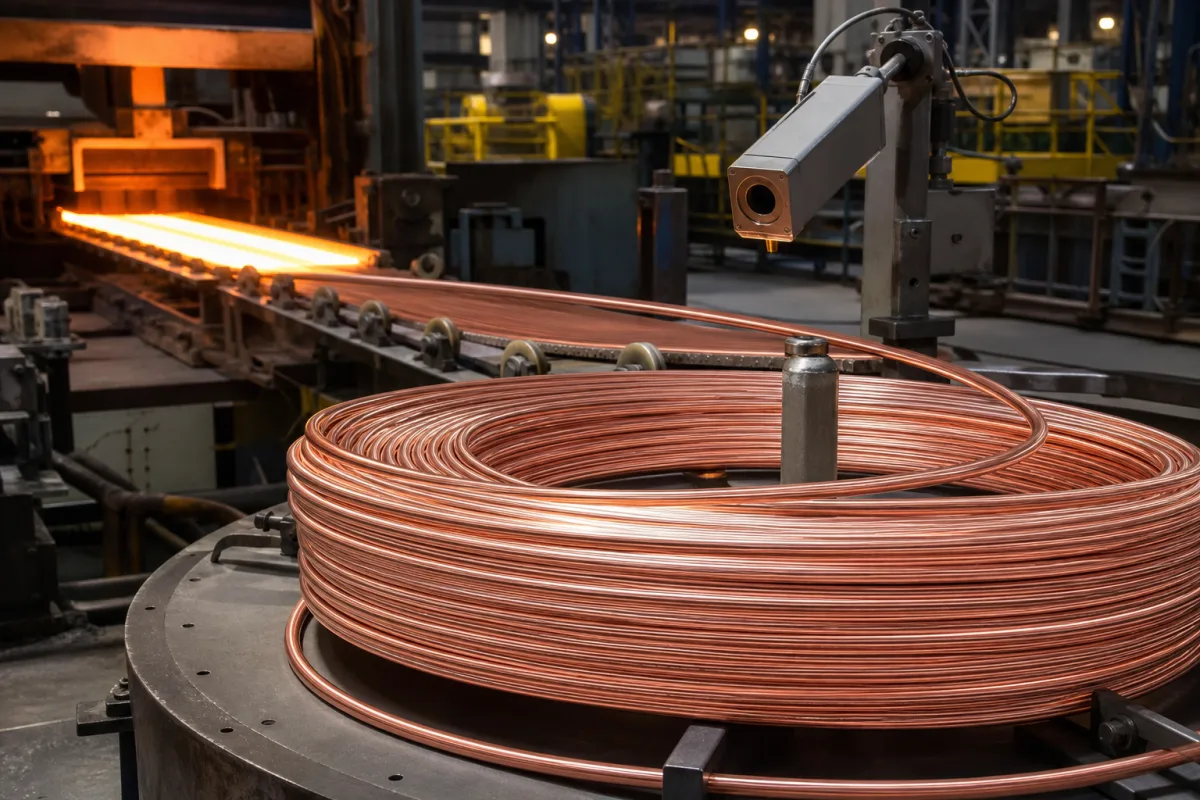
Copper wire rod for drawing: continuous cast and rolled Cu-ETP redraw rod, 8 mm, in coils
Continuous cast and rolled Cu-ETP wire rod, 8 mm and up, coiled for wire drawing · oxygen 100–400 ppm, conductivity over 101% IACS, coils of 4.6–4.75 t
Wire rod is the feedstock wire mills draw from: an 8 mm or thicker copper rod cast and hot-rolled in one continuous line from melted cathode, pickled, waxed and laid in coils of 4.6 to 4.75 tonnes. Wire mills draw it down to magnet wire, building wire and cable conductors, so what matters is less the rod's own strength than how it behaves in the drawing machine and the annealer: its oxygen level, its conductivity after drawing and annealing, how cleanly its surface comes off the coil, and whether the coil is one unbroken length.
Continuous cast and rolled copper wire rod (redraw rod) in Cu-ETP grades to EN 1977 and ASTM B49, 8 mm and larger diameters, supplied in coils for wire drawing, with oxygen-free and low-alloyed (CuAg, CuSn) rod for comparison. Wrought copper rod and bar for machining and bar stock, in ETP, oxygen-free and free-machining coppers, are covered on the Copper rod and bar page; cathode on the High-purity copper cathode page; wheel-and-band and other casting machines on the Continuous casting machine for non-ferrous metals page; copper busbar on the Copper busbar page; continuously cast copper alloy billets on the Copper alloy continuous casting billet page. Drawn wire, enamelled wire and cable are outside this page.
CNFX editorial research · Sources checked October 12, 2026 · 4 sources
Oxygen, conductivity and spiral elongation in three producers' 8 mm rod specifications
Wire rod is bought on a short list of numbers. Oxygen sets drawability and annealing behaviour, conductivity is the reason copper is used, and elongation or spiral elongation tells the wire mill how the rod will recrystallise. The three producers below publish them in different forms.
Palabora's specification adds how resistivity is tested: on specimens cleaned and drawn to about 2.0 mm and annealed at about 500 °C, measured by ASTM B193; the producer may test the rod as cast and rolled, but a dispute is settled on the drawn and annealed specimen. It takes 0.15328 Ω·g/m² at 20 °C, equal to 1.7241 µΩ·cm, as the international standard for annealed copper of 100% conductivity, and a density of 8.89 g/cm³ at 20 °C. [4]
Editorial calculation: KGHM's minimum of 58.8 MS/m equals a resistivity of 1 / 58.8 = 0.01701 Ω·mm²/m, about 1.4% below Palabora's 0.017241 Ω·mm²/m ceiling, which is the 100% IACS value; 58.8 / 58.0 = 1.014 reproduces KGHM's 101.4% IACS. [1][4]
KGHM states that its oxygen content is low enough to give good drawability and a low recrystallisation temperature, and that the rod surface is cleaned by the alcohol method and coated with a synthetic wax against oxidation in transport and storage. [1] Aurubis names surface quality as a basic requirement for high-temperature-resistant, error-free insulation on enamelled wire. [3]
Spiral elongation (EN 12893) min. 380, or AR test min. 20% [1]
—
—
State on the order the standard and grade, diameter and tolerance, oxygen range, minimum conductivity and how it is tested (as rolled or drawn and annealed), the spiral elongation or other recrystallisation test, and the surface protection required.
02
From cathode to coil on a wheel-and-belt line: 30-second solidification, 612 °C at the last stand, 4.6-tonne packages
Palabora describes its Southwire Continuous Rod (SCR) line in operating figures. Cathode is melted continuously in a vertical shaft furnace fired with LPG, held in a cylindrical holding furnace that evens out chemistry and temperature, and poured from a tundish into the casting machine: a wheel with a peripheral groove closed by an endless steel belt, cooled by water sprays. [4]
The copper solidifies in less than 30 seconds, and the cast bar leaves the caster at 20 to 28 cm/s. A bar preparation unit removes the belt-side corners and loose oxide before the bar enters a no-twist mill of vertical and horizontal stands; the rod leaves the last stand at about 612 °C, passes through in-line alcohol pickling, is waxed and is coiled continuously into packages weighing 4.6 tonnes on average. [4]
KGHM supplies its 8 mm rod in coils of about 4.75 t in one piece without joins, 1,130 mm inside and 1,800 mm outside diameter, on 1,750 × 1,750 mm pallets secured with PET straps and stretch foil. [1] Editorial calculation: an 8 mm rod has a cross-section of π × 4² = 50.3 mm², or 0.447 kg per metre at 8.89 g/cm³, so a 4.75 t coil holds about 10.6 km of rod before drawing (nominal diameter; the ±0.4 mm tolerance moves this). [1][4]
Aurubis puts the scale of the product in one figure: about 75% of global copper cathode production is processed into continuous cast wire rod. [3]
Ask for coil weight, inside and outside diameters and pallet size to match your pay-off, and confirm the coil is one length without welds.
03
When oxygen-bearing rod is not the right feed: oxygen-free silver-bearing rod and CuAg or CuSn grades
Both European producers sell rod that departs from Cu-ETP for particular wire uses, and the published figures show what changes.
KGHM states that its oxygen-free silver-bearing rod is supplied in a structurally cast state, has enhanced resistance to heat-related abrasion, and draws well with its trace oxygen of at most 5 ppm. [2] Aurubis lists on-board vehicle power supplies, overhead contact lines and electrical engineering as applications of its low-alloyed CuAg and CuSn rod. [3] Compared with KGHM's Cu-ETP rod, its published minimum conductivity is lower (58.0 against 58.8 MS/m) and its tensile figure is lower (180 against 225 MPa). [1][2]
Low-alloyed rod offered for a combination of higher strength and good conductivity [3]
04
Rod order details a wire mill should send
Paste it into your enquiry below or into an email to a maker, then replace every bracket.
Grade: [Cu-ETP1 / Cu-ETP / CuAg / CuSn / oxygen-free]
Standard: [EN 1977; ASTM B49]
Diameter: [8 mm or other; tolerance]
Oxygen: [range ppm]
Conductivity: [min. MS/m or % IACS; tested as rolled or drawn and annealed]
Recrystallisation: [spiral elongation per EN 12893 or AR test]
Surface: [pickling; wax coating]
Coil: [weight; inside and outside diameter; one length without welds; pallet]
End use: [magnet wire; building wire; cable; fine wire]
Explore company information and manufacturing capabilities, then discuss the scope of your project with a relevant supplier.
Share this page
Compiled and source-reviewed by the CNFX editorial team.
Each manufacturer above links to the page on that company's own website where the product is listed, with the date we checked it. How we source and review
· Page last updated 13 October 2026
Buyer questions
How much oxygen is in ETP copper wire rod?
KGHM specifies 150–190 ppm (max. 400 ppm) for its 8 mm Cu-ETP rod, and Aurubis gives 100–400 ppm for Cu-ETP1. [1][3]
What conductivity does copper wire rod have?
KGHM gives a minimum of 58.8 MS/m (101.4% IACS) at 20 °C, Aurubis more than 101% IACS for Cu-ETP1. [1][3]
How heavy is a coil of copper wire rod?
KGHM supplies 8 mm rod in coils of about 4.75 t in one piece; Palabora's SCR line produces packages of 4.6 t on average. [1][4]
How is copper wire rod cast?
On Palabora's SCR line, copper is cast in a grooved wheel closed by a steel belt, solidifies in under 30 seconds, and is rolled in line to 8 mm, leaving the last stand at about 612 °C. [4]
Sources and what still needs a direct check
Sources checked 2026-10-12. All values come from three rod producers' own specifications and product pages: KGHM Polska Miedź (Poland), Aurubis (Germany) and Palabora Copper (South Africa).