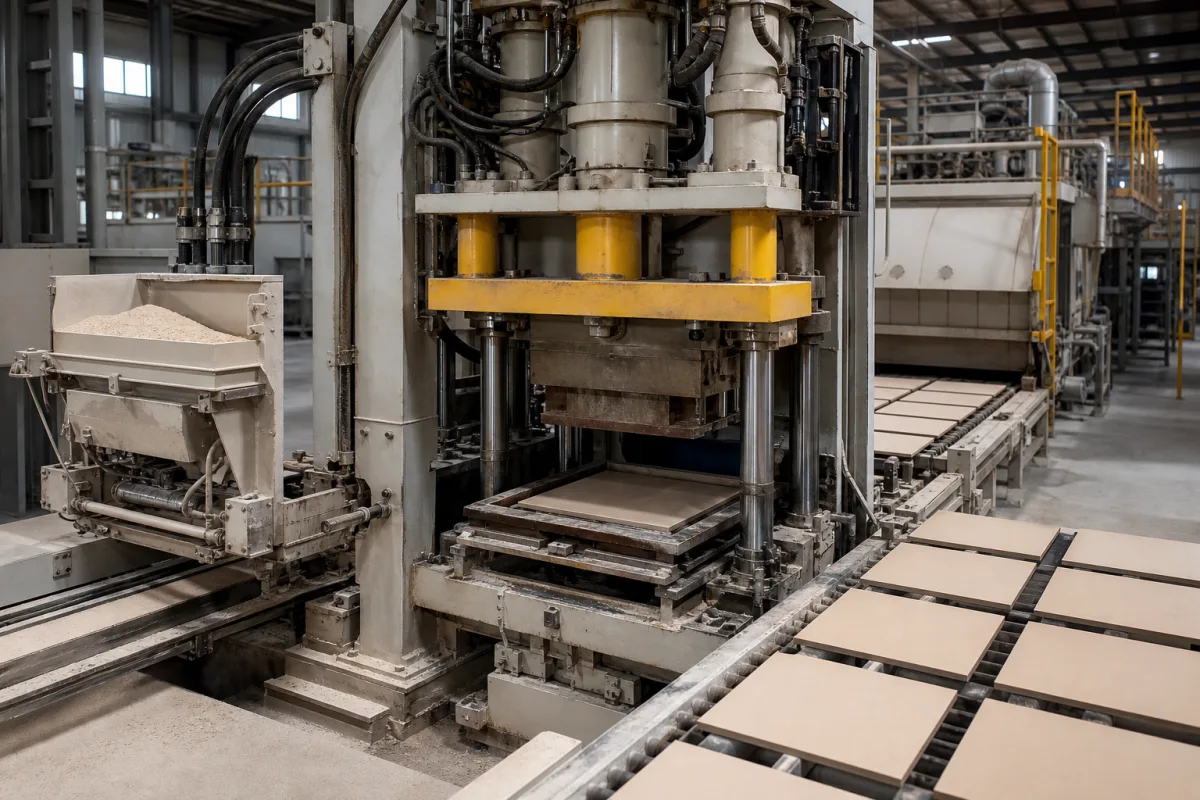
Hydraulic presses and press moulds for ceramic tiles and slabs · pressing force (t, kN), clearance between columns, specific pressure (kg/cm²), cycle rate (strokes per minute), mould type including isostatic punches, energy options
A ceramic tile press is a hydraulic forming machine that compacts spray-dried ceramic powder inside a mould to make green tiles, for firing. The press and its mould set (die box, liners, and upper and lower punches, rigid or isostatic) are bought together because the force, the clearance between columns and the mould format decide the tile sizes and the number of pieces each stroke produces. Ask three things first: the pressing force and gap needed for your largest format at your target specific pressure; the strokes per minute and cavities that give your output; and which mould type suits your body, thickness and finishing.
Hydraulic ceramic tile and slab presses with their moulds and mould accessories (die boxes, liners, punches, isostatic and floating-module systems, mould change carriages). Mouldless continuous compaction lines, refractory and insulator presses, roof-tile presses for steel sheet, spray dryers, kilns and individual press castings or rollers are outside this page except where compared.
CNFX editorial research · Sources checked October 11, 2026 · 5 sources
Size the pressing force, gap and specific pressure
SACMI's PH range of hydraulic tile presses lists eleven models: PH2090 at 2,000 ton force with a 1,750 mm gap, PH2890 at 2,750 ton and 1,750 mm, PH3020 at 3,000 ton and 2,250 mm, PH3590 at 3,500 ton and 1,750 mm, PH3800 at 3,800 ton and 2,450 mm, PH5000L, PH5000XL and PH5000XXL at 4,900 ton with 1,750, 2,250 and 2,450 mm gaps, PH6500 at 6,400 ton, PH8200 at 8,200 ton and PH10000 at 10,000 ton, the last three with a 2,450 mm gap. [1] SACMI's mould change carriages match this gap: the CE 45 handles moulds up to 1750x1000 mm and 4,500 kg for presses with 1,750 mm clearance between columns, and the CE 75N / 100 moulds up to 2450x1450 mm and 10,000 kg for 2,450 mm clearance. [2]
A SACMI patent (US6309206, priority 1997) describes the process: powder of 1% to 10% moisture is loaded into the mould, given a light first pressing, deaerated with pressing interrupted and the mould sometimes reopened, and then given the main pressing at about 400 kg/cm². It states that the largest presses then available had a capacity of 4,000 tonnes and pressed a surface of no more than 10,000 cm² per cycle, and proposes a partially isostatic punch that presses portions of the tile in turn to reach compaction pressures of up to 500 bar without a larger press. [4]
Editorial calculation: specific pressure = force ÷ pressed area, so 4,000 t over 10,000 cm² gives 400 kg/cm² (about 39 MPa, using 1 kgf = 9.81 N). At the same 400 kg/cm², a 10,000 ton PH10000 could press about 10,000,000 ÷ 400 = 25,000 cm² (2.5 m²) per stroke, and a 2,000 ton PH2090 about 5,000 cm² (0.5 m²), summed across all cavities. In kN, 2,000 t is about 19,600 kN and 10,000 t about 98,100 kN. Confirm the specific pressure your body needs before fixing the press size. [1][4]
Give the supplier the tile body and moisture, green and fired sizes and thickness, number of cavities, target specific pressure and green density, largest format and its mould dimensions, required strokes per minute and daily output, pressing programme (first pressing, deaeration, main pressing), mould type and punches, powder feeding and decoration, utilities, foundation and building limits, and acceptance trial conditions.
02
Match cycle rate, mould type and energy options
A Gruppo Concorde patent application (EP0858873, 1998) states that in a modern hydraulic press for average sizes the powder loading step takes about 50% of the pressing cycle: loading takes 1.5 to 3 seconds of a 4–5 second cycle, for 15 to 12 strokes per minute; its own machine aims at an active pressing time of about 3 seconds within a 5 second, 12-stroke cycle. It notes that double loading with a second carriage roughly halves press output. [5]
SACMI's mould catalogue describes four die types. Entering-punch moulds come face down for traditional formats or face up for large tiles that are later squared. Mirror or semi-entering moulds suit tiles of all sizes, including very thick ones, that need squaring, with progressive release of the pressing force on ejection. The SFS upper forming mould keeps the tile face up, forms chamfers in the press and is listed with no pressure limit. Isostatic back-side punches ("Laminasola" and "R2") have an inner membrane that SACMI says increases the compensation capacity of the isostatic punch, while floating modules let punch supports float on oil to even out density between cavities. [3][2]
SACMI's Energy Saving Pack fits an inverter to the main press motor and cites savings of up to 25% in electricity consumption against a conventional solution, headlined as 250,000 kWh per year per press. Its self-diagnostics kit is credited with a 66% average cut in repair time, and the SPE Plana ejector, for presses with a 2,450 mm gap, with an output increase of up to 60% depending on size. [2]
Editorial calculation: at 12 strokes per minute a press makes 720 strokes per hour; output in pieces per hour is that figure times the number of cavities, less stops for mould change and cleaning. Ask for stroke rates measured on your format, thickness and loading system. [5]
03
Force tables, stroke rates and reference lines to request from tile press makers
When requesting quotations, ask each press maker for the force and gap table, the stroke rate on your format, installed power and energy options, oil and cooling demand, mould types and their sizes, foundation loads, and reference lines making a similar product.
04
Frame, main cylinder, filler box, die liners and isostatic punches
Pressing force, column gap, specific pressure and strokes per minute for a tile press
Force and gap come as a pair in SACMI's PH table, while installed power and pieces per hour are not stated in the reviewed sources and have to be measured on your format. [1]
2 companies list this product among what they make. Company figures are quoted from each
company's own website; every card states where the relationship came from.
Foshan Henglitai Machinery Co.,Ltd.
Manufacturing site to be confirmed for the order
Its website has a product page for ceramic tile press.
Explore company information and manufacturing capabilities, then discuss the scope of your project with a relevant supplier.
Share this page
Compiled and source-reviewed by the CNFX editorial team.
Each manufacturer above links to the page on that company's own website where the product is listed, with the date we checked it. How we source and review
· Page last updated 13 October 2026
Buyer questions
What pressing force do tile presses have?
SACMI's PH range lists models from 2,000 to 10,000 ton force with 1,750 to 2,450 mm gap between columns. [1]
What specific pressure is used to press ceramic tiles?
A SACMI patent gives about 400 kg/cm² for the main pressing stage, after a light first pressing and deaeration. [4]
How fast does a tile press cycle?
A Gruppo Concorde patent cites a 4–5 second cycle, or 12–15 strokes per minute, for average sizes. [5]
Sources and what still needs a direct check
Sources checked 2026-10-11. Three sources come from SACMI, a press maker; two are patents describing tile pressing practice. Values for your press must come from the supplier's own data and trials.