Rolling elements · Silicon nitride density and stiffness, centrifugal load, contact stress, fatigue and material data
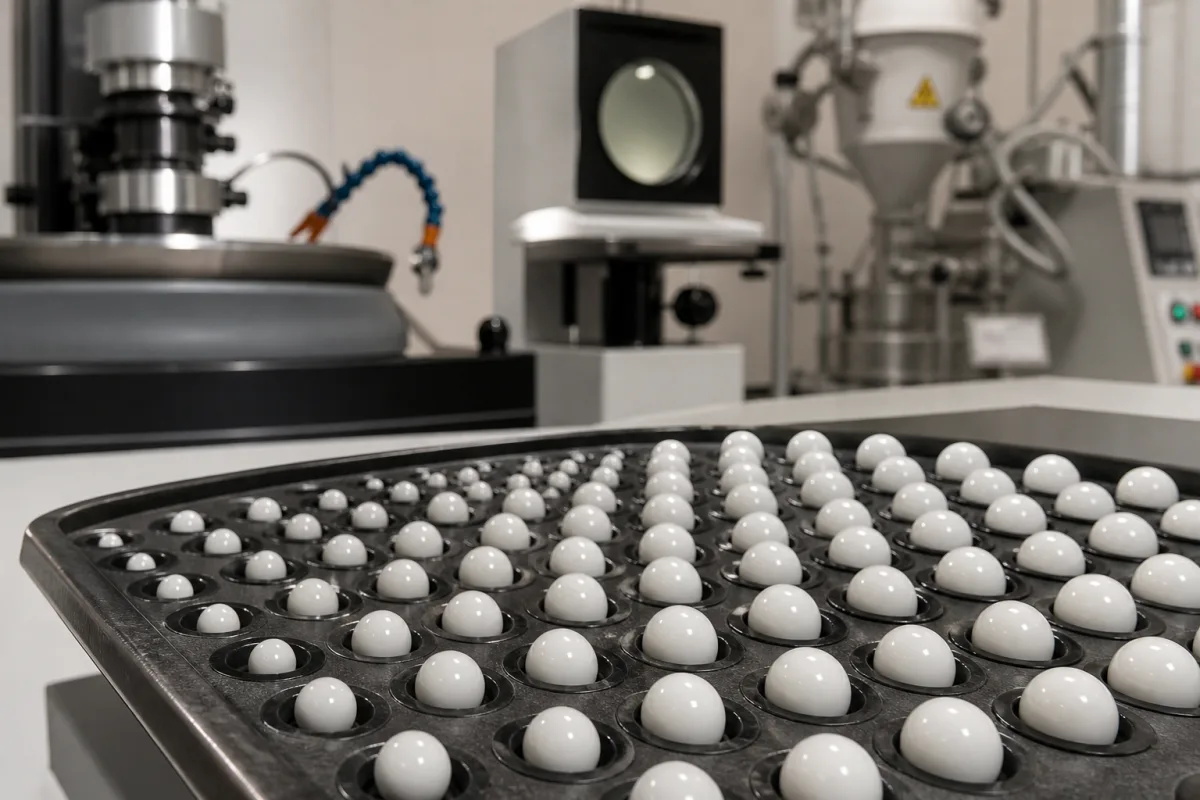
A ceramic bearing ball is a precision sphere of a technical ceramic such as silicon nitride, zirconia or alumina, used as the rolling element in hybrid or all-ceramic bearings. Ask three things first: the material and its grade of roundness and finish, the bearing and speed it will run in, and the material test data supplied with the batch.
Ceramic balls for rolling bearings: silicon nitride, zirconia and alumina balls in standard and custom sizes. Complete hybrid or ceramic bearings, ceramic valve and grinding balls, and plastic bearings are outside this page.
CNFX editorial research · Sources checked October 12, 2026 · 4 sources
NASA Technical Note D-7794 tested hot-pressed silicon nitride balls of 12.7 mm diameter in a five-ball rolling-contact tester and concluded that silicon nitride running against steel may give fatigue lives comparable to or greater than bearing steel on steel, with spalls similar in appearance to those on steel. The tested material had a bulk density of 3.11 to 3.24 g/cm³ and a modulus of elasticity about 1.5 times that of steel. [1]
Its analysis of 120 mm bore angular-contact bearings showed that replacing steel balls with silicon nitride balls of the same geometry cut centrifugal force by at least 50% but raised Hertz stress at the inner race because of the higher modulus, so bearing life did not improve at 2 to 4 million DN. Lower-mass balls are attractive for very high speeds, and ceramics keep strength and corrosion resistance over a wider temperature range than bearing steels. [1]
Editorial calculation: a 12.7 mm silicon nitride ball has a volume of about 1.07 cm³, so at 3.11–3.24 g/cm³ it weighs about 3.3–3.5 g. [1] Ask the bearing maker whether internal geometry is adjusted for ceramic balls rather than simply substituting them.
Give the supplier the material, ball diameter and tolerance, grade (sphericity and surface finish), quantity, bearing type and speed, operating temperature and media, inspection required (density, hardness, porosity, surface defects) and certificates.
02
Read a supplier material data sheet
Mascera's silicon nitride ball page lists 95% purity, density of at least 3.2 g/cm³, hardness 1,500 HV, Young's modulus 300 GPa, fracture toughness 6.2 MPa·m½, flexural strength over 720 MPa, compressive strength 2,200 MPa, thermal expansion 3.0–3.2 × 10⁻⁶/°C, maximum working temperature 1,200 °C and electrical resistivity over 10¹⁴ Ω·cm, with standard sizes from 1/16 inch (1.588 mm) to 1½ inch (38.1 mm). [2]
The data sheet labels hardness as HV with a unit of MPa, so confirm the hardness scale and test load. Its 1,200 °C figure is a material working temperature, not a bearing rating; ask the bearing maker for the bearing's limit. [2] The NASA work notes that earlier ceramic tests with alumina, silicon carbide and glass ceramic showed fatigue lives much lower than steel, so ask for evidence for the exact material and grade offered. [1]
03
Estimate hybrid bearing life with silicon nitride balls
NASA/TM-2005-213061 (Zaretsky, Vlcek and Hendricks) analyses bearings with silicon nitride rolling elements and steel races. It uses a Young's modulus of 310 GPa and Poisson's ratio of 0.29 for silicon nitride against 210 GPa and 0.30 for bearing steel; because the ceramic modulus is about 1.5 times that of the steel, a hybrid bearing under the same load runs at a higher Hertz contact stress than an all-steel bearing. [3]
The report cites a Hertz stress-life exponent for silicon nitride of 16 to 16.2 (average 16.1), against 9 to 12 for steel, and summarises tests of 45 mm bore hybrid angular-contact bearings with AISI M-50 races at inner-race maximum Hertz stresses of 1.95–2.44 GPa, where every failure was spalling of a silicon nitride ball and none was in the steel raceways. [3]
Editorial calculation: 310 / 210 ≈ 1.48, the modulus ratio behind the higher contact stress. Ask the bearing maker for the life calculation of the hybrid design at your load rather than applying all-steel catalogue ratings.
Bearing type (post-1960 steel races)
Life vs Lundberg-Palmgren calculation
Life vs equivalent all-steel bearing
Deep-groove ball
3.7×
58% lower
Angular-contact ball
3.2×
41% lower
Cylindrical roller
5.5×
28% lower
Give the bearing type, load and speed, and ask for the life calculation for the hybrid design and the ball grade and material class used.
04
Ask how the silicon nitride was sintered and how its fatigue life was tested
A 2026 study by the Harbin Institute of Technology and Sinoma Advanced Nitride Ceramics made G5 silicon nitride balls of 9.525 mm nominal diameter by cold isostatic pressing at 160 MPa, gas pressure sintering at 1,750 °C under 10 MPa nitrogen for 2 h, then hot isostatic pressing at 1,800 °C and 200 MPa for 4 h, followed by rough grinding, fine grinding and polishing. Only the Al₂O₃–Y₂O₃ sintering aid content changed between the three batches: 8, 10 and 12 wt%. [4]
The balls were tested ball-on-plate, dry, at 2,500 r/min under a 5.5 kN load, which the authors give as a maximum Hertzian contact stress of about 6.8 GPa; failure was defined as a spall at least 0.05 mm deep or 0.5 mm² in area, and five balls were tested per batch. All table values are from this study. [4]
Editorial calculation: the 10 wt% batch's characteristic life is about 1.36 times that of the 8 wt% batch (1.035 × 10⁷ / 7.629 × 10⁶). The 6.8 GPa test stress is roughly 2.8 to 3.5 times the 1.95–2.44 GPa inner-race stresses in the NASA hybrid bearing tests above, so these are accelerated material-screening results, not bearing life ratings. [4][3]
A low Weibull modulus means wide scatter between balls of one batch. When comparing offers, ask whether the balls are HIP-densified, what sintering aid system is used, and whether the maker can show rolling contact fatigue data with the test load, contact stress, failure criterion and number of balls tested. [4]
Sintering aid (Al₂O₃–Y₂O₃)
Mean β-Si₃N₄ grain aspect ratio
Characteristic RCF life η
Weibull modulus m
Failure mode reported
8 wt%
4.09 ± 0.52
7.629 × 10⁶ cycles
1.877
Spalling from residual pores
10 wt%
4.47 ± 0.48
1.035 × 10⁷ cycles
2.872
Slight wear, no early spalling
12 wt%
3.37 ± 0.41
8.240 × 10⁶ cycles
5.389
Wear of soft grain boundary phase
05
Black silicon nitride balls in inch and metric sizes, beside zirconia and alumina
Mascera lists black silicon nitride bearing balls in standard inch and metric sizes with a material data sheet; Wintrustek lists silicon nitride bearing balls alongside zirconia and alumina technical ceramics.
06
Material, density, modulus, size and grade, and finishing class
Density and modulus pull in opposite directions: in NASA's analysis the lower density of silicon nitride cut centrifugal force by at least half, while its higher modulus raised inner-race contact stress. [1]
NASA's test balls were finished to AFBMA grade 10. [1]
Grade, finish and inspection.
07
Diameter, grade, density, hardness scale and hybrid life basis for a ball order
Two rows need reading against the data sheet's own labels: Mascera gives hardness as HV with an MPa unit, so ask for the scale and test load, and its 1,200 °C is a material temperature rather than a bearing limit. [2]
2 companies list this product among what they make. Company figures are quoted from each
company's own website; every card states where the relationship came from.
XIAMEN MASCERA TECHNOLOGY CO.,LTD.
Manufacturing site to be confirmed for the order
Lists silicon nitride bearing balls in standard sizes with a material data sheet.
Explore company information and manufacturing capabilities, then discuss the scope of your project with a relevant supplier.
Share this page
Compiled and source-reviewed by the CNFX editorial team.
Each manufacturer above links to the page on that company's own website where the product is listed, with the date we checked it. How we source and review
· Page last updated 13 October 2026
Buyer questions
Do silicon nitride balls last longer than steel balls?
NASA tests found fatigue lives comparable to or greater than bearing steel, but a bearing of unchanged geometry did not gain life because the higher modulus raises contact stress. [1]
Why are ceramic balls used at high speed?
Their low density cuts centrifugal force; NASA's analysis found at least a 50% reduction for silicon nitride. [1]
Is the 1,200 °C rating the bearing temperature limit?
No. It is the ceramic material's working temperature on the data sheet, not a bearing rating; ask the bearing maker for the bearing's limit. [2]
Do silicon nitride balls make a bearing last longer?
NASA/TM-2005-213061 predicts hybrid bearings outlive their Lundberg-Palmgren calculation (3.7× for deep-groove) but have lower life than an all-steel bearing under the same load (58% lower for deep-groove), because the ceramic's higher modulus raises contact stress. [3]
Sources and what still needs a direct check
Sources checked 2026-10-12. NASA's Lewis Research Center published the fatigue tests and analysis. Mascera is a supplier listed on this page; its data sheet is used as an example, not a recommendation. A 2026 Harbin Institute of Technology and Sinoma study adds measured rolling contact fatigue lives for silicon nitride balls made with different sintering aid contents.