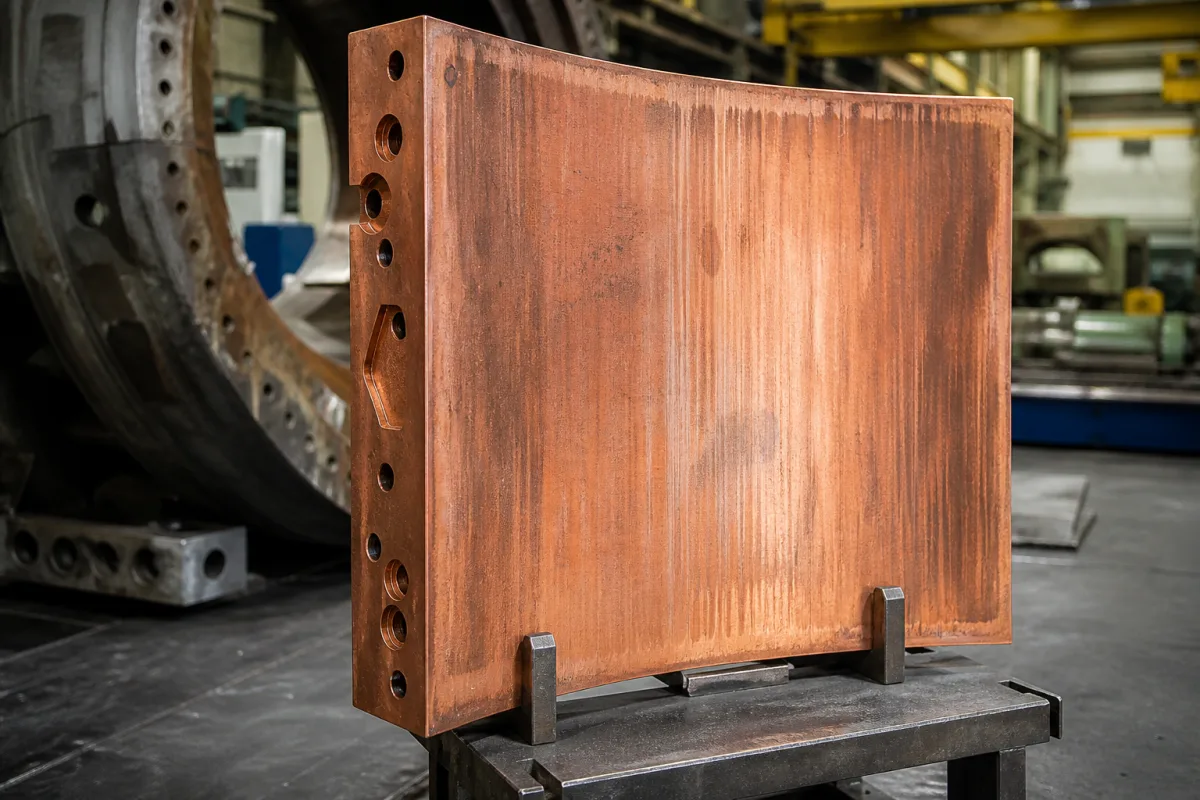
Copper and copper-alloy plates for slab and billet caster moulds · Wide and narrow face plates, water cooling, nickel, cobalt and chromium wear platings and their thickness limits, surface roughness and mould powder, and meniscus heat flow
A mould copper plate is the water-cooled copper wall of a continuous casting mould where the steel first solidifies; a slab mould is built from two wide-face and two narrow-face plates held in a steel structure that supplies cooling water. In both patents reviewed here the hot face carries a wear-resistant plating. Ask three things first: which mould and section the plates are for, what copper material and cooling design they use, and what plating system and thickness protect the hot face and how many casts or metres they are expected to last.
Copper and copper-alloy plates for continuous casting moulds, including wide-face and narrow-face plates for slab moulds, their water channels, hot-face platings and refurbishment by machining and replating. Mould powder, oscillators and complete casters are outside this page.
CNFX editorial research · Sources checked October 11, 2026 · 4 sources
Set the plate material, plating system and thickness
US patent 4,538,667 (Molds for continuously casting steel) describes the slab mould as a pair of opposed wide plates defining slab thickness and a pair of opposed narrow plates defining slab width, conventionally made of copper or copper alloy for high thermal conductivity and protected by a plating on the inner surface. A vitreous mould powder placed between the coated surface and the molten steel melts and acts as a lubricant. The patent attributes short mould life to damage where the poured steel contacts the coating and to breakouts from steel droplets adhering to it. [1]
Its plates have a deliberately rough base surface, about 20 to 200S (preferably 50 to 150S) by JIS B0601, produced for example by shot blasting or machining, covered with a nickel, cobalt or nickel-cobalt plating and a chromium topcoat. It explains that very smooth surfaces let the lubricant shift, leaving dry areas that abrade and cause breakouts and excess powder that thins the shell and causes corner cracks, while a rough surface holds the powder in its valleys and moderates stress between layers. [1]
The preferred nickel and/or cobalt layer is about 195 to 2950 µm and the chromium about 5 to 50 µm, a total of about 200 to 3000 µm. Above 2950 µm the patent reports cracks at the meniscus level, sometimes running into the copper; below 195 µm the layer wears through, exposing copper at the lower part early; chromium over 50 µm “tends to produce cracks locally”, and under 5 µm adheres poorly. [1]
Editorial calculation: a 1,000 µm nickel layer under a 20 µm chromium topcoat gives about 1.02 mm total, inside the patent's preferred 310–1,020 µm combination; ask for plating thickness maps for both faces. [1]
Laser cladding is a newer alternative to electroplating for the hot face. A 2026 open-access paper by You and co-authors at Central South University (Materials 19, 2781), which names Cu-Cr-Zr as a preferred material for the water-cooled inner wall of continuous casting crystallizers, built a two-layer Cu-Ni-W-Si gradient coating on a CuCrZr substrate by coaxial powder-feed laser cladding. Its optimised settings were 4,500 W laser power at 30 mm/s for the Cu-Ni-10(W,Si) bottom layer and 5,000 W at 60 mm/s for the Cu-Ni-20(W,Si) top layer, with a 2 mm scanning step. The finished coating reached 417 HV, which the authors give as 5.8 times the substrate hardness, and a room-temperature wear rate of 3.52 × 10⁻⁴ mm³/N·m, 49.1% of the substrate's; in the orthogonal trials, average surface hardness ranged from 165.1 to 286.5 HV and the highest-energy setting produced fine surface cracks, which the authors relate to thermal stress from the substrate's high conductivity. [4]
Editorial calculation: 417 HV ÷ 5.8 ≈ 72 HV for the CuCrZr substrate as tested. These are coupon results at room temperature; ask a supplier offering clad plates for coating thickness, bond and crack inspection results, and hot-wear or service data before treating cladding as equivalent to a Ni/Cr plating system. [4]
Give the supplier the caster type and mould section (slab width and thickness or billet size), plate drawings or the mould maker's design, copper or copper-alloy grade and its properties, water slot or channel design and cooling water data, hot-face plating system and thickness by zone, surface roughness, thermocouple holes if fitted, expected life and refurbishment allowance (minimum thickness after remachining), and inspection reports required.
02
Manage heat removal at the meniscus
US patent 5,899,259 (Molds for a continuous casting system) states that mould bodies are today made almost exclusively of copper or copper alloy, that the steel jacket positions the mould body and provides the cooling water circulation, and that the mould body is plated inside with a wear-resistant material such as nickel or chromium. Besides shaping the strand, the mould must form a sufficiently thick, strong and defect-free shell by continuous heat removal. [2]
To reduce heat removal at the meniscus, that patent plates the outside (water side) of the mould body at meniscus height with a material of lower thermal conductivity, such as nickel, applied electrically or by thermal spraying; it states nickel conducts heat more than four times less than copper and that the plating thickness and length are matched to casting and plant parameters. It says the higher meniscus temperatures improve surface and structure quality, and plating only some faces, for example the wide plates of adjustable moulds, can even out heat transfer around the strand. [2]
Editorial note: ask the supplier whether the plate's heat flow at the meniscus has been designed for your steel grades and casting speed, and how plating on the water side, if any, is inspected.
03
Choose the copper alloy for strength against conductivity
US patent 12,129,538 (Cunova GmbH; German priority 14 September 2018, granted 29 October 2024) states that continuous casting moulds are made from high-strength copper-chromium-zirconium (CuCrZr) or ductile copper-silver (CuAg), and that each fails differently: for CuCrZr it names “incipient crack formation due to the prevailing combination of thermal and mechanical fatigue” in the bath-surface (meniscus) region as a cause of failure, while softer CuAg does not crack but deforms permanently, known as bulging, when thermal-expansion stresses exceed its yield point. [3]
The patent's alternative is a low-alloy CuZrAg with 0.020–0.50% silver, 0.050–0.50% zirconium, not more than 0.060% phosphorus and not more than 0.005% chromium (kept low because chromium precipitates as brittle secondary phases). It reports a softening temperature of 530 °C measured to DIN ISO 5182, hardness values in the region of 110 HBW, conductivity of up to 95% IACS (50–54 MS/m, up to 370 W/m·K) and, for one alloy with 0.130% Zr, 0.1% Ag and 0.0045% P, a measured 97 HBW 2.5/62.5 and 53.7 MS/m. [3]
Its claimed route is hot forming at 600–1,000 °C, quenching at 50–2,000 K/min, cold forming by 10–50% and hardening at 350–500 °C. The patent places the conductivity above that of CuCrZr and near CuAg, and the softening resistance of over 500 °C near CuCrZr. [3] Editorial note: whichever alloy is offered, ask the supplier for the alloy designation, certified composition, hardness, conductivity and softening temperature on the delivered plate, and how the alloy choice suits your casting speed and the crack or bulging history of your current plates.
04
Wide and narrow faces, copper body, water side and platings
US 4,538,667 builds the hot-face protection as a nickel and/or cobalt base of about 195–2950 µm under a 5–50 µm chromium topcoat. [1]
Copper grade, hardness, softening temperature and channel layout of a mould plate
Published values here are few: 97–110 HBW and a 530 °C softening temperature for one CuZrAg alloy, and a 20–200S base roughness in one patent. Plate thickness, channel size and pitch come from your mould drawing. [3][1]
Field
What it means and published values
Ask the supplier for
Plate Thickness (mm)
Copper between hot face and water.
New and minimum.
Cooling Channel Diameter (mm)
Bore or slot size.
Design.
Copper Alloy Hardness (HB)
Wear and softening resistance; e.g. 97–110 HBW for one CuZrAg alloy. [3]
Value hot and cold.
Maximum Operating Temperature (°C)
Hot-face limit; softening temperature 530 °C (DIN ISO 5182) for one CuZrAg alloy. [3]
1 company lists this product among what they make. Company figures are quoted from each
company's own website; every card states where the relationship came from.
Explore company information and manufacturing capabilities, then discuss the scope of your project with a relevant supplier.
Share this page
Compiled and source-reviewed by the CNFX editorial team.
Each manufacturer above links to the page on that company's own website where the product is listed, with the date we checked it. How we source and review
· Page last updated 13 October 2026
Buyer questions
What plating protects a mould copper plate?
US 4,538,667 uses a nickel, cobalt or nickel-cobalt layer of about 195–2950 µm under a 5–50 µm chromium topcoat. [1]
Why not plate the mould copper thicker?
The same patent reports nickel/cobalt over 2950 µm cracks at the meniscus level, sometimes into the copper. [1]
Why plate the water side of a mould?
US 5,899,259 uses lower-conductivity nickel on the outside at meniscus height to reduce heat removal there and improve strand surface. [2]
Why do CuCrZr and CuAg mould plates fail differently?
US 12,129,538 names crack initiation from combined thermal and mechanical fatigue at the meniscus as a failure cause for high-strength CuCrZr, while ductile CuAg deforms permanently (bulging). [3]
Can mould copper plates be laser clad instead of plated?
Laboratory work says it is possible: a Cu-Ni-W-Si gradient coating laser clad on CuCrZr reached 417 HV and about half the substrate's wear rate (3.52 × 10⁻⁴ mm³/N·m) in Central South University tests, but service data must come from the supplier. [4]
Sources and what still needs a direct check
Sources checked 2026-10-11. Three sources are US patents describing mould designs, plating systems and a mould-plate copper alloy in their own terms; the thickness ranges and alloy properties are the patents' preferred or measured values, not standards. The Materials paper from Central South University reports laboratory results for a laser-clad coating on CuCrZr, not service data from a caster.