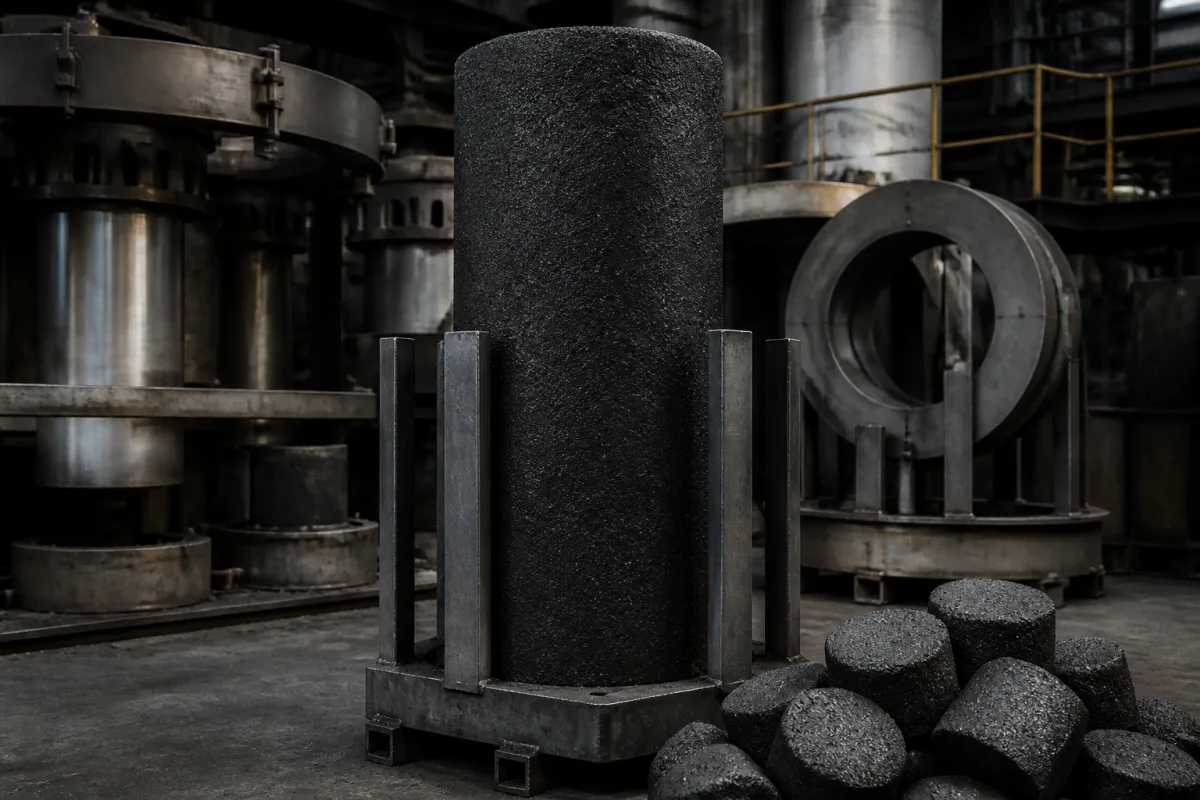
Söderberg (self-baking) electrode paste in cylinders, blocks and briquettes for submerged arc furnaces · ash, volatile matter, resistivity (μΩ·m), compressive strength, bulk density, plasticity and elongation, baking behaviour, cylinder size
Electrode paste is the carbon mix — calcined anthracite, sometimes with other carbon materials, bound with coal-tar pitch — that is charged into the steel casing of a self-baking Söderberg electrode, where furnace heat and current bake it into a solid carbon electrode during smelting of ferroalloys, silicon, pig iron, calcium carbide and platinum matte. It is cast into cylinders (the "electrode paste column"), blocks or briquettes. Ask three things first: which form and plasticity suit your casing and charging; which ash, volatile matter and baked resistivity, strength and density limits apply, and by which test methods; and what the supplier's test values are for each lot.
Söderberg (self-baking) electrode paste for submerged arc and other electric smelting furnaces, in cylinders, blocks, briquettes and egg or trapezoid shapes, including grades to the Chinese standard YB/T 5215. Prebaked carbon and graphite electrodes, cold ramming paste, carbon lining blocks, electrode casings and holders, and aluminium anode paste are outside this page except where compared.
CNFX editorial research · Sources checked October 11, 2026 · 5 sources
Choose the paste form and match its baking behaviour
Elkem describes Söderberg electrode paste as a carbon material made in cylinders or briquettes, and offers its ELSEP paste as cylinders in a range of diameters, rectangular blocks and briquettes, with formulations for slag-forming processes (pig iron, ferrochrome, manganese alloys, ferronickel, platinum matte), slag-free processes (ferrosilicon, silicon, calcium carbide) and high-purity ferrosilicon. The paste is filled into a vertical cylindrical steel casing, which Elkem gives as 1,200–2,000 mm in diameter. Above 500 °C the binder cokes and the paste bakes into a solid carbon electrode, reaching full strength at approximately 900 °C; the electrode is consumed at the tip and slipped down, with new paste added at the top. [1]
A North-West University dissertation on Söderberg paste raw materials states that calcined anthracite is crushed and screened to sizes from under 1 mm to approximately 15 mm, mixed with tar-pitch binder and cast into moulds, and that paste cylinders of 0.4 m to 1 m diameter are the main product, with briquettes and blocks also made. It defines plasticity as the percentage increase in diameter of a small paste cylinder heated under standardised conditions: a binder content of 30–40% gives a high-plasticity paste that flows easily, while 15–25% gives a dry, low-plasticity paste. It cites the paste softening and filling the casing at about 50 to 100 °C and a baking zone of about 400 to 500 °C, and warns that a baking zone that drops below the contact clamps can cause a soft (green) break. [2]
Rongxing, a Chinese paste maker, recommends cylindrical paste because it transfers its full weight to the bottom of the casing, unlike small blocks or egg-shaped paste, giving higher density and strength after baking and avoiding paste hanging in DC furnaces. It lists egg briquettes of 13 × 8 × 5 cm and trapezoid briquettes 7.5 cm high weighing 0.7 kg, with cylinders made to order. [4][3]
Editorial calculation: one metre of baked electrode in a 1,200 mm casing holds π × 0.6² ≈ 1.13 m³ of carbon, or about 1.63–1.74 t at a baked apparent density of 1.44–1.54 kg/dm³; in a 2,000 mm casing, π × 1.0² ≈ 3.14 m³, or about 4.52–4.84 t per metre. Use your slipping rate and density data to size paste stock and deliveries. [1][3]
Give the supplier the furnace type and product (alloy), AC or DC, open or closed furnace, electrode diameter and casing design, current and slipping rate, paste form and cylinder diameter, charging method, plasticity range, the paste and baked-property limits with test methods, packaging, climate during transport and storage, and monthly quantity.
02
Set limits for ash, volatile matter and baked properties
Rongxing's electrode paste page lists ash content of 2–10%, electrical resistivity of <55–90 uΩm, volatile matter of 10.0–15.0, density above 1.46 g/cm³, compressive strength above 18 MPa and ductility of 6–20, made from electrically calcined coal, calcined coke, graphite scraps, asphalt and coal tar. [3]
The same page reproduces a customer specification with Rongxing's test values for cylinders and briquettes: green apparent density 1.572–1.666 kg/dm³ (ISO 12985-1); baking loss 10–12% and baking shrinkage 3.9–6.5%; after baking at 1000 °C, apparent density 1.44–1.54 kg/dm³, total porosity 18.4–23.1%, specific electrical resistance 58–72 μΩm (ISO 11713), flexural strength 4–8 MPa (ISO 12986-1), compressive strength 18–35 MPa (ISO 18515), coefficient of thermal expansion 3–4 × 10⁻⁶/K (ISO 14420), thermal conductivity 3–6 W/mK (ISO 12987), real density 1.84–2.04 kg/dm³ (ISO 9088) and ash 0–5% (ISO 8005). Rongxing reports 66 and 68 μΩm, 20.0 and 25 MPa, 1.53 and 1.56 kg/dm³ and 2.1 and 2.3% ash for its two forms. [3]
Rongxing notes that lower resistance can cost strength, that volatile matter that is too high can cause under-baking and too low over-baking, and that parameters must be matched to furnace conditions. [4] The Roos dissertation adds that producers measure similar paste properties by differing methods, so a specification should name the test method for each value. [2]
In China, YB/T 5215-2015 Electrode paste, issued 2015-07-14 and effective 2016-01-01, replaces YB/T 5215-1996 and covers classification, technical requirements, test methods, inspection, packaging, labelling, storage, transport and quality certificates for Söderberg paste used in closed, semi-closed and open submerged arc furnaces; its grade limits were not available in the reviewed summary. [5]
03
Data sheets, lot certificates and furnace references from paste makers
When requesting quotations, ask each paste maker for its grade data sheet with test methods, lot test certificates, paste form and cylinder sizes, raw-material sources (calcined anthracite, pitch), plasticity results, packaging and storage advice, and references on furnaces of your type.
Explore company information and manufacturing capabilities, then discuss the scope of your project with a relevant supplier.
Share this page
Compiled and source-reviewed by the CNFX editorial team.
Each manufacturer above links to the page on that company's own website where the product is listed, with the date we checked it. How we source and review
· Page last updated 13 October 2026
Buyer questions
What is Söderberg electrode paste made of?
Elkem describes electrically calcined anthracite, optionally with other carbon materials, bound with coal-tar pitch and supplied as cylinders, blocks or briquettes. [1]
At what temperature does electrode paste bake?
Elkem states the binder cokes above 500 °C and the electrode reaches full strength at approximately 900 °C. [1]
What resistivity and strength should baked paste have?
One customer specification on a maker's data sheet sets 58–72 μΩm (ISO 11713) and 18–35 MPa compressive strength (ISO 18515) after baking at 1000 °C. [3]
Sources and what still needs a direct check
Sources checked 2026-10-11. Elkem and Rongxing are paste makers describing their own products; the dissertation is an open university thesis; the standard entry is a catalogue summary. Values for your paste must come from the supplier's lot tests.