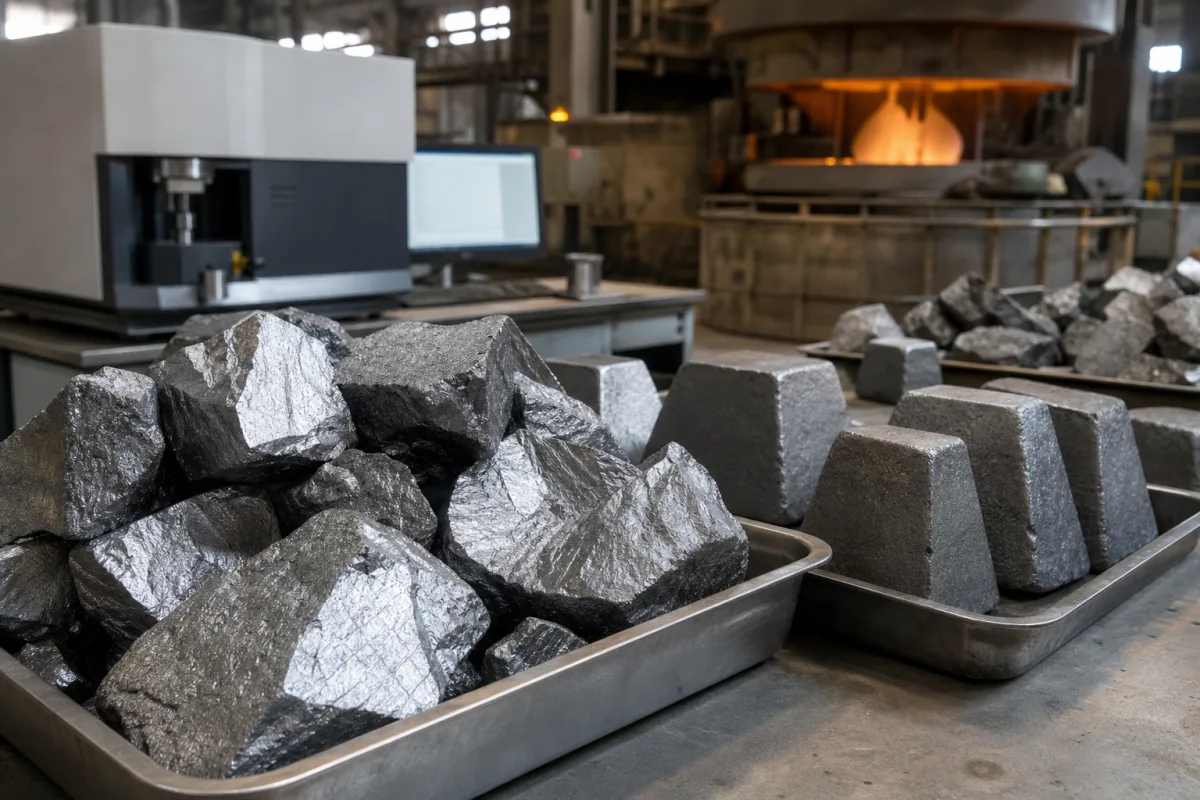
Ferromanganese (high-carbon, medium-carbon and low-carbon)
Ferromanganese for steelmaking · Standard, medium- and low-carbon grades, impurity and residual limits, size and friability, and the carbon thresholds used in customs classification
Ferromanganese is an iron–manganese alloy added to molten steel to raise manganese content and to deoxidise it. It is sold by carbon class — standard (high-carbon), medium-carbon and low-carbon. Fix three things before ordering: the carbon class and grade with the specification it is ordered to, the impurity and residual limits your steel can accept, and the size range, fines and friability your addition system needs.
Ferromanganese in standard (high-carbon), medium-carbon, low-carbon and nitrided grades for steelmaking and foundry additions. Silicomanganese, electrolytic manganese metal, manganese ore and manganese master alloys for aluminium are outside this page.
CNFX editorial research · Sources checked October 11, 2026 · 4 sources
ASTM A99, Standard Specification for Ferromanganese, covers ten grades: standard ferromanganese Grades A, B and C; medium-carbon ferromanganese Grades A, B, C and D and a nitrided grade; and low-carbon ferromanganese Grades A and B. Each grade must meet its limits for manganese, carbon, silicon, phosphorus, sulfur and nitrogen, and all grades must meet limits for arsenic, tin, lead and chromium. Inch-pound values are the standard. [1]
Eramet, a manganese alloy producer, says steel accounts for 90% of manganese consumption and that manganese is added to steel as ferromanganese or silicomanganese, raising strength and wear resistance and acting as a deoxidiser. It describes its plants as producing refined ferromanganese and silicomanganese. [3]
Editorial note: name the specification and grade (for example ASTM A99 medium-carbon Grade B, or the equivalent national grade) rather than a generic carbon range, so that the residual-element limits travel with the order. [1]
Give the supplier the specification and grade, manganese and carbon ranges, maximum silicon, phosphorus, sulfur, nitrogen and residuals (arsenic, tin, lead, chromium), size range and allowable fines and oversize, friability expectation, packing (big bags, drums, bulk), lot size, sampling and analysis method, and certificate requirements.
02
Set impurities, size, friability and trade paperwork
ASTM A99 requires the material to be supplied in standard sizes with stated tolerances and friability ratings. [1] The US tariff lines quoted in the USGS 2025 manganese summary classify ferromanganese by carbon: more than 4% carbon (7202.11.5000, 1.5% ad valorem), more than 2% but less than 4% (7202.11.1000, 1.4%), more than 1% but less than 2% (7202.19.5000, 1.4%) and 1% or less (7202.19.1000, 2.3%). [2]
USGS reports US ferromanganese imports for consumption of 223,000 to 330,000 t a year from 2020 to 2024 (310,000 t estimated for 2024) and reported consumption of 300,000 to 339,000 t, with net import reliance of 100% of apparent manganese consumption. Import sources for ferromanganese in 2020–23 were Malaysia 24%, Australia 16%, Norway 15%, South Africa 14% and others 31%. [2]
Editorial note: because the tariff line changes at 1%, 2% and 4% carbon, ask the supplier to state carbon on the certificate to the precision customs will need for your shipment. [2]
03
Ferromanganese producers on the listed pages: certificate, size analysis and sampling
Ask any supplier for the grade certificate with full chemistry, size analysis and the sampling method used. [1]
04
Check the Indian Standard IS 1171 limits when a lot is offered to it
IS 1171:2011, the Bureau of Indian Standards specification for ferromanganese, defines the alloy as 65–95% manganese by mass and sets carbon classes at up to 0.5% (low carbon), 0.5–2.0% (medium carbon) and 6.0–8.0% (high carbon). Its clause 4 says the standard covers 13 grades "as specified in Table 1", but Table 1 lists 11 (five high-carbon, three medium-carbon and three low-carbon), the 11 shown in the table below [4]. It lists what the buyer must state when ordering: quantity, constitution of consignment, material name, grade, size range, and analysis-report and packing requirements. [4]
Size is ordered by class, from 100–315 mm down to material up to 3.15 mm; for size classes 1, 2 and 3 the −3 mm fraction shall not exceed 5%, and no piece may exceed 1.15 × the upper size limit in two or three directions. In a graded lot, the manganese content of the melts may not differ by more than 3% absolute. [4]
Editorial comparison: clause 3.1.2 defines medium carbon as 0.5–2.0% C, but the Table 1 medium-carbon grades allow 1.0–3.0% C [4]. A lot between 2% and 3% carbon would sit in the US tariff line for more than 2% but less than 4% carbon [2]. Order by grade designation and write the maximum carbon into the contract.
Manganese, carbon, silicon, phosphorus, sulfur and size for a ferromanganese order
Chemistry rows refer to the A99 grade limits or the IS 1171 table above; density, melting range, bulk density and moisture are not given in the reviewed sources and must come from the producer. [1][4]
2 companies list this product among what they make. Company figures are quoted from each
company's own website; every card states where the relationship came from.
HSferralloy
Manufacturing site to be confirmed for the order
Lists high-, medium- and low-carbon ferromanganese grades (for example FeMn80C0.4 and FeMn78C1.5); its about page describes its own blast furnace and ore furnaces.
Explore company information and manufacturing capabilities, then discuss the scope of your project with a relevant supplier.
Share this page
Compiled and source-reviewed by the CNFX editorial team.
Each manufacturer above links to the page on that company's own website where the product is listed, with the date we checked it. How we source and review
· Page last updated 13 October 2026
Buyer questions
What grades of ferromanganese does ASTM A99 cover?
Standard A–C, medium-carbon A–D plus nitrided, and low-carbon A and B — ten grades in all. [1]
What is ferromanganese used for?
Eramet says it adds manganese to steel for strength and wear resistance and acts as a deoxidiser. [3]
How is ferromanganese classified for US import?
USGS lists HTS lines split at 1%, 2% and 4% carbon (7202.11 and 7202.19). [2]
Where does the US import ferromanganese from?
USGS lists Malaysia 24%, Australia 16%, Norway 15% and South Africa 14% for 2020–23. [2]
How does the Indian standard classify ferromanganese?
The Bureau of Indian Standards' IS 1171:2011 says in clause 4 that it covers 13 grades, though its Table 1 lists 11; it covers 65–95% manganese, in low-carbon (up to 0.5% C), medium-carbon and high-carbon (6.0–8.0% C) classes. [4]
Sources and what still needs a direct check
Sources checked 2026-10-11. ASTM A99 sets ferromanganese grades; the USGS 2025 manganese summary gives trade data and tariff lines; Eramet describes uses.