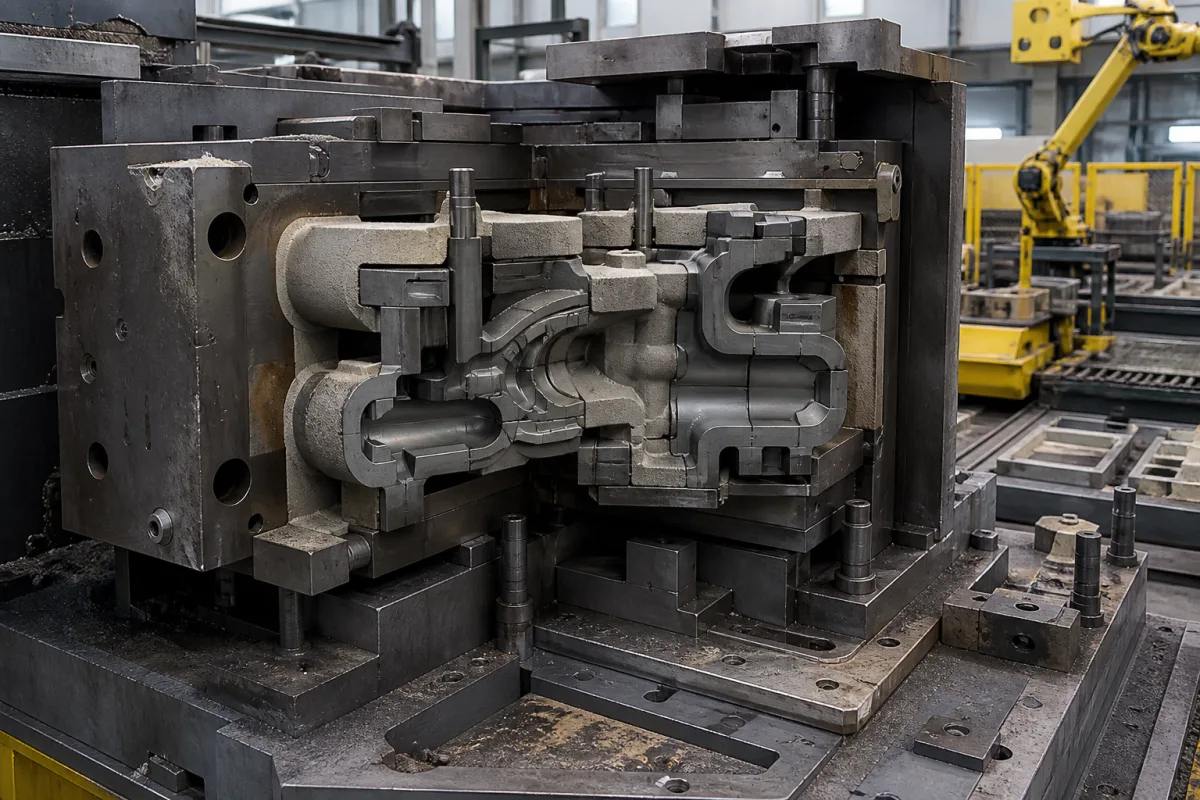
Metal casting mould core: bonded sand cores for internal cavities
Bonded sand cores for metal casting · binder process and core-box settings, strength versus collapsibility, gas release through the core print
A metal casting mould core is a shaped body of foundry sand held together by a binder, placed in the mould to form internal cavities, channels and undercuts in the casting, then broken up and removed after the metal solidifies. Ask three things first: which binder process the core is made by and at what core-box settings, how strong it must be against how easily it must come out of the casting, and how the gas it releases during pouring will escape.
Expendable sand cores bonded with organic or inorganic binders (resin-coated sand, warm-box and hot-box furan, cold-cured furan, geopolymer and similar) and 3D-printed sand cores, used to form internal cavities in metal castings. Ejector pins and other steel mould components are covered on the Mould ejector pin page. Steel core pins and mould inserts for die casting or injection moulds, core-making machines, binders sold as chemicals and finished castings are outside this page.
CNFX editorial research · Sources checked October 12, 2026 · 3 sources
Trade core strength against knock-out after casting
Obzina and co-authors at VŠB – Technical University of Ostrava cast AlSi7Mg0.3 at 720 °C around four core systems and counted the knocks needed to remove each core. Transverse (three-point bending) strength ranged from 0.92 MPa for 3D-printed furan cores to 7.36 MPa for geopolymer (GEOPOL) cores, and knock-out went the same way: about 6 knocks for the printed furan cores and about 46 for the geopolymer cores. [1]
Conventional furan cores reached 3.45 and 2.67 MPa with two sand grades and showed excellent collapsibility; resin-coated sand (RCS) cores reached 4.47 MPa, gave the smoothest cast surfaces and sat between furan and geopolymer for knock-out. The authors report a correlation: as transverse strength rises, so does the number of knocks needed to remove the core. [1] The printed furan cores, at the lowest strength, gave the roughest cast surfaces, which the authors attribute to erosion by the liquid alloy. [1]
Budavári and co-authors at the University of Miskolc found the same tension in warm-box cores: more acid hardener gave better thermal stability early in heating but lower residual bending strength after 15 minutes of thermal loading at 400 °C, which helps knock-out. [2] Editorial note: specify the strength the core needs for handling and metal pressure, then ask the core maker for a knock-out or residual-strength result on your casting, not the strength alone.
Give the core maker the casting alloy and pouring temperature, core drawing or 3D model, core weight and wall thickness of the casting around it, required handling strength, surface finish of the cored passage, venting route and core-print design, permitted binder systems (organic or inorganic), coating, quantity and delivery packaging.
02
Vent the gas the core releases through its core print
A 2023 study in Materials poured grey iron at 1360 °C around 3D-printed furan sand cores whose only exit was the core print. Gas generation was highest in the first 60 s, with a peak pressure of 1.09 kPa at the print, and gas release lasted 10 minutes. [3]
A core with a blind core print peaked at an exhaust speed of 1.10 m/s and held about 1 m/s for 500 s, while a hollow core peaked at 1.89 m/s and then slowed. The authors warn that gas pores can form early in casting from this eruption of gas, and that burnt core sand cut off from air produced 30.7% more gas than sand burnt with air, so open-air gas evolution tests understate what a core releases inside a casting. [3] The same paper cites earlier tube-furnace measurements of 10–15 mL of gas per gram of resin sand at 700–850 °C. [3]
Editorial note: ask how the core is vented through its print, whether hollow sections or vent channels are included, and what gas evolution test the core maker runs and in what atmosphere.
03
Compare binder processes by published core-making settings
These are settings reported for laboratory and test cores, not recommendations for a production core.
Transverse strength, knock-out, pour temperature and permeability for a sand core
The reviewed papers measure strength in bending and collapsibility in knocks, not the tensile or hardness values a generic spec sheet asks for; permeability, density and thermal expansion are not stated and need the core maker's own data.
Field
What it means and published values
Ask the supplier for
Core Length (mm)
Overall core size; test cores of 120 mm cube in the gas study. [3]
Drawing dimensions and tolerance.
Core Diameter (mm)
For round passages.
Diameter and tolerance.
Surface Finish (Ra)
RCS gave the smoothest cast surfaces in the Ostrava tests. [1]
Expected cast roughness in the passage.
Thermal Expansion Coefficient (10^-6/°C)
Not stated in the reviewed sources.
Sand type and expansion data.
Maximum Operating Temperature (°C)
Test pours at 720 °C (aluminium) and 1360 °C (iron). [1][3]
Explore company information and manufacturing capabilities, then discuss the scope of your project with a relevant supplier.
Share this page
Compiled and source-reviewed by the CNFX editorial team.
Each manufacturer above links to the page on that company's own website where the product is listed, with the date we checked it. How we source and review
· Page last updated 13 October 2026
Buyer questions
Why is a stronger sand core not always better?
In the Ostrava tests, knock-out effort rose with transverse strength: about 46 knocks for 7.36 MPa geopolymer cores against about 6 for 0.92 MPa printed furan cores. [1]
How long does a sand core release gas during casting?
In a grey iron test with 3D-printed furan cores, gas release lasted 10 minutes, with the highest generation in the first 60 s and a peak pressure of 1.09 kPa. [3]
Do sand cores lose strength in storage?
Warm-box test bars stored for 7 days lost less than 15% of the bending strength measured after 5 hours, in the Miskolc study. [2]
Sources and what still needs a direct check
Sources checked 2026-10-12. Two peer-reviewed open-access papers from Archives of Foundry Engineering (VŠB – Technical University of Ostrava; University of Miskolc) and one from Materials (MDPI). Values come from laboratory and test castings.