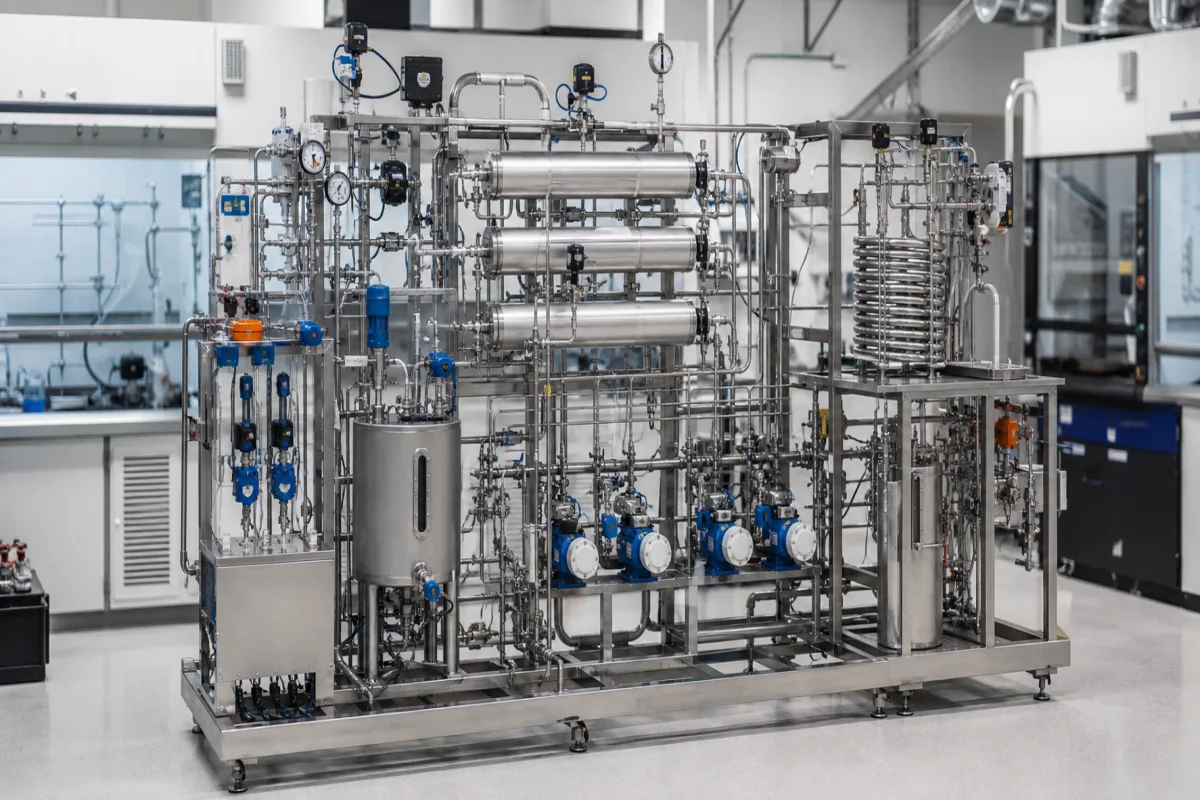
Continuous flow chemical synthesis system for fine chemicals and agrochemical intermediates: scaling silicon carbide reactor skids from 20 mL/min to 6.7 L/min
Production skids for fine and specialty chemicals and agrochemical intermediates · the jump from millilitre lab reactors to multi-tonne silicon carbide modules, how wall material sets channel size, and why mixing is fixed before residence time on fast exothermic steps
A continuous flow chemical synthesis system is the whole production unit around a flow reactor: feed pumps, mixers, reactor plates or coils, thermostat loop, quench point and controls, built on one frame for a fine-chemical, specialty-chemical or crop-protection intermediate plant. The buying questions here are not pharmaceutical validation questions. They are how far the reactor family scales in flow and hold-up volume, what wall material the production reactor uses and what that does to channel size and heat removal, and whether mixing has been proven at the flow rate the plant will run.
Integrated continuous flow synthesis skids for fine chemicals, specialty chemicals and agrochemical intermediates, from pilot to multi-tonne production, with ceramic (silicon carbide), glass or stainless-steel coil reactors, mixers, thermal control and quench. Continuous plug-flow and microchannel reactors for drug substance (API) synthesis under ICH Q13 are covered on the Continuous flow reactor for pharmaceutical synthesis page; metering pump feed skids on the Reagent feed system (metering pump skid) for continuous chemical reactors page; in-line membrane and gravity separators on the Separation unit for continuous flow processes page; multi-pump centrifugal skids for utility and fire water on the Pumping system page; fermentation and cell-culture vessels on the Industrial bioreactors page.
CNFX editorial research · Sources checked October 12, 2026 · 4 sources
Protrix at 0.2–20 mL/min against Plantrix MR555 at 80–6667 mL/min: one reactor family across a 333-fold flow range
Chemtrix builds both ends of the range in diffusion-bonded 3M SiC with SiC, PTFE and FFKM as wetted materials. Its Protrix reactor, for process development and small-scale production, runs at 0.2–20 mL/min (up to 1.2 kg/h) with 1 to 13.5 mL of reactor volume in a 350 × 200 × 250 mm body. [2] The Plantrix MR555, for pilot and full-scale production at multi-tonne scale, runs at 80–6667 mL/min (up to 400 kg/h) with 100 up to 4000 mL of reactor volume, in a 346 × 823 × 1421 mm frame, with titanium or Hastelloy tube fittings. [1]
Chemtrix states that the Plantrix modules use standard compression tube fittings, so they can run on a plant's existing pumps and thermostats or be delivered as a complete system, and it lists fast, strongly exothermic reactions, aggressive media and unstable intermediates, including nitrations, cyanations, lithiations, diazotisations and halogenations, among user applications. [1]
Editorial calculation: the top flow of the MR555 is 6667 / 20 ≈ 333 times that of the Protrix, and its largest volume 4000 / 13.5 ≈ 296 times. Residence time is volume divided by flow, so the MR555 specification ranges bracket roughly 100 mL at 6667 mL/min (about 0.9 s) to 4000 mL at 80 mL/min (50 min); which module count gives which volume has to be confirmed with the maker. [1]
Corning's scale-up patent describes the same gap from the other side: lab microreactor throughput runs from less than one millilitre per minute to a few dozen millilitres per minute, while mass production needs flows in the thousands of millilitres per minute, with heat transfer, mixing, residence time distribution and pressure drop held at least equal. [3]
Give the supplier the reaction's residence time at the lab scale, the target annual tonnage and operating hours, and the flow and volume of the lab reactor the chemistry was proven on, and ask which module count reproduces that residence time at production flow.
02
A 140 W/m·K silicon carbide wall lets the channel grow from 1.5 to 3.6 mm at the same 710 kW/m³K
Corning's US 10,046,295 sets out why production reactors move away from glass. Lengthening a channel to double flow at the same hydraulic diameter gives a pressure drop nearly 8 times the base case, which the patent calls unacceptable; changing the wall material instead lets the channel grow while volumetric heat transfer stays put. [3]
In its water-like example, a glass wall of 1 W/m·K and 1.3 mm thickness on a 1.5 mm channel at 3 m/s gives an overall volumetric heat transfer coefficient of 710 kW/m³K. With silicon carbide inside glass at 140 W/m·K and the same wall thickness, the channel can be raised from 1.5 to 3.6 mm, nearly 2.5 times, at the same thermal properties; the patent puts the benefit at 25% to nearly 250%, meaning up to 2.5 times less equipment for the same production than if the lab material had been kept. [3]
For an organic solvent the glass case gives 400 kW/m³K at a 1.5 mm channel and 1.2 mm wall; moving to alumina at 27 W/m·K lets the channel rise from 1.5 to 2.2 mm, nearly 50% more, at the same 400 kW/m³K. The claimed method uses a lab reactor wall below 3 W/m·K and a production reactor wall above 5 W/m·K. [3]
Editorial calculation: at a constant fluid velocity, flow through a channel of fixed width rises with channel height, so 3.6 / 1.5 = 2.4 times the flow per channel for the silicon carbide case and 2.2 / 1.5 ≈ 1.47 times for alumina, before any change in the number of channels or plates.
Ask for the volumetric heat transfer coefficient (kW/m³K) of the production plates with your solvent, the wall material and thickness, channel height and the pressure drop at design flow, and compare them with the same figures for the lab reactor the chemistry was developed on.
03
Conversion levelled off above 8 mL/min only after a static mixer was added: mixing proven before residence time
Guo, Su and Su (Zhejiang University of Technology, Beilstein J. Org. Chem. 2024) ran a fast, highly exothermic step for a neonicotinoid insecticide intermediate, which they note is made industrially in batch reactors, in a coil-type continuous system. With a T-mixer alone, conversion had still not levelled off at 14 mL/min total flow; with a homemade static mixer of 1.3154 mL total internal volume (a 1/16-inch SS316L coil followed by a 1/4-inch PTFE tube packed with 3 mm SiO2 beads) it plateaued once total flow passed 8 mL/min. [4]
The reaction then took place in a 1/8-inch SS316L coil, with preheat tubes, mixers and coil in one water bath, residence time set by flow rate or coil length, and the stream quenched with ice water from a third pump at a second T-mixer. The kinetic model gave an activation energy of 192.57 kJ/mol, and its optimum was 87.4% conversion at 40 °C and 12.36 min residence time; predictions held within 4% for residence times extended from the 1–5 min modelling range to 5–12 min. [4]
Editorial calculation: holding 12.36 min at the 8 mL/min mixing plateau would need about 99 mL of reactor volume (12.36 × 8), already inside the 100–4000 mL range listed for the MR555 rather than the 1–13.5 mL of the Protrix. This is an illustration of sizing logic, not a published transfer of that process. [4][1][2]
Ask the supplier to show conversion against total flow for your reaction with and without the proposed mixer, and to place the quench point and its pump in the quotation.
04
Published figures for lab reactor, production module and coil system side by side
Explore company information and manufacturing capabilities, then discuss the scope of your project with a relevant supplier.
Share this page
Compiled and source-reviewed by the CNFX editorial team.
Each manufacturer above links to the page on that company's own website where the product is listed, with the date we checked it. How we source and review
· Page last updated 13 October 2026
Buyer questions
How far can one silicon carbide flow reactor family scale?
Chemtrix lists 0.2–20 mL/min and 1 to 13.5 mL for its Protrix lab reactor, and 80–6667 mL/min (up to 400 kg/h) and 100 up to 4000 mL for its Plantrix MR555 production module. [2][1]
Why use silicon carbide rather than glass in a production flow reactor?
Corning's patent shows that a 140 W/m·K silicon carbide wall lets the channel grow from 1.5 to 3.6 mm while keeping 710 kW/m³K volumetric heat transfer, nearly 2.5 times the channel height of the glass case. [3]
Why check mixing before setting residence time?
In Guo et al.'s coil system, conversion did not level off with a T-mixer alone even at 14 mL/min, but did above 8 mL/min once a static mixer was added. [4]
Sources and what still needs a direct check
Sources checked 2026-10-12. Reactor ranges come from Chemtrix's own product pages; the heat transfer and channel-height figures from Corning's US patent on scale-up of continuous reactors; the mixing and kinetic data from an open-access Beilstein Journal of Organic Chemistry paper.