Industry-Verified Manufacturing Data (2026)

Bridge Beam

Based on aggregated insights from multiple verified factory profiles within the CNFX directory, the standard Bridge Beam used in the Other Transport Equipment Manufacturing sector typically supports operational capacities ranging from standard industrial configurations to heavy-duty production requirements.

Technical Definition & Core Assembly

A canonical Bridge Beam is characterized by the integration of Flange and Web. In industrial production environments, manufacturers listed on CNFX commonly emphasize Structural Steel construction to support stable, high-cycle operation across diverse manufacturing scenarios.

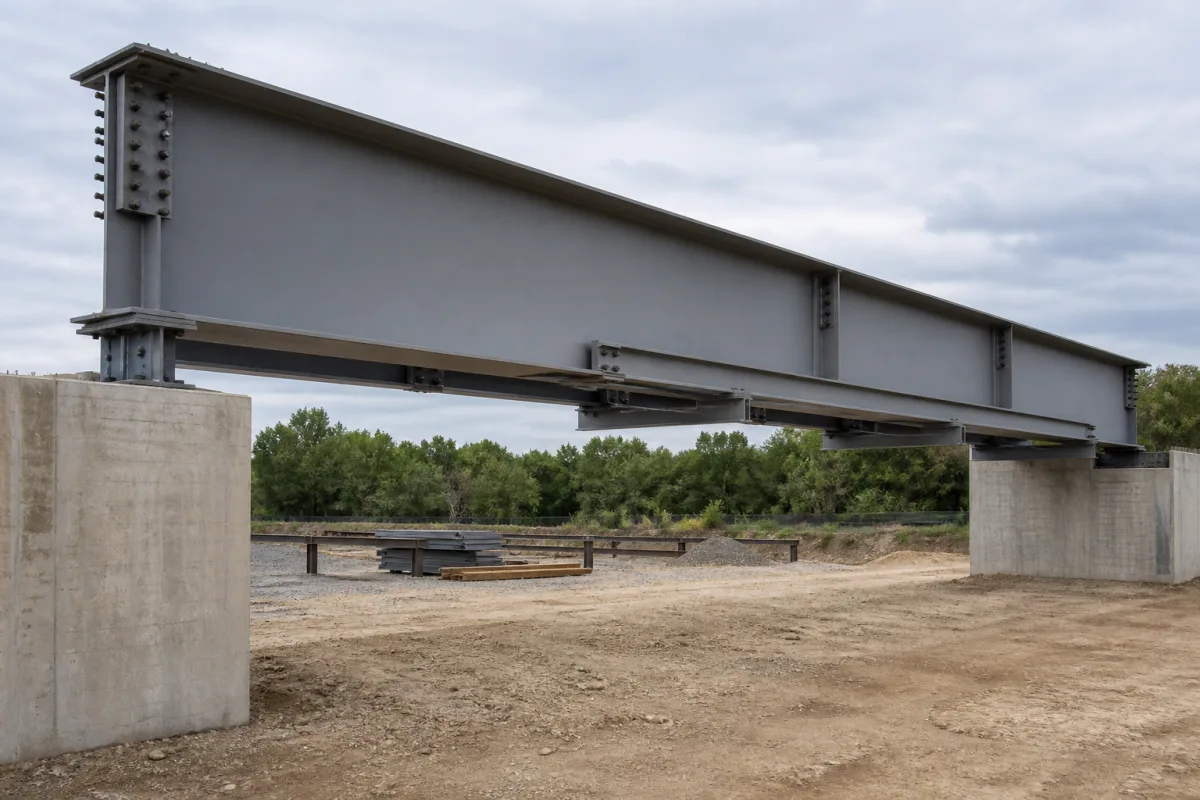
A primary horizontal structural member that carries vertical loads and transfers them to bridge supports.
Product Specifications

Technical details and manufacturing context for Bridge Beam

Definition
The bridge beam is a fundamental structural component within a bridge system that spans between supports (piers or abutments) and bears the weight of the bridge deck, traffic loads, and other imposed forces. It functions as the main load-carrying element, resisting bending moments and shear forces while maintaining structural integrity and stability.
Working Principle
Bridge beams operate on the principle of flexural strength, where the material's ability to resist bending under load is utilized. When vertical loads are applied to the bridge deck, they are transferred to the beams, which bend slightly. The beam's cross-sectional shape (I-beam, box girder, etc.) and material properties are engineered to distribute these stresses efficiently from the center (where bending is maximum) to the supports, preventing structural failure.
Common Materials
Structural Steel, Prestressed Concrete, Reinforced Concrete
Technical Parameters
  • Span length between supports (mm) Per Request
Components / BOM
  • Flange
    Resists bending moments by carrying compressive and tensile forces
    Material: steel or concrete
  • Web
    Connects flanges and resists shear forces
    Material: steel or concrete
  • Reinforcement Bars
    Provide tensile strength in concrete beams
    Material: steel
  • Prestressing Tendons
    Apply compressive force to concrete to improve load capacity
    Material: high-strength steel
Engineering Reasoning
Maximum bending stress: 0-250 MPa, Deflection limit: L/800 to L/1000 (span length dependent), Temperature range: -40°C to +60°C
Yield stress exceedance at 345 MPa (A36 steel) or 414 MPa (A572 Grade 50), Buckling at critical compressive stress of 0.5*E*(t/b)^2 where E=200 GPa, Fatigue failure at 2×10^6 cycles with stress range >95 MPa
Design Rationale: Plastic hinge formation due to bending moment exceeding Mp=Z*Fy, Euler buckling under axial compression, Fatigue crack propagation from stress concentrations at weld joints following Paris' Law da/dN=C(ΔK)^m
Risk Mitigation (FMEA)
Trigger Corrosion-induced section loss exceeding 15% of original cross-sectional area
Mode: Reduced moment capacity leading to excessive deflection exceeding L/400
Strategy: Hot-dip galvanizing with 85μm zinc coating, Cathodic protection at -0.85V vs Cu/CuSO4, Epoxy coating system with DFT 250-400μm
Trigger Resonant vibration at natural frequency fn=1/(2π)*√(k/m) matching traffic loading frequency 1.5-3.0 Hz
Mode: Accelerated fatigue damage with stress concentration factor Kt=2.5 at connection details
Strategy: Tuned mass dampers with mass ratio 0.01-0.02, Stiffness optimization to shift natural frequency >4.0 Hz, Viscous dampers with damping ratio ξ=0.05

Industry Taxonomies & Aliases

Commonly used trade names and technical identifiers for Bridge Beam.

Applied To / Applications

This component is essential for the following industrial systems and equipment:

Industrial Ecosystem & Supply Chain DNA

Complementary Systems
Downstream Applications
Specialized Tooling

Application Fit & Sizing Matrix

Operational Limits
pressure: N/A (structural load bearing, not fluid pressure)
other spec: Maximum span: 50-200m (varies by material), Deflection limit: L/800 to L/1000, Fatigue cycles: 2×10^6 cycles minimum
temperature: -40°C to +60°C (standard steel), -50°C to +80°C (special alloys)
Media Compatibility
✓ Concrete deck systems ✓ Steel truss assemblies ✓ Composite material superstructures
Unsuitable: Continuous immersion in saltwater without cathodic protection
Sizing Data Required
  • Maximum design load (kN/m)
  • Span length (m)
  • Required safety factor (typically 1.5-3.0)

Reliability & Engineering Risk Analysis

Failure Mode & Root Cause
Fatigue cracking
Cause: Cyclic loading from traffic, wind, or thermal expansion exceeding material endurance limits, often initiated at stress concentrations like weld joints or bolt holes.
Corrosion-induced section loss
Cause: Exposure to moisture, de-icing salts, or atmospheric pollutants leading to rust formation, particularly in steel beams, reducing cross-sectional area and load-bearing capacity.
Maintenance Indicators
  • Visible cracks or spalling in concrete or rust bleeding/active corrosion on steel surfaces
  • Excessive deflection or vibration under normal loads, audible creaking or popping sounds
Engineering Tips
  • Implement regular non-destructive testing (e.g., ultrasonic, magnetic particle) to detect subsurface flaws before they propagate to critical sizes
  • Apply and maintain protective coatings (e.g., galvanization, epoxy) with scheduled reapplication, and ensure proper drainage to prevent water/debris accumulation on beam surfaces

Compliance & Manufacturing Standards

Reference Standards
ISO 12944-5:2019 - Corrosion protection of steel structures ASTM A709/A709M-22 - Standard Specification for Structural Steel for Bridges EN 1090-2:2018 - Execution of steel structures and aluminium structures
Manufacturing Precision
  • Length: +/- 5mm per 10m
  • Straightness: 1mm per 1m
Quality Inspection
  • Ultrasonic Testing (UT) for internal defects
  • Dimensional Verification with Laser Scanning

Factories Producing Bridge Beam

Verified manufacturers with capability to produce this product in China

✓ 94% Supplier Capability Match Found

P Project Engineer from United Arab Emirates Jan 13, 2026
★★★★★
"Testing the Bridge Beam now; the technical reliability results are within 1% of the laboratory datasheet."
Technical Specifications Verified
S Sourcing Manager from Australia Jan 10, 2026
★★★★★
"Impressive build quality. Especially the technical reliability is very stable during long-term operation."
Technical Specifications Verified
P Procurement Specialist from Singapore Jan 07, 2026
★★★★★
"As a professional in the Other Transport Equipment Manufacturing sector, I confirm this Bridge Beam meets all ISO standards."
Technical Specifications Verified
Verification Protocol

“Feedback is collected from verified sourcing managers during RFQ (Request for Quote) and factory evaluation processes on CNFX. These reports represent historical performance data and technical audit summaries from our B2B manufacturing network.”

10 sourcing managers are analyzing this specification now. Last inquiry for Bridge Beam from Turkey (1h ago).

Supply Chain Compatible Machinery & Devices

Ship-to-Shore Crane

A large gantry crane used at container terminals to load and unload containers from ships.

Explore Specs →
Offshore Crane

A heavy-duty crane specifically designed and engineered for marine and offshore operations, capable of lifting and moving loads in challenging sea environments.

Explore Specs →
Reach Stacker

A specialized container handling vehicle used in ports and terminals for stacking and transporting shipping containers.

Explore Specs →
Container Handler

A heavy-duty industrial machine designed for lifting, moving, and stacking shipping containers in ports, terminals, and logistics facilities.

Explore Specs →

Frequently Asked Questions

What are the main differences between structural steel and prestressed concrete bridge beams?

Structural steel beams offer high strength-to-weight ratios and faster installation, while prestressed concrete beams provide excellent durability, corrosion resistance, and lower maintenance costs in many environments.

How do reinforcement bars and prestressing tendons function in bridge beams?

Reinforcement bars (rebar) provide tensile strength in concrete beams, while prestressing tendons are tensioned steel cables that compress the concrete, improving its load-bearing capacity and reducing cracking under service loads.

What factors determine the appropriate bridge beam material for a specific project?

Key factors include span length, load requirements, environmental conditions (corrosion, seismic activity), construction timeline, budget constraints, and long-term maintenance considerations.

Can I contact factories directly on CNFX?

CNFX is an open directory, not a transaction platform. Each factory profile provides direct contact information and production details to help you initiate direct inquiries with Chinese suppliers.

Get Quote for Bridge Beam

Request technical pricing, lead times, or customized specifications for Bridge Beam directly from verified manufacturing units.

Your business information is encrypted and only shared with verified Bridge Beam suppliers.

Thank you! Your message has been sent. We'll respond within 1–3 business days.

Need to Manufacture Bridge Beam?

Connect with verified factories specializing in this product category

Add Your Factory Contact Us
Previous Product
Brake System
Next Product
Bridge Control System