Industry-Verified Manufacturing Data (2026)

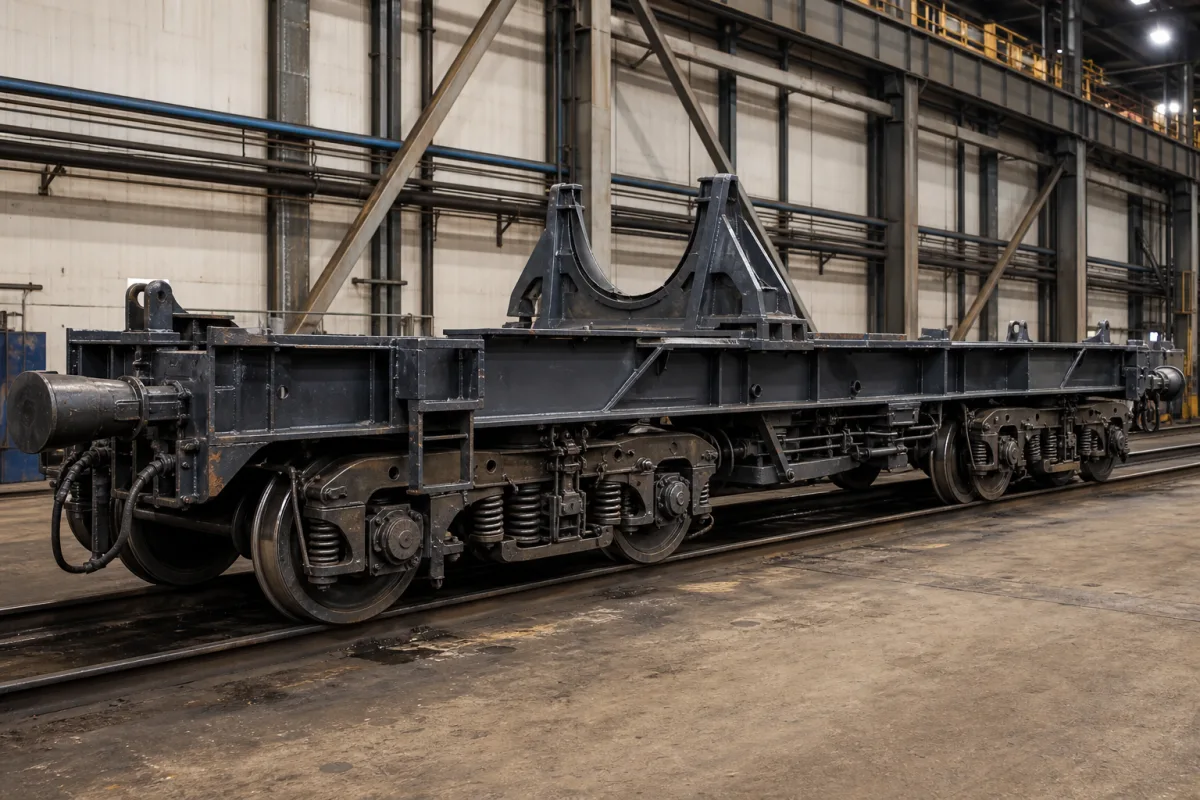
Rail chassis

Based on aggregated insights from multiple verified factory profiles within the CNFX directory, the standard Rail chassis used in the Other Transport Equipment Manufacturing sector typically supports operational capacities ranging from standard industrial configurations to heavy-duty production requirements.

Technical Definition & Core Assembly

A canonical Rail chassis is characterized by the integration of Main Frame and Bogie (Truck). In industrial production environments, manufacturers listed on CNFX commonly emphasize High-strength alloy steel construction to support stable, high-cycle operation across diverse manufacturing scenarios.

The structural framework that supports and carries the hot metal torpedo car on railway tracks.
Product Specifications

Technical details and manufacturing context for Rail chassis

Definition
The rail chassis is the foundational structural component of a Hot Metal Torpedo Car, designed to bear the immense weight of the molten metal container and its contents. It provides the interface with the railway tracks through its bogies and axles, ensuring stable movement, load distribution, and safe transport of high-temperature cargo along the rail network.
Working Principle
The chassis acts as a rigid, load-bearing platform. It transfers the weight of the superstructure (the torpedo ladle) down through its frame to the bogies (trucks), which then distribute the load across multiple axles and wheels. This design minimizes stress on the rails, provides stability during transit, and allows for negotiation of curves and gradients on the railway line.
Common Materials
High-strength alloy steel
Technical Parameters
  • Overall length, width, and height of the chassis frame; distance between bogie centers (wheelbase). (mm) Customizable
Components / BOM
  • Main Frame
    Primary longitudinal and transverse structural beams that form the rigid backbone of the chassis, supporting all other components and transferring loads to the bogies.
    Material: High-strength alloy steel
  • Bogie (Truck)
    A pivoting assembly mounted under each end of the chassis, consisting of a frame, springs, axles, and wheels. It supports the chassis, distributes the load, and guides the car along the tracks.
    Material: Cast steel, alloy steel
  • Center Sill
    The main longitudinal beam running the length of the chassis centerline, providing critical tensile and compressive strength, especially during coupling impacts.
    Material: High-strength alloy steel
  • Bolster
    A transverse structural member that connects the main chassis frame to the bogie, allowing for rotational movement and weight transfer.
    Material: Cast steel
  • Coupler & Draft Gear
    The mechanism at each end of the chassis for connecting to adjacent railcars. The draft gear absorbs shock and buff forces during train operation.
    Material: Forged steel, alloy components
Engineering Reasoning
0-250 kN vertical load per axle, 0-80 km/h speed, -40°C to +60°C ambient temperature
Yield strength exceeded at 345 MPa stress (ASTM A572 Grade 50 steel), fatigue failure at 10^7 cycles under 200 MPa alternating stress, lateral instability at 15 mm track gauge deviation
Design Rationale: High-cycle fatigue from cyclic bending stresses during rail joint impacts, plastic deformation from overload exceeding yield point, buckling instability from lateral track misalignment
Risk Mitigation (FMEA)
Trigger Corrosion-induced section loss exceeding 20% of original thickness
Mode: Structural collapse under 180 kN vertical load
Strategy: Hot-dip galvanizing to 85 μm zinc coating thickness with sacrificial anode protection
Trigger Resonant vibration at 8-12 Hz matching natural frequency of chassis structure
Mode: Fatigue crack propagation at weld joints
Strategy: Dynamic vibration absorbers tuned to 10 Hz with 15% critical damping ratio

Industry Taxonomies & Aliases

Commonly used trade names and technical identifiers for Rail chassis.

Applied To / Applications

This component is essential for the following industrial systems and equipment:

Industrial Ecosystem & Supply Chain DNA

Complementary Systems
Downstream Applications
Specialized Tooling

Application Fit & Sizing Matrix

Operational Limits
pressure: N/A (structural load-bearing only, not pressure vessel)
other spec: Max payload capacity: 200-400 tons, Rail gauge: Standard (1435mm) or custom, Operating speed: ≤ 40 km/h
temperature: Ambient to 500°C (limited by thermal expansion and material properties)
Media Compatibility
✓ Molten iron transport ✓ Steel slag handling ✓ High-temperature industrial materials transport
Unsuitable: Corrosive chemical environments (acids, chlorides) without protective coatings
Sizing Data Required
  • Total payload weight (including torpedo car and contents)
  • Rail track specifications (gauge, curvature, grade)
  • Required service life and maintenance intervals

Reliability & Engineering Risk Analysis

Failure Mode & Root Cause
Fatigue cracking in bogie frames
Cause: Cyclic loading from track irregularities and dynamic forces exceeding material endurance limits, often exacerbated by stress concentrations at weld joints or geometric transitions
Wheel flange and tread wear
Cause: Frictional contact during rail negotiation, particularly on curves, combined with inadequate lubrication and misalignment of wheelsets
Maintenance Indicators
  • Visible cracks or paint flaking at welded joints on bogie frames, indicating structural fatigue
  • Audible screeching or grinding noises during curve negotiation, signaling excessive wheel-rail friction or misalignment
Engineering Tips
  • Implement ultrasonic testing (UT) or phased array inspection at regular intervals to detect subsurface cracks in high-stress areas before they propagate to critical failure
  • Use automated flange lubrication systems and conduct periodic wheel profile measurements to maintain optimal contact geometry and reduce wear rates

Compliance & Manufacturing Standards

Reference Standards
ISO 9001:2015 - Quality management systems EN 15085-2:2007 - Railway applications - Welding of railway vehicles and components ASTM A370 - Standard Test Methods and Definitions for Mechanical Testing of Steel Products
Manufacturing Precision
  • Wheelbase alignment: +/- 1.5 mm
  • Frame flatness: 0.5 mm per meter
Quality Inspection
  • Magnetic Particle Inspection (MPI) for weld integrity
  • Dimensional verification using coordinate measuring machine (CMM)

Factories Producing Rail chassis

Verified manufacturers with capability to produce this product in China

✓ 95% Supplier Capability Match Found

P Project Engineer from Brazil Feb 02, 2026
★★★★★
"As a professional in the Other Transport Equipment Manufacturing sector, I confirm this Rail chassis meets all ISO standards."
Technical Specifications Verified
S Sourcing Manager from Canada Jan 30, 2026
★★★★★
"Standard OEM quality for Other Transport Equipment Manufacturing applications. The Rail chassis arrived with full certification."
Technical Specifications Verified
P Procurement Specialist from United States Jan 27, 2026
★★★★★
"Great transparency on the Rail chassis components. Essential for our Other Transport Equipment Manufacturing supply chain."
Technical Specifications Verified
Verification Protocol

“Feedback is collected from verified sourcing managers during RFQ (Request for Quote) and factory evaluation processes on CNFX. These reports represent historical performance data and technical audit summaries from our B2B manufacturing network.”

6 sourcing managers are analyzing this specification now. Last inquiry for Rail chassis from Turkey (1h ago).

Supply Chain Compatible Machinery & Devices

Floating Crane

A specialized marine vessel equipped with a crane for lifting heavy loads in port operations, offshore construction, and salvage operations.

Explore Specs →
Container Crane

A large crane designed specifically for loading and unloading intermodal containers from container ships at port terminals.

Explore Specs →
Ship-to-Shore Crane

A large gantry crane used at container terminals to load and unload containers from ships.

Explore Specs →
Offshore Crane

A heavy-duty crane specifically designed and engineered for marine and offshore operations, capable of lifting and moving loads in challenging sea environments.

Explore Specs →

Frequently Asked Questions

What materials are used in manufacturing rail chassis for hot metal torpedo cars?

Rail chassis for hot metal torpedo cars are constructed from high-strength alloy steel to withstand extreme temperatures and heavy loads while maintaining structural integrity on railway tracks.

What are the main components of a rail chassis?

Key components include the bogie (truck), bolster, center sill, coupler & draft gear, and main frame, which work together to support and transport hot metal torpedo cars safely on rails.

How does a rail chassis support hot metal torpedo cars?

The rail chassis provides a robust structural framework that distributes the weight of the loaded torpedo car evenly across railway tracks, ensuring stability and safe transport of molten metal in industrial settings.

Can I contact factories directly on CNFX?

CNFX is an open directory, not a transaction platform. Each factory profile provides direct contact information and production details to help you initiate direct inquiries with Chinese suppliers.

Get Quote for Rail chassis

Request technical pricing, lead times, or customized specifications for Rail chassis directly from verified manufacturing units.

Your business information is encrypted and only shared with verified Rail chassis suppliers.

Thank you! Your message has been sent. We'll respond within 1–3 business days.

Need to Manufacture Rail chassis?

Connect with verified factories specializing in this product category

Add Your Factory Contact Us
Previous Product
Protective Enclosure
Next Product
Reach Stacker