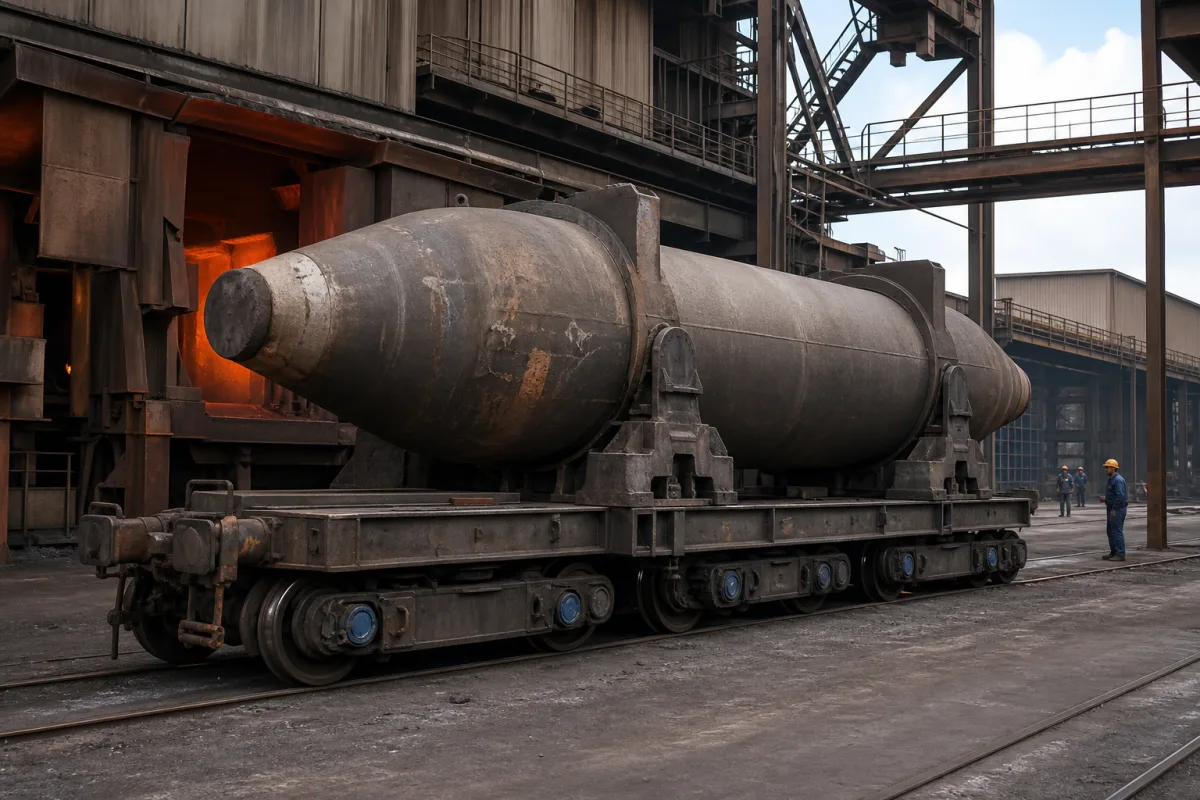
Rail cars that carry molten iron from the blast furnace to the steel plant · Torpedo-shaped refractory-lined vessel on bogies, pouring mouth, rotation to pour, desulfurization in the car, cycle times and heat loss, mouth covers, and relining
A hot metal torpedo car is a rail vehicle that carries molten pig iron from the blast furnace to the steelmaking shop in a long, refractory-lined vessel shaped like a torpedo. It is filled through a mouth on top, may stop for desulfurization, and is rotated to pour the iron into the steel plant's ladle. Ask three things first: what capacity and track the car must suit, how the vessel is lined, rotated and maintained, and how heat loss and in-car treatment fit your plant's route and cycle.
Torpedo (mixer-type hot metal) cars for transporting molten iron by rail within integrated steel plants, including vessel, refractory lining, bogies, rotation drive and mouth covers. Open transfer ladles, ladle cars, slag pot carriers, desulfurization stations (see molten metal desulfurization reactor) and locomotives are outside this page except where compared.
CNFX editorial research · Sources checked October 12, 2026 · 4 sources
US patent 4,524,954 (Method of operating a mixer type hot metal car for the transport of molten iron, 1985) states that pig iron "manufactured in a blast furnace is usually conveyed in the liquid state to a steel making plant" in a mixer-type hot metal car, also called a torpedo car: a rail vehicle with a torpedo-shaped transfer vessel lined inside with refractory bricks and supported on a bogie at each end. The vessel has an opening, the pouring mouth, which is at the top during filling and transport; to empty it the vessel is rotated about its longitudinal axis so the iron pours through the opening into a receiver. [1]
US patent 4,424,957 (Hot metal car heat retention shield) describes torpedo cars as large elongated vessels rotatably supported on wheels, with steel plate bodies lined with refractory brick and a mouth that is upright to receive metal and turned roughly horizontal and slightly downward to pour. [2]
Editorial note: give the supplier your track gauge, axle load limits, curve radii and clearance gauge, and the pouring position at the steel plant, so it can size the vessel and its rotation drive.
Give the supplier the iron capacity per car, track gauge, maximum axle load, curve radii and clearance profile, filling height at the blast furnace and pouring arrangement at the steel plant, rotation drive and controls, refractory lining design and expected campaign, mouth size for filling and lance access, desulfurization practice, mouth cover practice, locomotive coupling and braking, and maintenance and relining facilities.
02
Plan the cycle, heat loss and in-car treatment
US 4,524,954 says the vessel is filled at the blast furnace with iron at about 1500°C, may stop on the way for treatment, "typically being desulphurised", with a lance inserted through the opening, and is emptied at the steel plant and returned. More than one car runs at a time in a steel works, and a car's cycle averages 15 hours: 3 hours filling, 6 hours outward and 6 hours return, with considerable variation from stops. Heat is lost by radiation and convection from the shell and mainly by radiation through the mouth, so iron reaches the steel plant cooler than it was filled; the patent closes the opening with a disposable cover partly lost into the iron. [1]
US 4,424,957 explains that after pouring, heat stored in the refractory lining dissipates through the open mouth while the car waits, and the next charge of iron loses heat to the cooled lining; it describes a consumable shield of cardboard or plywood faced with refractory, placed by hand in the mouth and consumed when metal is poured onto it. [2]
EPA's AP-42 Section 12.5 (Iron and Steel Production) states that hot metal desulfurization may be carried out in the hot metal transfer (torpedo) car between the blast furnace and the BOF, or in the transfer ladle in the BOF shop, by injecting powdered calcium carbide and calcium carbonate or salt-coated magnesium through a lance with high-pressure nitrogen, for about 5 to 30 minutes. It lists hot metal transfer particulate at source of 0.095 kg/Mg of hot metal. [3]
Editorial calculation: with a 15-hour average cycle, one car can make about 24 ÷ 15 = 1.6 round trips a day; divide the daily hot metal to be moved by the car capacity and by 1.6 to estimate cars in service before spares and relining. [1]
03
Plan how lining wear will be measured during the campaign
A 2020 study in Materials by Ge and co-authors tested an electromotive-force (EMF) method for tracking refractory wear on an industrial 285 t torpedo ladle, alongside a laboratory vessel and a new 2,000 m³ blast furnace hearth. On the torpedo ladle, EMF sensors were fitted into the air-exhaust holes of the steel shell at six locations, at depths of 32 mm (one location also at 44 mm), and signals were recorded for three days while the ladle received hot metal under the cast house; the working lining was Al₂O₃-SiC-C (ASC) brick backed by further refractory layers to the shell. The authors report a relative error of about 6.8% for the torpedo ladle measurement and under 11% for the blast furnace hearth, and argue that knowing and predicting lining wear lets such vessels be run longer within a campaign. [4]
Editorial calculation: on an assumed 300 mm remaining lining, a 6.8% error is about ±20 mm. With the 15-hour average cycle noted above, a 285 t car making about 1.6 round trips a day moves roughly 456 t of hot metal daily. Ask a supplier which lining design it proposes (for example ASC brick in the working lining), the expected campaign in heats or tonnes, and how lining thickness can be checked between relines. [4][1]
Fill the specification fields with values for your plant
A torpedo car quotation needs values for your plant. The table explains each field, gives published values where a reviewed source states them, and says what to obtain from the supplier.
The manufacturer below lists torpedo cars for hot metal on its own website; each card links to the page reviewed. Confirm ratings, materials and approvals for your order.
Dalian Huarui Heavy Industry Group Co., Ltd.
Manufacturing site to be confirmed for the order
Lists 335 t and 380 t torpedo cars and a 320 t tubular hot-metal mixing car on its metallurgical vehicles page, stated as developed and manufactured by the company.
Product scope checked 2026-10-12
Metallurgical vehicles product page · profile compiled by CNFX from public sources
Explore company information and manufacturing capabilities, then discuss the scope of your project with a relevant supplier.
Share this page
Compiled and source-reviewed by the CNFX editorial team.
Published product pages show what a company offers, not tested performance. Confirm the legal seller, factory and scope for your order. How we source and review
· Page last updated 13 October 2026
Buyer questions
What is a torpedo car?
A rail vehicle with a torpedo-shaped, refractory-lined vessel on bogies that carries molten iron from blast furnace to steel plant and rotates to pour (US 4,524,954). [1]
How long is a torpedo car's cycle?
US 4,524,954 gives an average 15 hours: 3 hours filling, 6 hours out and 6 hours back, with wide variation. [1]
Is hot metal treated in the torpedo car?
Yes; AP-42 says desulfurization may be done in the torpedo car by lance injection of reagents, taking about 5 to 30 minutes. [3]
How can torpedo car lining wear be monitored?
One industrial study fitted EMF sensors into the shell's air-exhaust holes of a 285 t torpedo ladle and measured refractory thickness with about 6.8% relative error. [4]
Sources and what still needs a direct check
Sources checked 2026-10-12. The two US patents describe torpedo cars and their operation in their own terms; AP-42 Section 12.5 is US EPA emission-factor guidance (1986, reformatted 1995).