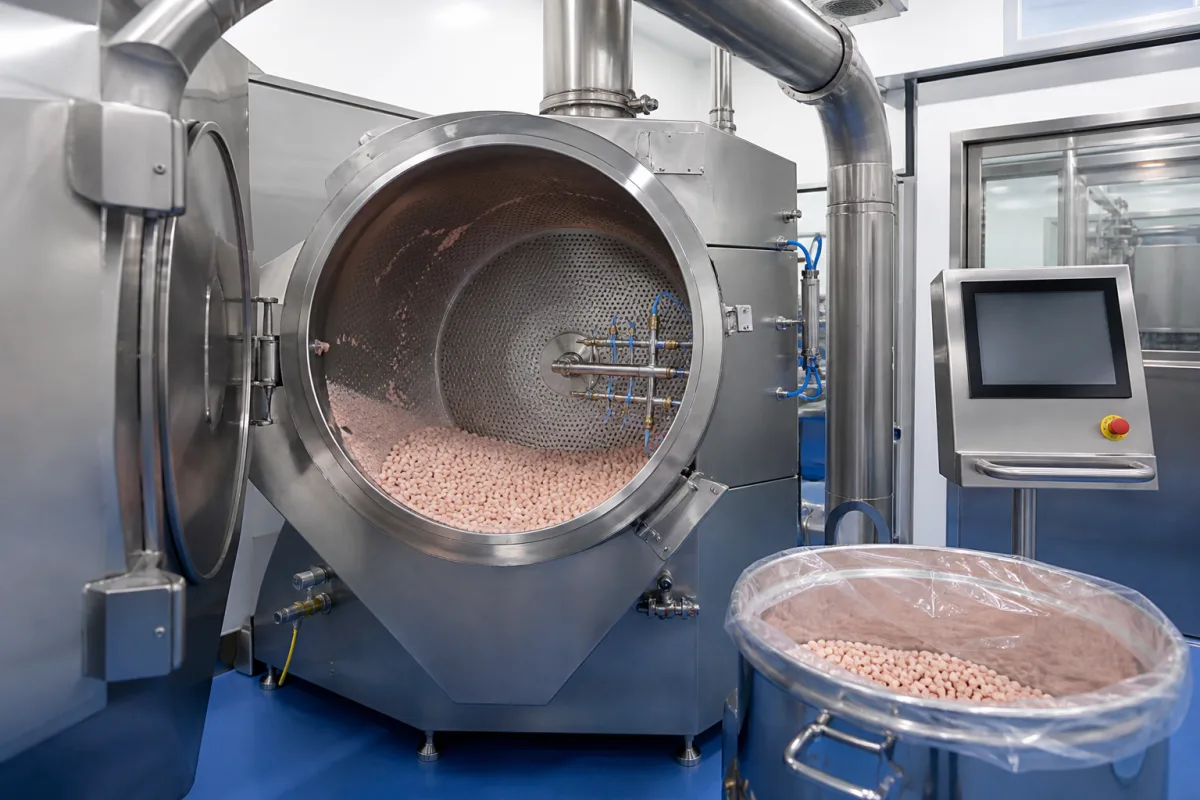
Production film coater with recipe control, closed loading and discharge, automatic washing and in-line coating-thickness sensing
An automated pharmaceutical tablet coating system is a production drum coater built so that a recipe, not an operator, runs charging, spraying, drying, discharge and cleaning, with process data recorded for each batch and, increasingly, the coat measured in-line while it grows. Ask three things first: which steps run automatically with the door closed, what the control system records and how it complies with electronic-record rules, and how coat thickness or end point is measured during the run.
Production-scale automated film coaters for tablets, judged on their control system, closed charging and discharge, automatic washing and in-line process measurement. Sizing the pan charge, drying air and spray rate, and the mixing mechanics of drum and baffles, are covered on the Pharmaceutical tablet coating machine (pan coater) page. Fluid-bed coaters, laboratory coaters, coating formulations and battery or thin-film coaters are outside this page.
CNFX editorial research · Sources checked October 12, 2026 · 3 sources
Check which steps run automatically and what the control records
ACG's SMARTCOATER 1400 X•ONE lists a working capacity of 140 to 1,400 L for tablet coating (the minimum for select formulations only), and 560 to 1,120 L for micro-tablets and 700 to 1,120 L for pellets, with flexibility to run 10–100% batch occupancy. ACG describes a modular, automated design for tablet charging and discharging with built-in discharge baffles, dust-free closed-door charging and 100% tablet discharge, and a command and control system it states is compliant with ATEX, GAMP 5 and 21 CFR Part 11. [1]
L.B. Bohle, describing its redesigned BFC coater, writes that a fill level between 10 and 100% corresponds to 65 to 650 L on a BFC 400. Its iFix control system records long-term measured values, alarms and messages, provides data interfaces to external systems and a recipe management system, and the nozzle angle and distance adjustment is motorised and automatic. [2]
Bohle also lists fully automatic sampling and loading of tablets with the door closed, discharge by reversing the drum and adjusting its inclination, followed by fully automatic cleaning, with an extra cleaning lance at the bottom of the unit as standard. [2] ACG describes wash-in-place with an arranged set of nozzles that wets dead spots, and a spray nozzle with an anti-bearding cap it says is 50% lighter. [1]
Editorial note: makers state compliance with 21 CFR Part 11 and GAMP 5 for their control systems; ask for the validation documents, audit-trail description and user roles, and for the washing recipe and its cleaning validation data, rather than the claim alone.
Give the supplier the tablet size, shape and core mass, batch volume range, coating system and solvent (aqueous or organic), which steps must run with the door closed, the control and data standards required (21 CFR Part 11, GAMP 5, ATEX), the plant data system interface, washing and drying requirements, and any in-line sensor to be fitted.
02
Measure coat thickness in-line to set the end point
Researchers at the University of Cambridge, the University of Liverpool and TeraView fitted an in-line terahertz sensor to the side of a production-scale, side-vented perforated pan coater (Premier 200) coating 175 kg batches of 10 mm, 370 mg biconvex tablets with three spray guns at 300 mL/min, 1.5 bar atomising air, 6 rpm, 2,200 m³/h inlet air at 52 °C and exhaust at 38–40 °C. [3]
The sensor acquired waveforms at 120 Hz; with strict selection, 8,200 tablet readings over 6 hours (about 0.3% of waveforms, over 20 tablets per minute) gave R² = 0.91 and RMSE = 5.8 µm against off-line terahertz measurements, and relaxed selection raised the readings to 16,660 at R² = 0.8 and RMSE = 10 µm. [3]
The study used the sensor to detect induced faults: removal of the baffles, uncoated cores added part way, the drum halted and spray guns blocked or slowed. Inter-tablet variability fell with time along a log–log slope of −0.57. [3] Editorial note: an in-line reading is only useful for an automated end point if the control system can act on it; ask how the sensor signal enters the recipe and what happens when readings drop out.
03
Automatic charging, sampling, discharge and washing differ by model
The supplier linked to this page lists tablet coating machines it describes as highly automated; the card links to the page reviewed.
Ask each supplier which steps of charging, sampling, discharge and washing are automatic on the model offered, what the control system records, and whether in-line sensors have been fitted to it.
04
What surrounds the perforated drum: spray arm, air handling, wash-in-place and controls
Part
Role
Fix in the order
Perforated drum
Holds and mixes the bed; one study used 3 mm holes with 51% open area. [3]
Volume range and fill level.
Spray arm and nozzles
Motorised angle and distance. [2] Anti-bearding cap. [1]
Nozzle count and adjustment.
Charging and discharge
Closed-door loading; discharge by reversing drum. [1][2]
Automatic or manual.
Air handling
Inlet and exhaust conditions under recipe; heat recovery option. [3][2]
Airflow, temperature, humidity.
Wash-in-place
Nozzles and bottom lance for automatic cleaning. [1][2]
Explore company information and manufacturing capabilities, then discuss the scope of your project with a relevant supplier.
Share this page
Compiled and source-reviewed by the CNFX editorial team.
Each manufacturer above links to the page on that company's own website where the product is listed, with the date we checked it. How we source and review
· Page last updated 13 October 2026
Buyer questions
What batch range can one automated coater run?
ACG lists 10–100% batch occupancy, 140–1,400 L on its 1400 model; Bohle gives 65–650 L for a BFC 400. [1][2]
Can coating thickness be measured during the run?
Yes; a Cambridge study fitted a terahertz sensor to a production coater and reached RMSE 5.8 µm against off-line measurement. [3]
What does the control system record?
Bohle lists long-term measured values, alarms, messages, recipes and external data interfaces. [2]
Sources and what still needs a direct check
Sources checked 2026-10-12. ACG and L.B. Bohle are coater makers describing their own machines; the terahertz study is peer-reviewed work by the University of Cambridge, the University of Liverpool and TeraView on a production coater.