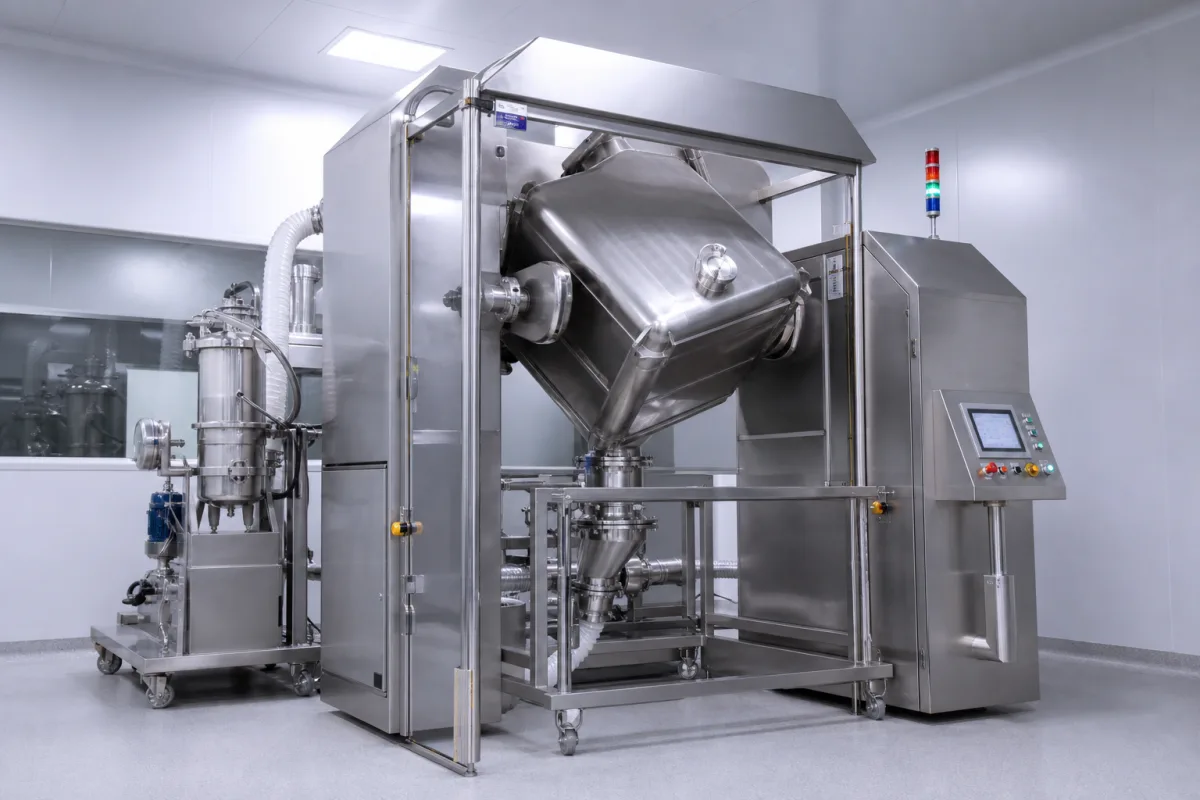
Pharmaceutical powder blenders · tumbling (bin, V and double-cone) versus convective designs, GMP equipment construction and cleaning under 21 CFR 211, demonstrating blend uniformity, and sampling locations and RSD criteria from FDA's 2003 draft guidance
An automated pharmaceutical powder blender mixes active ingredients with excipients into a uniform blend before tableting or capsule filling; designs either tumble the powder in a rotating container (bin, V or double-cone) or move it with internal agitators (convective, such as ribbon blenders), with automated controls. Ask three things first: which blender type suits the powders and batch sizes, how blend uniformity will be sampled and demonstrated, and how product-contact parts will be cleaned and verified.
Tumbling (bin/IBC, V-type, double-cone, drum) and convective blenders for pharmaceutical solid-dose manufacturing, with automated controls. Ribbon blender agitators sold as parts (a separate product page), granulators, mills, food and chemical mixers and laboratory blenders are outside this page except where compared.
CNFX editorial research · Sources checked October 11, 2026 · 5 sources
US current good manufacturing practice for finished pharmaceuticals (21 CFR 211) requires equipment of appropriate design and adequate size, located to facilitate operation, cleaning and maintenance [1]; surfaces that contact components, in-process materials or drug products must not be reactive, additive or absorptive so as to alter the product, and lubricants or coolants must not contact the product in a way that alters it [2]. Equipment must be cleaned, maintained and, as appropriate, sanitized at suitable intervals under written procedures covering responsibility, schedules and methods. [3] In-process controls must include, where appropriate, adequacy of mixing to assure uniformity and homogeneity. [4]
Editorial note: ask the supplier for product-contact material certificates, surface finish, seal and gasket materials, how drive lubricants are kept away from product, the cleaning method (manual, wash-in-place) and the documents it provides for qualification.
Give the supplier the products and their powder properties (particle size, density, flow, segregation tendency), batch sizes and working volume range, blender type (bin/IBC, V, double-cone, convective), container sizes and docking, rotation speed and time control, loading and discharge (vacuum conveying, valves), containment level, product-contact materials and finish, cleaning method, sampling ports or thief access, recipe control, data integrity and audit trail, qualification documents, and site utilities.
02
Plan how blend uniformity will be shown
FDA's 2003 draft guidance on powder blends and finished dosage units, issued for comment and marked not for implementation, recommended identifying at least 10 sampling locations in the blender to represent potential areas of poor blending; in tumbling blenders such as V-blenders, double cones or drum mixers, samples from at least two depths along the blender axis, and for convective blenders such as ribbon blenders, at least 20 locations including corners and the discharge area. It suggested at least 3 replicate samples per location, assaying one per location, with an RSD of all individual results of 5.0% or less and all results within 10.0% (absolute) of the mean, and investigation of failures. [5]
Editorial calculation: 10 locations with 3 replicates means 30 samples are taken and 10 assayed in the first stage; a ribbon blender at 20 locations doubles that to 60 taken and 20 assayed. The counts follow the draft's recommendations; confirm current expectations with your quality unit and regulator, since the draft was not for implementation.
03
Tumbling containers versus blenders with internal agitators
Tumbling blenders such as V-blenders, double cones and drum mixers rotate the whole container; convective blenders such as ribbon blenders move powder with internal elements and, in the draft guidance, call for more sampling locations including corners and the discharge area. [5]
04
Container, drive, sampling access and cleaning provisions under 21 CFR 211
Three rows trace to the regulation: non-reactive contact surfaces and lubricants kept from product in 211.65, written cleaning procedures in 211.67. The sampling-access row follows the location counts in FDA's 2003 draft. [2][3][5]
Contact materials, cleaning, mixing adequacy and sampling plan for a blender quotation
The sampling-plan row carries the only numbers here — at least 10 locations, 20 for convective blenders, and an RSD of 5.0% or less — and they come from a 2003 draft marked not for implementation. [5]
Field
What it means and published values
Ask the supplier for
Blender type
Tumbling (V, double cone, drum, bin) or convective. [5]
2 companies list this product among what they make. Company figures are quoted from each
company's own website; every card states where the relationship came from.
Changzhou Dachu Drying Equipment Co., Ltd.
Manufacturing site to be confirmed for the order
Its website has a product page for automated pharmaceutical powder blender.
Product scope checked 2026-10-12
Product page on own website · profile compiled by CNFX from public sources
Explore company information and manufacturing capabilities, then discuss the scope of your project with a relevant supplier.
Share this page
Compiled and source-reviewed by the CNFX editorial team.
Each manufacturer above links to the page on that company's own website where the product is listed, with the date we checked it. How we source and review
· Page last updated 13 October 2026
Buyer questions
What does US GMP require of blending equipment?
21 CFR 211 requires appropriate design for cleaning, non-reactive product-contact surfaces, written cleaning procedures and in-process control of mixing adequacy. [1][2][3][4]
What number of locations should be sampled in a blender?
FDA's 2003 draft guidance suggested at least 10 for tumbling blenders (at two or more depths) and at least 20 for ribbon blenders. [5]
What RSD shows an acceptable blend?
The 2003 draft suggested an RSD of 5.0% or less with all results within 10.0% of the mean; it was not for implementation, so confirm current expectations. [5]
Sources and what still needs a direct check
Sources checked 2026-10-11. 21 CFR 211 is the US federal CGMP regulation for finished pharmaceuticals (cited from the eCFR text); the 2003 FDA document is a draft guidance issued for comment and marked not for implementation (cited from an Internet Archive copy).