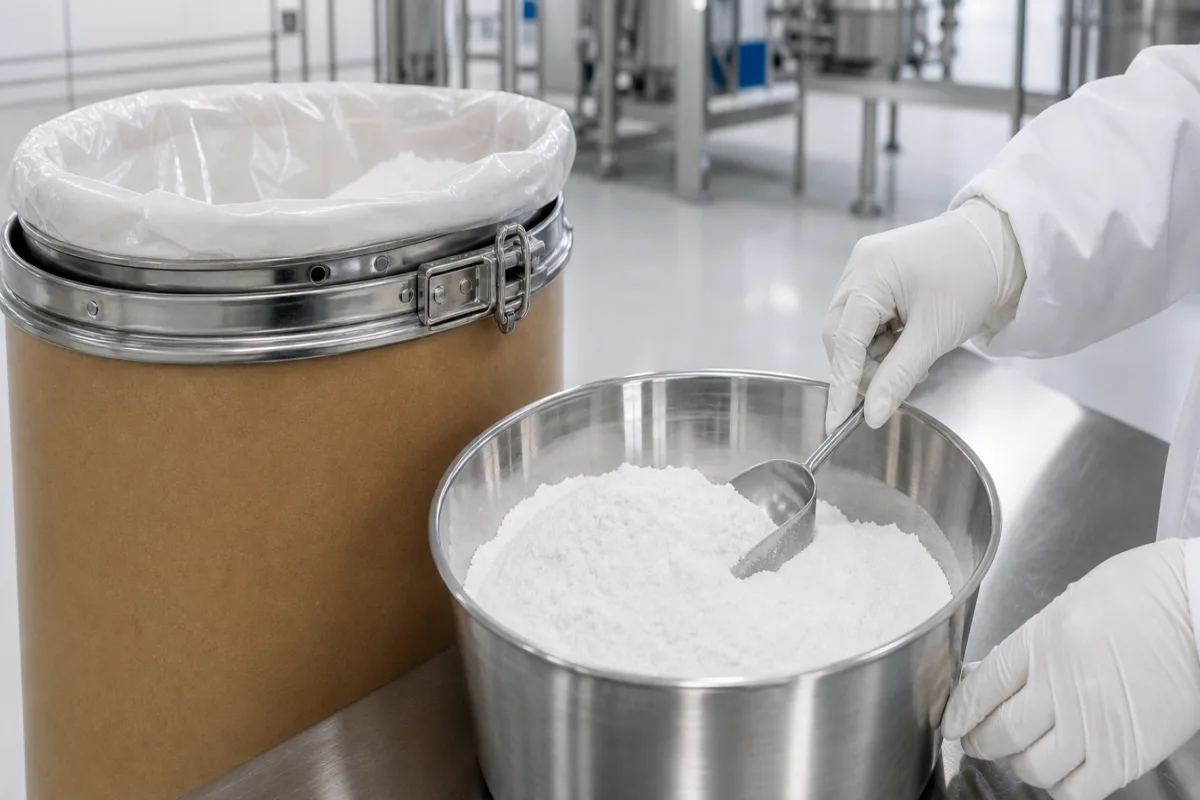
Pharmaceutical lactose monohydrate · The pharmacopoeial tests (water 4.5–5.5%, specific optical rotation, heavy metals, sulfated ash, microbial limits) plus the functionality characteristics buyers set by grade: milled, sieved, spray-dried or inhalation lactose, particle size, bulk and tapped density
Lactose monohydrate is a milk sugar excipient used as a filler or diluent in tablets, capsules and powders. Pharmaceutical grades must meet a pharmacopoeia monograph and are supplied in different physical forms, such as milled, sieved, spray-dried or inhalation grades, that behave differently in processing. Ask three things first: which pharmacopoeias the grade must meet, which physical grade suits the process, and which particle size and density values must be controlled.
Alpha-lactose monohydrate excipient grades for oral solid dosage forms, specified to pharmacopoeia monographs and by functional characteristics. Anhydrous lactose, food or feed lactose, and other excipients are outside this page.
CNFX editorial research · Sources checked October 11, 2026 · 4 sources
The Ph. Eur. monograph 0187 for lactose monohydrate, as reproduced in the British Pharmacopoeia 2013, defines O-β-D-galactopyranosyl-(1→4)-α-D-glucopyranose monohydrate, C12H22O11·H2O, Mr 360.3, CAS 10039-26-6, as a white or almost white crystalline powder, freely but slowly soluble in water and practically insoluble in ethanol, used as an excipient. [1]
Its tests include specific optical rotation of +54.4 to +55.9 (anhydrous substance); an acidity limit of not more than 0.4 mL of 0.1 M sodium hydroxide for 6.0 g; absorbance limits at 400 nm and 210–300 nm; heavy metals at most 5 ppm; water 4.5–5.5% by Karl Fischer; sulfated ash at most 0.1%; total aerobic microbial count (TAMC) acceptance criterion 10² CFU/g; and absence of Escherichia coli. It is to be stored in an airtight container. [1]
The monograph's non-mandatory functionality-related characteristics for lactose used as a filler or diluent in compressed and powder dosage forms are particle size distribution and bulk and tapped density, with the Hausner index calculated from them. [1] Check which edition and which pharmacopoeias (Ph. Eur., USP-NF, JP, ChP) your filing requires, since this source is the 2013 text.
Give the supplier the pharmacopoeias and editions to be met, the physical grade and particle size distribution, bulk and tapped density targets, any nitrite, endotoxin or elemental impurity requirements, packaging, retest period, documentation (certificate of analysis, regulatory statements) and annual volume.
02
Choose the physical grade for the process
MEGGLE describes its GranuLac 200 as a milled 200-mesh alpha-lactose monohydrate meeting Ph. Eur., USP-NF, JP and ChP, with fine, sharp-edged, cohesive particles for wet and dry granulation, blends, premixes, sachets and triturations. It says milled lactose, being brittle, consolidates "primarily by fragmentation" but has limited flowability, so it should be granulated before tableting where possible, and that its narrow particle size distribution and controlled density help tune tabletability and compressibility. [2]
MEGGLE lists GranuLac 200 for capsules, sachets and tablets, packed as 25 kg paper bags with a PE-EVOH-PE inliner, with a 36-month retest period, made in Wasserburg am Inn, Germany, and supplies statements on elemental impurities, nitrosamines, microbial testing and other compliance topics. Its range also includes sieved, spray-dried, direct-compression, dry powder inhalation and low-endotoxin lactose grades. [2]
Editorial calculation: a TAMC criterion of 10² CFU/g is 100 CFU per gram; a 36-month retest period is 3 years. [1][2]
03
Weigh particle size against flow and blending
A 2011 Universiti Putra Malaysia study in Drug Design, Development and Therapy measured two lactose grades used as filler-binder: lactose 100M had a mean particle size of 118 µm, poured density 0.73 g/mL, tapped density 0.88 g/mL, Hausner ratio 1.21 and Carr's index 17% (flow rated fair), while lactose 200M had 49 µm, 0.54 g/mL, 0.80 g/mL, Hausner ratio 1.47 and Carr's index 33% (flow rated poor). [3]
Blending these with ascorbic acid and zinc oxide in a convective ribbon mixer at 40, 60 and 80 rpm for 5 to 25 minutes, the authors found that with preblending the 200M mixture reached the required homogeneity sooner and at a lower rotational speed; they attribute this to the fine 200M particles adhering to the larger ascorbic acid particles and limiting segregation, while the freer-flowing 100M needed longer. All mixtures met the homogeneity requirement after 25 minutes at the lowest speed tested, and the authors warn that prolonged high-speed mixing leads to segregation. [3]
Editorial calculation: the Hausner ratio is tapped over poured density, 0.88 ÷ 0.73 ≈ 1.21 and 0.80 ÷ 0.54 ≈ 1.48, consistent with the published 1.21 and 1.47 — the bulk and tapped densities that monograph 0187 lists as functionality-related characteristics. The fine grade's poor flow matches MEGGLE's advice to granulate milled 200-mesh lactose before tableting. Ask suppliers for PSD, bulk and tapped density measured on the lot, not only a grade name. [3][1][2]
04
Lot data and certificates to request from a lactose supplier
Ask any supplier for the pharmacopoeias met, the specified particle size distribution and lot results, bulk and tapped density, water, microbial and elemental impurity results, GMP or EXCiPACT certification, change-control policy, packaging, retest period and lead time.
05
Compare a second maker's milled lactose data with the study values
DFE Pharma's product page for Pharmatose 200M describes a pure, white, crystalline, milled lactose monohydrate for filler-binder, diluent and binder use in tablets and capsules, with wet granulation, extrusion spheronization and continuous processing as recommended processes. Under the heading "Typical product data" it gives particle size x10 5 µm, x50 35 µm and x90 100 µm, bulk density 0.60 g/mL and Hausner ratio 1.41. It lists 25 kg paper bags, 50 kg drums and 500–1,000 kg big bags, a 36-month shelf life, production in Veghel, the Netherlands, and a downloadable product specification, ICH Q3D statement and certificate of suitability. [4]
Editorial calculation: tapped density is bulk density × Hausner ratio, 0.60 × 1.41 ≈ 0.85 g/mL. The 2011 study's lactose 200M had a 49 µm mean size, 0.54 g/mL poured density and a Hausner ratio of 1.47; the study does not name the maker, and x50 is a median, not a mean, so the figures are not a like-for-like comparison. [4][3]
Editorial note: DFE lists these under "Typical product data", not as limits. Ask for the product specification sheet and the lot certificate with the PSD method, and agree which x10, x50, x90 and density limits apply to your order. [4][1]
Optical rotation, water, ash, microbial limits and particle size: what each test controls
Four of the six rows are monograph 0187 tests with fixed limits; particle size and density are its non-mandatory functionality characteristics, which the supplier's grade and lot data have to cover. [1]
Monograph limits and density values for a lactose monohydrate order
Water 4.5–5.5%, heavy metals at most 5 ppm and sulfated ash at most 0.1% are fixed by the monograph; loss on drying, pH and assay are not in the reviewed text, which uses Karl Fischer water and an acidity titration instead. [1]
Field
What it means and published values
Ask the supplier for
Particle Size D90 (μm)
PSD is a functionality characteristic; 200 mesh milled grade offered. [1][2]
D10/D50/D90.
Loss on Drying (%)
Not in the reviewed monograph text; water by KF instead. [1]
If required.
Bulk Density (g/mL)
Functionality characteristic; e.g. 0.73 (100M) and 0.54 g/mL (200M) poured in one study. [1][3]
Value.
Tapped Density (g/mL)
Functionality characteristic; Hausner index; e.g. 0.88 and 0.80 g/mL, Hausner 1.21 and 1.47. [1][3]
Explore company information and manufacturing capabilities, then discuss the scope of your project with a relevant supplier.
Share this page
Compiled and source-reviewed by the CNFX editorial team.
Each manufacturer above links to the page on that company's own website where the product is listed, with the date we checked it. How we source and review
· Page last updated 13 October 2026
Buyer questions
What water content must lactose monohydrate have?
The Ph. Eur. monograph 0187 text reviewed sets 4.5 to 5.5% by Karl Fischer. [1]
Which physical properties matter for fillers?
The monograph lists particle size distribution and bulk and tapped density as functionality characteristics. [1]
What is milled lactose used for?
MEGGLE says its milled 200-mesh GranuLac 200 suits wet and dry granulation but has limited flowability. [2]
How do 100-mesh and 200-mesh lactose differ in flow?
In a 2011 study lactose 100M (118 µm) had a Hausner ratio of 1.21 and fair flow, while lactose 200M (49 µm) had 1.47 and poor flow. [3]
What particle size does a milled 200M lactose grade have?
DFE Pharma's Pharmatose 200M page gives x10 5 µm, x50 35 µm and x90 100 µm, bulk density 0.60 g/mL and a Hausner ratio of 1.41 (typ.). [4]
Sources and what still needs a direct check
Sources checked 2026-10-11. The British Pharmacopoeia reproduces the Ph. Eur. lactose monohydrate monograph; MEGGLE makes pharmaceutical lactose; the Universiti Putra Malaysia paper measured flow and blending of two lactose grades.