Parenteral packaging · Elastomer safety and extractables, coring and fragmentation, container closure integrity, machinability
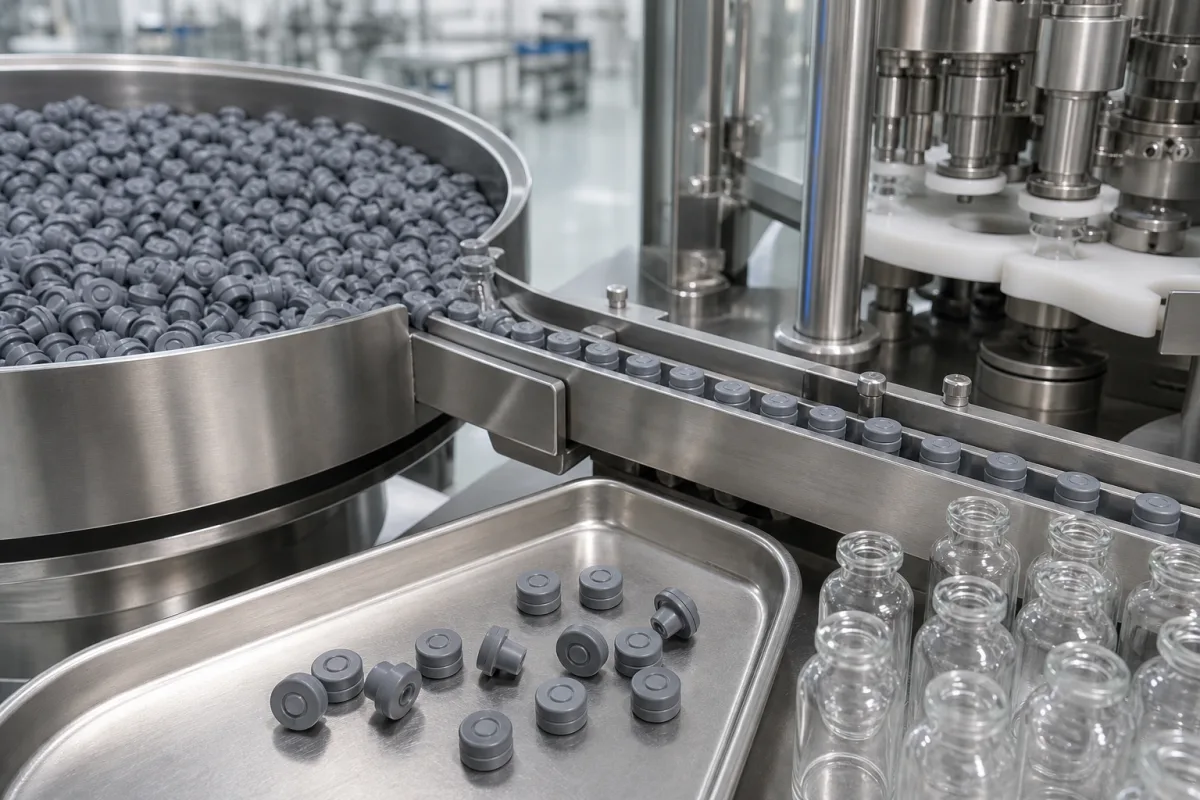
A pharmaceutical vial rubber stopper is the elastomeric closure that seals an injectable or freeze-dried drug in its glass vial under an aluminium crimp and lets a needle pass through. Ask three things first: what safety and extractables data the stopper formulation has with your drug, how it behaves when pierced (coring, fragmentation, resealing), and how closure integrity and machinability on your filling line were proven.
Elastomeric stoppers for injectable and lyophilised drug vials, including coated and uncoated elastomer formulations. Blood-collection tube stoppers, syringe plungers, aluminium crimp seals and vial adapters are outside this page.
CNFX editorial research · Sources checked October 12, 2026 · 4 sources
FDA's 1999 guidance on container closure systems says injectable products need protection from microbial contamination and may need protection from light, gases, solvent loss or water vapour. For elastomeric components, data from the USP Biological Reactivity Tests and USP Elastomeric Closures for Injections tests "will typically be considered sufficient evidence of material safety", and extraction studies should use the drug product where possible, especially where its pH or excipients make it a stronger extractant than water. [1]
If extracts significantly exceed those from water extraction, the guidance asks for an extraction profile; for elastomeric components undergoing heat sterilisation, current practice is to obtain the profile at 121 °C for 1 hour with a suitable solvent. It also lists evaluation of swelling effects for elastomeric components, and recommends periodically comparing a quantitative extraction profile of new component batches with the original as a check on consistent composition. [1]
West Pharmaceutical advises running stopper assessments under pharmaceutically representative conditions, with components lubricated, washed and sterilised as they will be in commercial use. [3]
Give the supplier the drug product and its vehicle, pH and excipients, fill volume and vial neck finish, liquid or lyophilised presentation, sterilisation method (steam or irradiation), coating or siliconisation needs, needle or spike access in use, and the regulatory documentation you need.
02
Control coring, fragmentation and closure integrity
West distinguishes cores, cylindrical pieces cut by the needle cannula, from fragments, small irregular particles abraded by the outside of the cannula; both are particulate risks, and large cores may stop the stopper resealing. It lists technique causes: blunt tips fragment more than sharp bevels, needles larger than 21 gauge promote fragmentation, poor needle siliconisation or reuse increases both, higher insertion force increases coring, a 45° insertion angle increases coring, and multiple punctures greatly increase both. [2][3]
On the closure side West notes that natural rubber and synthetic isoprene formulations “typically have more robust functional properties than butyl formulations and show reduced coring because of their increased tensile strength”, that “generally, thinner stopper diaphragms reduce the likelihood of coring”, notes that unsiliconised closures may core more, and that heavy processing such as high gamma irradiation can degrade the elastomer and increase coring. [2] Its piercing guidance favours thin (higher-gauge, e.g. 27 G) single-use, consistently lubricated needles, puncture within the target circle at the proper angle, slow insertion and no rotation. [3]
For container closure integrity West refers to USP <1207>, which favours deterministic methods such as trace-gas leak detection, and cites helium leak detection against the Kirsch limit of 6.0 × 10⁻⁶ cm³/s. Crimping force, stopper hardness and dimensional compatibility of vial, stopper and seal all affect results, and machinability depends on stopper lubricity, hardness, centre of mass and feeder-bowl and insertion settings. [3]
03
Bromobutyl stoppers for injectable and lyophilised products in supplier listings
Listings include bromobutyl stoppers for injectable and lyophilised products and other pharmaceutical rubber closures.
04
Test coring with the needle gauges and angles your users apply
A 2022 study in Heliyon from Rajavithi Hospital, Bangkok, punctured the 4 mm thick stoppers of 50 ml propofol vials three times each at a 10 N compression force, using bevel-up 18G, 20G and 21G needles at 45° and 90°, 25 stoppers per setting. The fluid was filtered through a 0.8 µm filter and examined at 100x. Coring occurred in 26 of 150 samples (17.33%): 38% with 18G needles against 8% with 20G and 6% with 21G (p < 0.01). [4]
Angle made a significant difference only with the 18G needle, 56% at 45° against 20% at 90° (p = 0.01). Needle size and angle did not affect particle size: mean widths were 0.028–0.051 mm and mean lengths 0.040–0.082 mm. The authors suggest a small needle used for a single puncture. [4]
Editorial note: the study covers one bromobutyl stopper and sharp needles; West names diaphragm thickness, siliconisation and blunt tips as further factors [2]. Ask the stopper supplier for coring and fragmentation results at the gauges, angles and puncture counts used with your product. [4]
Elastomer, diaphragm, flange and plug, siliconisation and processing state
Formulation, diaphragm thickness and siliconisation are also the closure-side coring factors West names, so they belong in the coring test plan as well as on the drawing. [2]
Neck-fit dimensions, hardness, penetration force, resealing and extractables for a stopper order
The one condition with a figure is the 121 °C, 1 hour extraction profile FDA's guidance expects for heat-sterilised elastomers; the hardness, penetration and resealing rows need the supplier's test method as well as its result. [1]
2 companies list this product among what they make. Company figures are quoted from each
company's own website; every card states where the relationship came from.
Qingdao Huaren Medical Product Co., Ltd.
Manufacturing site to be confirmed for the order
Lists bromobutyl rubber stoppers for injectable lyophilised powders.
Explore company information and manufacturing capabilities, then discuss the scope of your project with a relevant supplier.
Share this page
Compiled and source-reviewed by the CNFX editorial team.
Each manufacturer above links to the page on that company's own website where the product is listed, with the date we checked it. How we source and review
· Page last updated 13 October 2026
Buyer questions
What safety data does FDA expect for vial stoppers?
FDA's 1999 guidance says data from the USP Biological Reactivity Tests and USP Elastomeric Closures for Injections tests “will typically be considered sufficient evidence of material safety”, and asks for extraction studies with the drug product where needed. [1]
What causes stopper coring?
West lists large or blunt needles, poor siliconisation, needle reuse, high force, a 45° angle and multiple punctures, plus formulation and diaphragm thickness. [2]
How is vial closure integrity tested?
West refers to USP <1207>, favouring deterministic methods such as helium leak detection with the Kirsch limit of 6.0 × 10⁻⁶ cm³/s. [3]
Does needle gauge affect vial stopper coring?
In a 2022 Heliyon study of propofol vial stoppers, 18G needles cored in 38% of samples against 8% for 20G and 6% for 21G. [4]
Sources and what still needs a direct check
Sources checked 2026-10-12. FDA's 1999 guidance is advisory and is shown as final on FDA's site; West Pharmaceutical is a stopper maker describing its own experience. USP and Ph. Eur. chapters govern the actual tests.