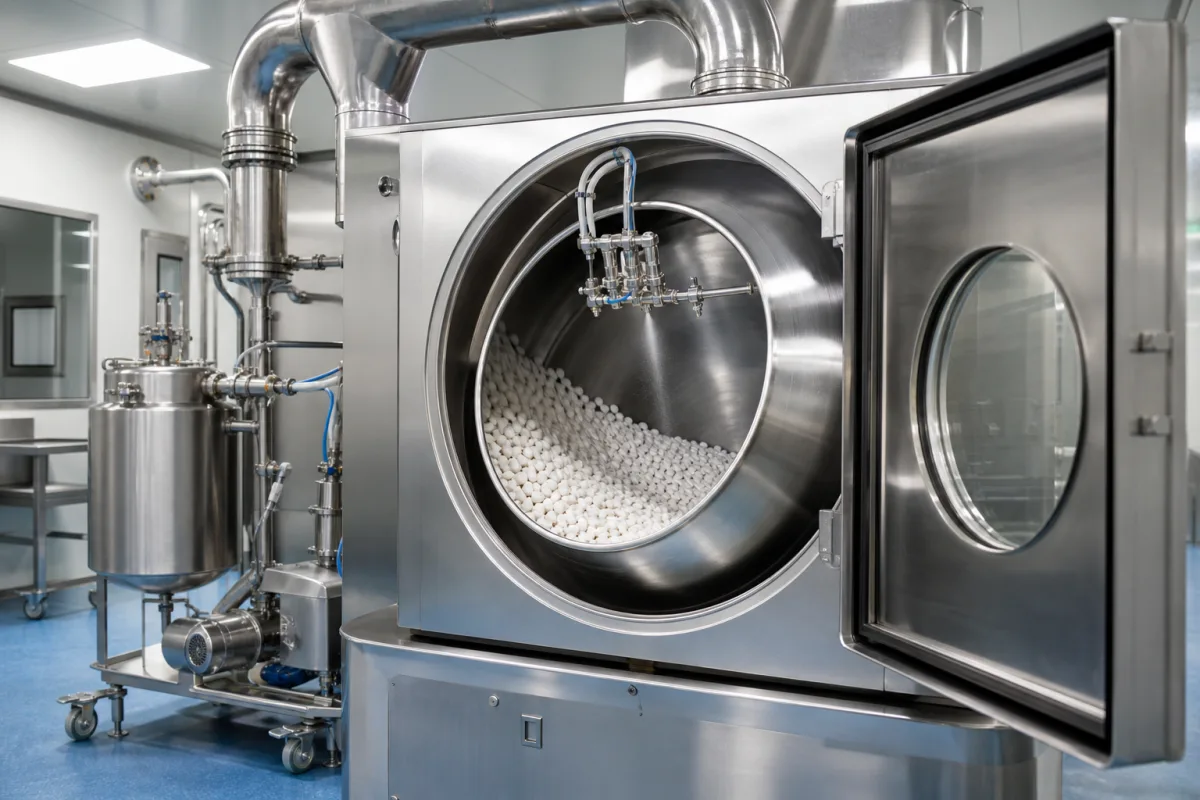
Pan coaters for tablets · Pan size, charge and air volume, spray rate and bed temperature, mixing and baffles for coating uniformity
A pharmaceutical tablet coating machine, or pan coater, tumbles tablets in a rotating perforated drum while spray guns apply a film-forming polymer solution or suspension and heated air dries it, building a uniform coat for protection, taste masking, appearance or modified release. Ask three things first: what tablet charge and drying-air capacity the pan has, what spray rate and bed temperature it holds for your coating system, and how its baffles and drum geometry mix tablets through the spray zone.
Batch and continuous drum (pan) coaters for film and sugar coating of tablets, perforated or non-perforated, with spray system and air handling. Fluid-bed coaters, capsule banding machines and coating formulations alone are outside this page.
CNFX editorial research · Sources checked October 11, 2026 · 4 sources
Colorcon's coating parameters for its aqueous Opadry film system (15% solids, 3% w/w theoretical weight gain) on fully perforated side-vented pans give: 38.1 cm pan, 1.5–3.0 kg charge, 250–290 m³/h air, 18 rpm, 1 gun, 10–18 g/min; 60.96 cm, 12–15 kg, 424–470 m³/h, 14 rpm, 1–2 guns, 40–56 g/min; 122 cm, 120–160 kg, 2,300–3,060 m³/h, 8 rpm, 3–4 guns, 260–420 g/min; and 152.4 cm, 320–350 kg, 5,440–6,630 m³/h, 6 rpm, 5–6 guns, 650–700 g/min. [1]
Across these pans it pre-warms the tablet bed to 45–50 °C, uses inlet air of 60–65 °C and holds the bed at 42–45 °C, with 1.2 mm nozzles, 10–25 cm gun-to-bed distance and 1.4–2.5 bar atomising and pattern air; approximate coating times run 17–123 minutes. Colorcon notes that pan speed should give even mixing and depends on tablet size, shape, friability and baffle type, and that conditions should be adapted to each product and machine. [1]
Editorial calculation: 3% weight gain on a 150 kg charge needs 4.5 kg of solids, or 30 kg of a 15% suspension; at 260–420 g/min that takes about 71–115 minutes — consistent with the 57–123 minutes Colorcon lists for the 122 cm pan. The charge is an assumed example within that pan's range. [1]
At laboratory scale, Riga Stradiņš University coated a 350 g charge (about 530 biconvex 13 mm, 660 mg tablets) in a Glatt GC1 fully perforated side-vented pan of 30 cm internal diameter and 11 cm width, with one Schlick two-component nozzle (0.8 mm) at 18 cm gun-to-bed distance and the pan at 12 rpm. With organic solvents the settings moved with solvent boiling point: acetone ran at 20.5 m³/h and 25 °C inlet air, 0.3 bar atomising air and 9.0 g/min for 28 min; acetonitrile at 20.8 m³/h, 45 °C, 1.7 bar and 6.7–4.9 g/min for 50 min; DMSO at 60 m³/h, 80 °C, 2.1 bar atomising plus 1.4 bar pattern air and 0.5 g/min for 739 min, leaving 1.5 wt.% residual DMSO in the coat and hints of sticking. [4]
Give the supplier the tablet size, shape, friability and bulk density, batch sizes (minimum and maximum load), coating type (aqueous or organic film, sugar, functional), solids content and target weight gain, required spray rate and number of guns, air handling and dew-point control, containment and cleaning (WIP/CIP), GMP documentation and utilities.
02
Get uniform coating from mixing and baffles
A 2025 review in Pharmaceutics on pan coating explains that tablets cascade down the bed and receive a partial coat each time they pass the spray zone, so passage frequency and residence time in the spray zone set coating uniformity; radial mixing is fast but axial mixing slow, and baffles are added to improve it, while some tablets can be trapped in slow regions and bypass the spray. [2]
The review distinguishes fully perforated, semi-perforated and non-perforated drums and biconical versus cylindrical pans: cylindrical drums have a larger spray area and shallower beds that help mixing, combined with baffle design; airflow below the bed improves drying but can disturb droplet deposition. It names pan speed, spray rate, atomising pressure, gun-to-bed distance, inlet air temperature and humidity and formulation solids and viscosity as key parameters, warns that overwetting causes picking, sticking, logo bridging and orange peel while excessive drying causes cracking, peeling and spray drying, and notes that round tablets show lower intra-tablet variability than oval ones. [2]
A 2012 Rutgers University and Sunovion Pharmaceuticals study in AAPS PharmSciTech measured tablet-to-tablet coating variability by laser-induced breakdown spectroscopy (LIBS) on lots coated with Opadry II film coating. In its first sample set the relative standard deviation (RSD) of the tablet-averaged LIBS score was 9.51 for a 60-inch pan loaded with 270 kg at a 2.50% target coating weight and 10.90 at 265 kg and 4.50%; in a 19-inch pan with 15 kg it was 11.53 and 10.07 at 4.50% and 7.63 at 7.50%. The designed experiments varied spray rate (S, 1.25S and 1.5S g/min), exhaust temperature within an 8 °C window and pan speed (P, P + 2 and P + 4 rpm, all below 10 rpm), sampling at weight gains of about 0.27% to 6%. [3]
The study's models predicted the lowest variability index (standard deviation of the tablet-averaged score divided by weight gain) at 6% weight gain with the pan at its highest speed and maximum fill level and the lowest spray rate and temperature tested, and the authors report that applying the approach reduced coating variability by more than half. [3]
Editorial note: ask suppliers for coating-uniformity data (for example weight-gain variation across tablets) at your minimum and maximum pan loads, since partially filled pans change bed depth and mixing.
The same study counted pan rotations as a uniformity driver: at 12 rpm the 28, 50 and 739 min runs equal 336, 600 and 8,868 rotations, and the relative standard deviation of drug content per tablet fell from 5.25% to 2.93% as coating time rose from 28 to 739 min, fitting a power function with R² = 0.9843. The authors attribute drug lost from the target 12.63 mg per tablet to spray-drying losses into the exhaust air. [4] Ask the supplier how many drum turns the intended coat receives at your spray rate.
03
The GRAND-B listing: organic, aqueous and sugar coating
The listing reviewed offers compact film coating machines for organic, aqueous and sugar coatings of tablets, pills and candies; ask for pan size, working capacity, air volume and spray system.
04
Drum, baffles, guns and air handling in a pan coater
The Pharmaceutics review links the baffles row to axial mixing and the air handling row to drying and spray defects; Colorcon supplies the gun and air figures.
Explore company information and manufacturing capabilities, then discuss the scope of your project with a relevant supplier.
Share this page
Compiled and source-reviewed by the CNFX editorial team.
Each manufacturer above links to the page on that company's own website where the product is listed, with the date we checked it. How we source and review
· Page last updated 13 October 2026
Buyer questions
What spray rate does a 120 cm coating pan use?
Colorcon gives 260–420 g/min with 3–4 guns for a 122 cm fully perforated pan coating 120–160 kg. [1]
What bed temperature is used for aqueous film coating?
Colorcon's Opadry guidance holds the tablet bed at 42–45 °C with 60–65 °C inlet air. [1]
What controls coating uniformity?
How often and how long tablets pass the spray zone, set by pan speed, load, baffles and drum geometry. [2]
What causes coating defects?
Overwetting causes picking, sticking and logo bridging; over-drying causes cracking, peeling and spray drying. [2]
Which pan settings improved coating uniformity in a published study?
A 2012 AAPS PharmSciTech study predicted the lowest variability at the highest pan speed and maximum fill with the lowest spray rate and temperature tested, and reported variability cut by more than half. [3]
Sources and what still needs a direct check
Sources checked 2026-10-11. Colorcon is a coating-system maker publishing starting parameters for its Opadry product; the Pharmaceutics review summarises published coating research; the AAPS PharmSciTech paper reports measured coating variability from lots coated in 19-inch and 60-inch pans; a Riga Stradiņš University paper gives full laboratory-pan settings for organic-solvent coating; GrandPack is a linked supplier.