Structured Manufacturing Data (2026)

Pharmaceutical Powder Blending Machine

Based on aggregated insights from structured factory profiles within the CNFX directory, the standard Pharmaceutical Powder Blending Machine used in the Pharmaceutical Preparation Manufacturing sector typically supports operational capacities ranging from standard industrial configurations to heavy-duty production requirements.

Technical Definition & Core Assembly

A canonical Pharmaceutical Powder Blending Machine is characterized by the integration of Mixing Chamber and Agitator Assembly. In industrial production environments, manufacturers listed on CNFX commonly emphasize Stainless Steel 316L construction to support stable, high-cycle operation across diverse manufacturing scenarios.

Industrial machine for homogeneous blending of pharmaceutical powders and granules
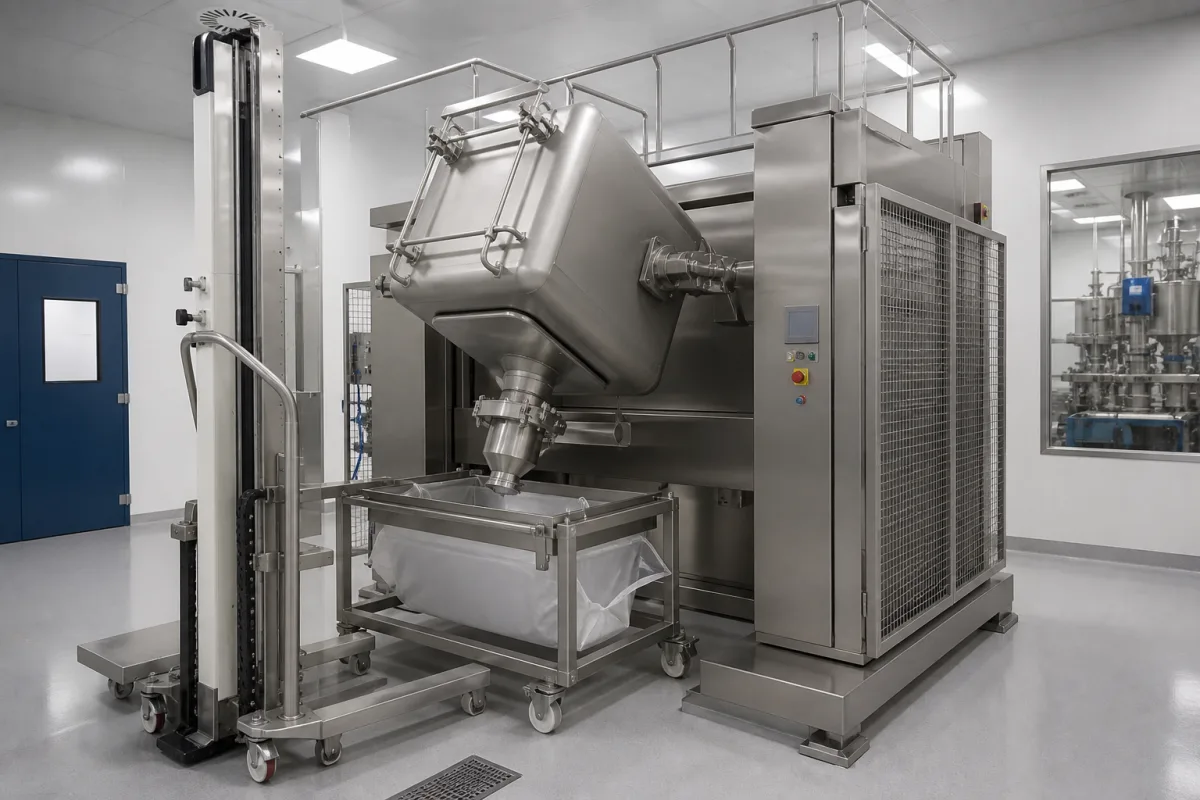
Product Specifications

Technical details and manufacturing context for Pharmaceutical Powder Blending Machine

Definition
A standalone industrial machine designed for precise and uniform blending of active pharmaceutical ingredients (APIs) with excipients in powder or granular form. It ensures consistent mixture homogeneity critical for dosage accuracy and product quality in tablet, capsule, and powder formulation manufacturing. The machine operates in controlled environments to prevent cross-contamination and maintain product integrity throughout the blending process.
Working Principle
Utilizes mechanical agitation through rotating blades or tumblers to create shear and convective forces that distribute particles uniformly throughout the mixture volume
Common Materials
Stainless Steel 316L, Pharmaceutical-grade elastomers
Technical Parameters
  • Maximum working volume of mixing chamber (liters) Per Request
  • Relative standard deviation of mixture composition (RSD%) Per Request
Components / BOM
  • Mixing Chamber
    Contains and isolates the blending materials
    Material: Stainless Steel 316L
  • Agitator Assembly
    Provides mechanical mixing action through rotating elements
    Material: Stainless Steel 316L
  • Drive Motor
    Powers the mixing mechanism rotation
    Material: Industrial-grade electrical components
  • Control Panel
    Interface for setting and monitoring blending parameters
    Material: Stainless Steel with IP65 rating
  • Discharge Valve
    Controls material outflow from mixing chamber
    Material: Stainless Steel 316L with pharmaceutical seals

Industry Taxonomies & Aliases

Commonly used trade names and technical identifiers for Pharmaceutical Powder Blending Machine.

Industrial Ecosystem & Supply Chain Structure

Complementary Systems
Downstream Applications
Specialized Tooling

Application Fit & Sizing Matrix

Operational Limits
pressure: Atmospheric to 0.5 bar gauge (sealed operation)
rpm range: 5-60 RPM (variable frequency drive)
motor power: 0.5-50 kW depending on batch size
temperature: Ambient to 80°C (with heating/cooling jacket)
blending time: 2-30 minutes per batch
batch capacity: 5-5000 liters
Media Compatibility
✓ Pharmaceutical excipients (lactose, microcrystalline cellulose) ✓ Active pharmaceutical ingredients (APIs) in powder form ✓ Granules for tablet compression
Unsuitable: Highly abrasive materials (silica sand, metal powders) or corrosive chemicals requiring specialized alloy construction
Sizing Data Required
  • Required batch volume (liters)
  • Material bulk density (kg/m³)
  • Required blending homogeneity (RSD percentage)

Reliability & Engineering Risk Analysis

Failure Mode & Root Cause
Bearing seizure due to powder ingress
Cause: Inadequate sealing allows fine pharmaceutical powders to infiltrate bearing housings, mixing with lubricant to form abrasive paste that accelerates wear and ultimately seizes rotating components.
Blade imbalance and fatigue cracking
Cause: Uneven powder distribution and material buildup on blending blades creates dynamic imbalance, leading to excessive vibration and cyclic stress that initiates fatigue cracks at blade roots or weld joints.
Maintenance Indicators
  • Audible grinding or scraping noises from the blending chamber during operation
  • Visible powder leakage around shaft seals or housing joints during active blending cycles
Engineering Tips
  • Implement predictive maintenance using vibration analysis to detect early bearing degradation and imbalance conditions before catastrophic failure occurs
  • Establish strict cleaning validation protocols with proper drying cycles to prevent moisture-induced powder adhesion and corrosion in critical components

Compliance & Manufacturing Standards

Reference Standards
ISO 14644-1:2015 Cleanrooms and associated controlled environments ANSI/ASME BPE-2019 Bioprocessing Equipment CE Marking (EU Machinery Directive 2006/42/EC)
Manufacturing Precision
  • Blade-to-wall clearance: +/-0.5mm
  • Shaft runout: 0.05mm maximum
Quality Inspection
  • Material Composition Verification (Spectrographic Analysis)
  • Surface Roughness Measurement (Ra ≤ 0.8μm for contact surfaces)

Factories Producing Pharmaceutical Powder Blending Machine

Manufacturer profiles with relevant production capability in China

Manufacturer listings support early research and capability understanding. They are not certification, ranking, or transaction guarantees.

Technical documentation
4/5
Manufacturing capability
4/5
Inspection readiness
5/5
Supplier transparency
3/5

These scores are example evaluation dimensions, not real customer ratings, country-specific buyer feedback, or live inquiry activity.

Frequently Asked Questions

What materials are used in the construction of this pharmaceutical powder blending machine?

The machine is constructed with Stainless Steel 316L for all contact surfaces and pharmaceutical-grade elastomers for seals and gaskets, ensuring compliance with GMP standards and preventing contamination.

What is the typical cycle time for blending pharmaceutical powders with this machine?

Cycle time varies based on material properties and batch size, typically ranging from 5 to 30 minutes. The machine is designed for efficient, homogeneous blending with minimal cycle times to optimize production throughput.

How does this blending machine ensure homogeneous mixing of pharmaceutical powders?

The machine utilizes an advanced agitator assembly and precise control system to achieve uniform particle distribution throughout the mixing chamber, ensuring consistent blend homogeneity critical for pharmaceutical product quality.

Can I contact factories directly on CNFX?

CNFX is an open directory, not a transaction platform. Each factory profile provides direct contact information and production details to help you initiate direct inquiries with Chinese suppliers.

Data Basis

CNFX manufacturer profiles, technical classification, publicly available product information, and ongoing plausibility checks.

Preliminary Technical Classification
This page supports structured research, RFQ preparation, and supplier evaluation. It does not replace buyer-led supplier qualification, standards review, or technical approval.

Request Manufacturing Insight for Pharmaceutical Powder Blending Machine

Ask for use case, specification boundaries, supplier type, and RFQ preparation information for Pharmaceutical Powder Blending Machine.

Your business information is used only to process this request.

Thank you! Your message has been sent. We'll respond within 1–3 business days.

Need to Manufacture Pharmaceutical Powder Blending Machine?

Compare manufacturer profiles with relevant product and process capability.

Create Manufacturer Profile Contact Us
Previous Product
Pharmaceutical Aseptic Filling and Sealing System
Next Product
Pharmaceutical Tablet Coating Machine