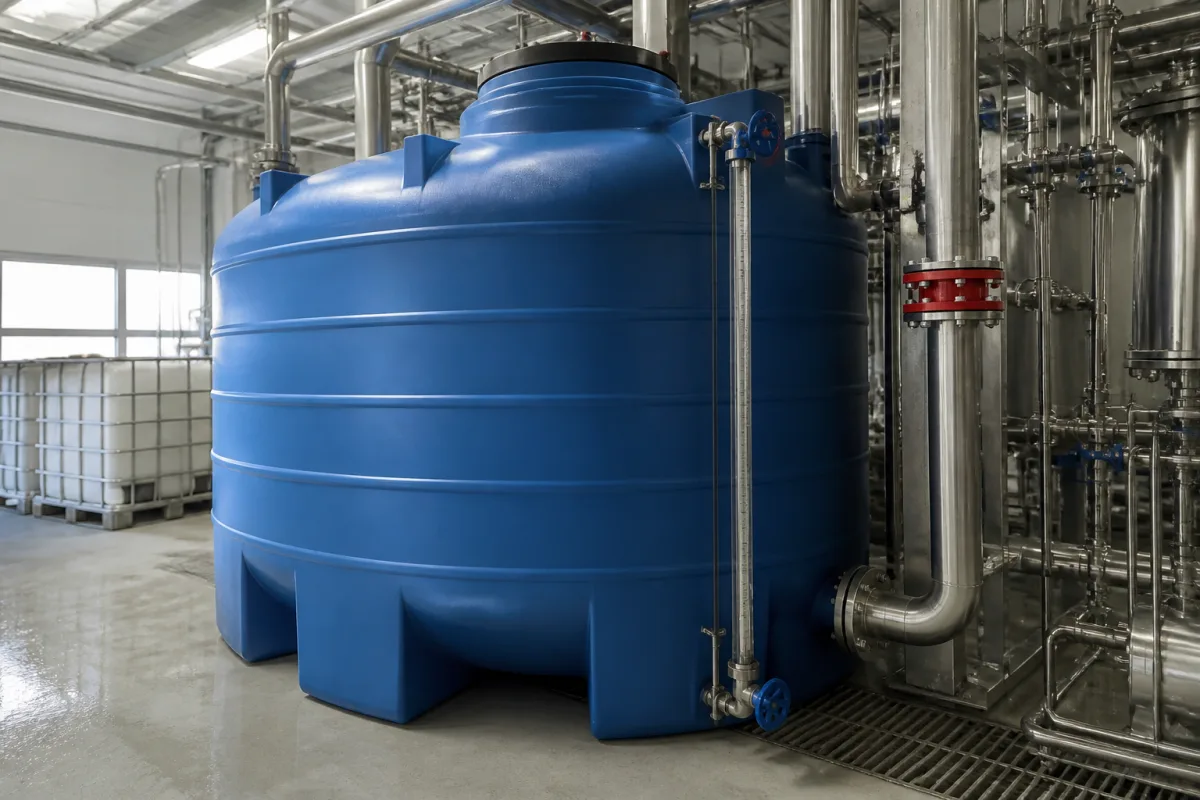
Rotomoulded polyethylene storage tank for water and general liquids: the resin grade, UV rating and moulding behind an "HDPE" tank
Rotomoulded polyethylene tank · the 0.936–0.939 g/cm³ linear PE grades it is moulded from, UV rating, drinking-water approvals and moulding limits
A blue or black one-piece tank standing on moulded feet, with a screw lid on top and an outlet near the base, is made by rotational moulding: polyethylene powder is tumbled in a heated mould until it fuses into a seamless wall. Buyers call it an HDPE tank, but the grades resin makers publish for water tanks are linear polyethylenes of 0.936 to 0.939 g/cm³. What sets a tank's life is which grade was used, how it is protected against sunlight, whether it is approved for drinking water, and whether the moulder kept to the resin maker's processing limits.
Rotationally moulded one-piece polyethylene storage tanks and containers for water, agricultural and general non-hazardous liquids — vertical tanks on moulded feet, with top manways, sight gauges and bottom outlets — and the resin grade, UV stabilisation, drinking-water approvals and moulding conditions behind them. Composite and rigid plastic intermediate bulk containers are covered on the Industrial-grade plastic storage container page; tanks for corrosive reagents in cross-linked polyethylene, FRP or glass-lined steel, with their bunds, on the Reagent storage tank page; drain valves on the Tank drain valve for polyethylene storage tanks page; and HDPE resin for general conversion on the High-density polyethylene (HDPE) resin page.
CNFX editorial research · Sources checked October 12, 2026 · 3 sources
The resin inside an "HDPE" tank: three published rotomoulding grades for water tanks
All three grades below are sold by their makers for rotomoulded water tanks, and all three are described as linear low or linear medium density polyethylene rather than HDPE. Ask the tank maker which grade a quoted tank is moulded from and for its data sheet.
Editorial calculation: GAIL's 6200 kg/cm² flexural modulus is about 608 MPa and its 170 kg/cm² yield strength about 16.7 MPa (× 0.0980665). For the same wall geometry, SCG's 890 MPa grade is about 1.46 times as stiff as GAIL's (890 / 608), which bears on how much a tall tank wall bulges when full. [1][3] All three makers state that their figures are typical values and not specifications, and Reliance and GAIL measured mechanical properties on compression-moulded specimens rather than on a moulded tank. [1][2][3]
Editorial calculation: SCG's ARM impact of 29 J/mm on a 5.5 mm sample is about 160 J, matching the 118 lb-ft it prints alongside (118 × 1.356 ≈ 160 J). [1]
Property
SCG M9001RW (hexene LLDPE)
Reliance LL36RA045UV (butene)
GAIL R36A050U
Named tank uses
Large tanks 5,000–22,500 L, underground water tanks, septic tanks, parts with walls of 10 mm and above [1]
Ask for the resin grade and data sheet, the nominal and minimum wall thickness of the tank, and whether any regrind or filler was added.
02
Sunlight and drinking water: UV20 grades, HALS, carbon black and AS/NZS 4020 / 4766 claims
A tank that stands outdoors needs a UV-stabilised grade or a pigment that blocks light. SCG rates M9001RW UV20 for outdoor use, Reliance stabilises LL36RA045UV with HALS for continuous outdoor exposure with or without carbon black, and GAIL states R36A050U is not UV stabilised and should be used with adequate carbon black or UV stabiliser outdoors. [1][2][3]
For water contact, SCG states M9001RW meets AS/NZS 4020:2018 for drinking water, AS/NZS 4766:2020 for polyethylene storage tanks for water and chemicals, and FDA 21 CFR 177.1520 (c) 2.1 for food contact. [1] Reliance states its grade complies with Indian Standard IS 10146 for polyethylene in contact with foodstuffs, pharmaceuticals and drinking water, and with 21 CFR 177.1520. [2] GAIL gives a certificate on request. [3]
Editorial note: these are claims for the resin. A tank moulded from a compliant resin is not automatically a compliant tank; for drinking water, ask whether the finished tank, with its pigment, lid seal and fittings, holds its own approval and test report.
State whether the tank stands outdoors, the colour wanted, and whether it will hold drinking water, food or chemicals, so the supplier can name the grade, pigment and approvals.
03
Moulding limits the resin maker sets: oven temperature, PIAT, flaming and regrind
Resin makers give process windows for rotomoulding. SCG recommends oven temperatures between 250 and 300 °C and a peak internal air temperature (PIAT) of about 195 °C for M9001RW; GAIL gives an oven temperature of 240 to 280 °C for R36A050U; Reliance lists processing temperatures of 180 to 220 °C and says the grade is pulverised to 20 to 30 mesh powder for moulding. [1][3][2]
SCG advises against flaming the surface of moulded parts with an open torch, because of the risk of thermal degradation and premature failure, and against adding fillers or recycled material by compounding or dry blending, because impact strength may be compromised. [1] All three makers ask for the resin to be stored dry, below 50 °C and away from direct sunlight. [1][2][3]
Editorial note: a moulder's records of PIAT for each batch, and an impact test on a cut-out from a production tank, show whether the tank reached the properties on the resin data sheet; ask whether they are kept.
04
What to state when ordering a rotomoulded polyethylene tank
Paste it into your enquiry below or into an email to a maker, then replace every bracket.
Use: [water; drinking water; agricultural; other liquid; temperature]
Size: [capacity; diameter and height; feet or flat base]
Resin: [grade and data sheet; UV rating; colour; no regrind]
Wall: [nominal and minimum thickness]
Fittings: [manway; outlet size and height; sight gauge; vent]
Approvals: [AS/NZS 4766; AS/NZS 4020; food contact; other]
Quality: [PIAT records; impact test on production sample]
Explore company information and manufacturing capabilities, then discuss the scope of your project with a relevant supplier.
Share this page
Compiled and source-reviewed by the CNFX editorial team.
Each manufacturer above links to the page on that company's own website where the product is listed, with the date we checked it. How we source and review
· Page last updated 13 October 2026
Buyer questions
Is an HDPE water tank made of HDPE?
The rotomoulding grades reviewed for water tanks are linear polyethylenes of 0.936 to 0.939 g/cm³, which SCG, Reliance and GAIL describe as LLDPE or linear medium density. [1][2][3]
Does a polyethylene tank need UV protection outdoors?
GAIL says its R36A050U grade is not UV stabilised and needs carbon black or a UV stabiliser outdoors; SCG rates M9001RW UV20. [3][1]
What oven temperature is used to mould these tanks?
SCG recommends 250 to 300 °C with a PIAT of about 195 °C; GAIL gives 240 to 280 °C. [1][3]
Sources and what still needs a direct check
Sources checked 2026-10-12. SCG Chemicals, Reliance Industries and GAIL publish technical data sheets for their own rotomoulding polyethylene grades.