Editorial Technical Reference

Plastic Film Blowing Machine

This page explains how Plastic Film Blowing Machine is classified within Manufacture of Plastic Products. Technical values and manufacturer relationships are research references; confirm the current specification and supplier evidence for each order.

Technical Definition & Core Assembly

Industrial machine that produces plastic film by extruding molten polymer through a circular die and inflating it into a bubble.
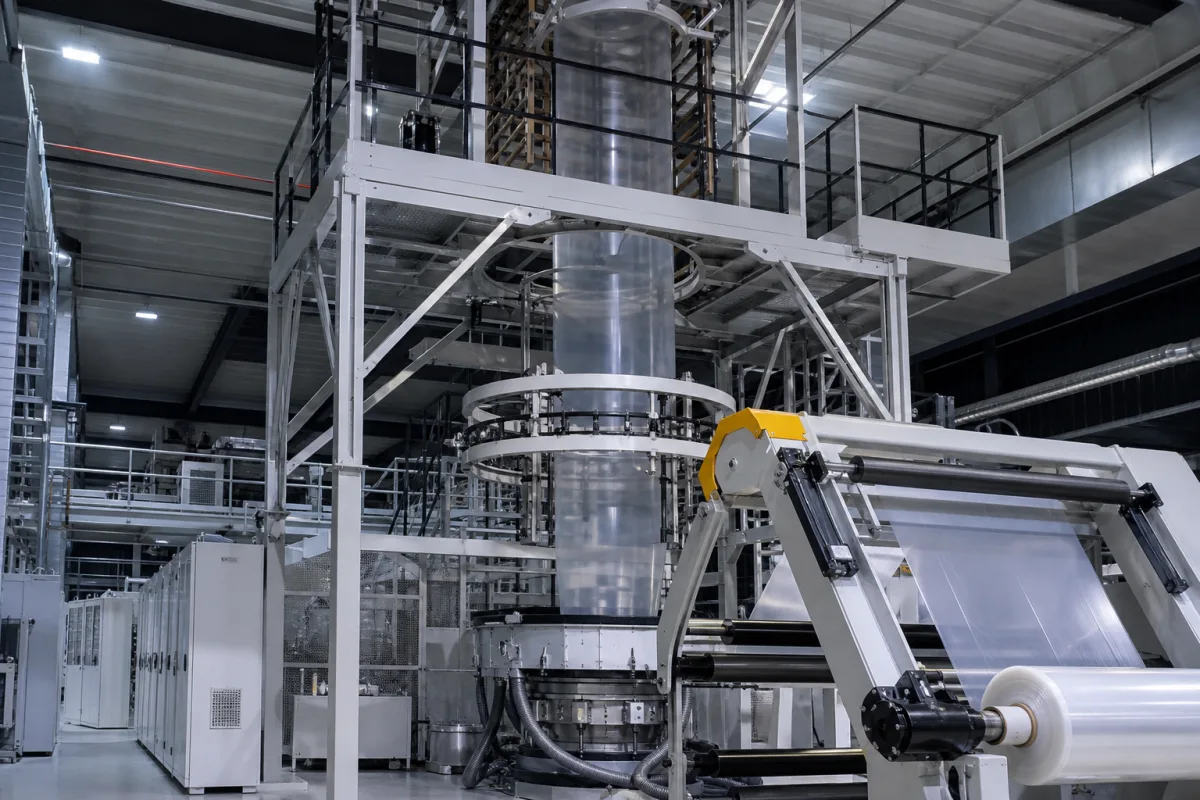
Plastic Film Blowing Machine in a manufacturing environment
Representative product image. Confirm appearance and specifications with the manufacturer.

Product Specifications

Technical details and manufacturing context for Plastic Film Blowing Machine

Definition
A plastic film blowing machine is a continuous extrusion system that manufactures thin plastic films used in packaging, agriculture, and industrial applications. It operates by melting plastic resin pellets, forcing the molten polymer through an annular die to form a tube, then inflating it with air to create a thin-walled bubble that is cooled and collapsed into flat film. This equipment is essential in B2B supply chains for producing flexible packaging materials, greenhouse covers, and protective wraps at high volumes with consistent thickness control. Manufacturers rely on these machines to convert raw plastic resins into value-added film products for downstream packaging converters and industrial users. The machine typically includes an extruder with a screw diameter of 45–120 mm and an L/D ratio of 25–30, achieving maximum outputs of 50–500 kg/h. It can produce film widths from 200 to 2000 mm and thicknesses from 0.01 to 0.10 μm, with bubble diameters up to 200–1200 mm. Operating pressure ranges from 1.0 to 1.6 MPa, and melt temperatures for common polyolefins are 150–250 °C. Heating power is 20–150 kW, and total installed power is 50–300 kW. Electrical supply is three-phase at 380–480 V AC and 50–60 Hz (per IEC 60038). Machine weight varies from 3000 to 15000 kg, and footprint dimensions range from 5000×2000×3000 to 12000×4000×6000 mm. Construction materials include carbon steel, stainless steel, chrome-plated components, and industrial-grade electrical components. These specifications are typical reference ranges; actual values must be confirmed with the legal manufacturer or supplier for specific models and applications. Standards listed are for verification purposes only and do not imply certification or compliance of any particular machine.
Working Principle
Plastic resin is melted in an extruder, forced through a circular die to form a tube, inflated with air to stretch and thin the material, then cooled and collapsed into flat film rolls. The exact control sequence and interface behavior depend on the selected model and process integration.
Common Materials
Carbon Steel, Stainless Steel, Chrome-plated Components, Industrial-grade Electrical Components
Technical Parameters
ParameterTypical rangeNotes & selection driver
Screw DiameterRequired45–120 mmDiameter of the main extrusion screw
L/D RatioRequired25–30 ratioLength to diameter ratio of extrusion screw
Maximum OutputRequired50–500 kg/hMaximum polymer throughput capacity
Film Width RangeRequired200–2000 mmRange of producible film widths
Film Thickness RangeRequired0.01–0.10 μmRange of producible film thicknesses
Bubble Diameter200–1200 mmMaximum inflated bubble diameter
Operating Temperature150–250 °CMelt temperature range for common polyolefins.
Heating Power20–150 kWDepends on machine size and barrel length.
Installed Power50–300 kWTotal electrical load including drives and heaters.
Voltage380–480 V ACThree-phase; other voltages available on request.IEC 60038
Frequency50–60 HzMust match motor and drive specifications.IEC 60038
Machine Weight3000–15000 kgVaries with configuration and options.
Footprint (L×W×H)5000×2000×3000–12000×4000×6000 mmRequires adequate floor space and ceiling height.

Ranges are indicative industry figures for RFQ preparation, not a supplier commitment. Confirm every value and standard with the legal manufacturer before ordering.

Components / BOM
  • Extruder Barrel Part
    Houses the screw and provides heating zones for polymer melting
    Material: Nitrided Steel
  • Annular Die
    Forms molten polymer into a continuous tube for inflation
    Material: Hardened Tool Steel
  • Air Ring
    Provides controlled air flow to cool and stabilize the film bubble
    Material: Aluminum Alloy
  • Nip Rolls
    Collapses the cooled bubble into flat film and provides tension control
    Material: Rubber-coated Steel
  • Winder
    Winds the finished film into rolls for storage and transport
    Material: Carbon Steel
  • Extruder Screw
    Melts and conveys the polymer through the heated barrel to the die.

Industry Taxonomies & Aliases

Commonly used trade names and technical identifiers for Plastic Film Blowing Machine.

Industrial Ecosystem & Supply Chain Structure

Complementary Systems
Downstream Applications
Specialized Tooling

Application Fit & Sizing Matrix

Operational Limits
pressure: 10-40 MPa (die head pressure)
flow rate: 50-500 kg/hr (extruder capacity)
temperature: 150-300°C (polymer dependent)
blow up ratio: 1.5:1 to 4:1 (bubble expansion ratio)
film thickness range: 10-200 microns
Media Compatibility
✓ LDPE (Low-Density Polyethylene) ✓ LLDPE (Linear Low-Density Polyethylene) ✓ HDPE (High-Density Polyethylene)
Unsuitable: Highly abrasive filled polymers (e.g., glass fiber reinforced compounds)
Sizing Data Required
  • Required film width (layflat width in mm)
  • Target production rate (kg/hr)
  • Desired film thickness (microns)

Reliability & Engineering Risk Analysis

Failure Mode & Root Cause
Die Lip Buildup and Contamination
Cause: Accumulation of degraded polymer residues, additives, or contaminants on the die lip, often due to improper material handling, inadequate purging procedures, or thermal degradation from prolonged exposure to high temperatures, leading to flow disruptions and film defects.
Gearbox Bearing Fatigue and Misalignment
Cause: Progressive wear or sudden failure of bearings in the extruder or winder gearbox, primarily caused by improper alignment during installation, excessive mechanical loads from torque variations, inadequate lubrication, or contamination from external particles, resulting in vibration, noise, and eventual seizure.
Maintenance Indicators
  • Irregular or pulsating bubble formation with visible thickness variations or instability in the film bubble, indicating potential die issues, temperature inconsistencies, or air ring malfunctions.
  • Unusual grinding, knocking, or high-pitched whining noises from the extruder or gearbox areas, accompanied by increased vibration levels, suggesting bearing wear, misalignment, or lubrication failures.
Engineering Tips
  • Implement a rigorous preventive maintenance schedule for the air ring and cooling system, including regular cleaning of air passages and calibration of airflow to ensure consistent cooling, which stabilizes the bubble and reduces stress on the film, extending die and equipment life.
  • Establish a strict material handling and purging protocol using appropriate purging compounds between material changes or during shutdowns to prevent polymer degradation and residue buildup in the extruder and die, minimizing contamination-related failures and maintaining film quality.

Indicative industry ranges for design and RFQ preparation. Confirm the exact figures and applicable standard with the manufacturer before specifying.

Compliance & Manufacturing Standards

Applicable Standards
CE Marking - Machinery Directive 2006/42/EC ASTM D1921 - Standard Test Methods for Particle Size (Sieve Analysis) of Plastic Materials

Quoted from the published standard.

Manufacturing Precision
  • Die Gap Uniformity: +/-0.005mm across circumference
  • Screw Barrel Straightness: 0.02mm per meter length
Quality Inspection
  • Film Thickness Uniformity Test using laser micrometers
  • Material Melt Flow Index (MFI) Analysis for polymer consistency

Manufacturers of Plastic Film Blowing Machine

3 companies list this product among what they make. Company figures are quoted from each company's own website; every card states where the relationship came from.

Guangdong Boxing Machinery Co., Ltd.
Shantou, Guangdong, CN
Listed on the company's own website · profile compiled by CNFX from public sources
Listed there as: “Blown Film Machine”
View source page ↗ boxing-machinery.com · checked 2026-09-03
Jiangsu Xinmen Energy Equipment Co., Ltd.
Wenzhou, Zhejiang, CN
Listed on the company's own website · profile compiled by CNFX from public sources
Listed there as: “Blown Film Machine”
View source page ↗ xymachine.com · checked 2026-09-05
Ruian Tplast Machine Co.,ltd
Rui'an, Zhejiang, CN
Listed on the company's own website · profile compiled by CNFX from public sources
Listed there as: “3 Layer Blown Film Machine”
View source page ↗ tplastmachine.com · checked 2026-09-03

Manufacturer listings support early research and capability understanding. They are not certification, ranking, or transaction guarantees.

Share this page
Technical documentation
Request current drawings, revision history, and a signed specification sheet.
Manufacturing capability
Verify equipment lists, process limits, capacity, and representative production evidence.
Inspection readiness
Confirm test methods, calibrated equipment, sampling plans, and traceable reports.
Supplier transparency
Check the legal entity, factory address, ownership, certifications, and direct contacts.

CNFX does not score or rank suppliers. Buyers must verify all claims and documents with the legal manufacturer before ordering.

Frequently Asked Questions

What is the typical output range of a plastic film blowing machine?

The maximum output typically ranges from 50 to 500 kg/h, depending on the screw diameter and machine configuration. Verify the exact capacity for your model with the supplier.

What film thicknesses can be produced?

The producible film thickness range is 0.01 to 0.10 μm. Actual achievable thickness depends on the resin, die design, and processing conditions.

What electrical supply is required?

The machine typically requires three-phase power at 380–480 V AC and 50–60 Hz, per IEC 60038. Confirm the exact voltage and frequency requirements with the manufacturer.

What standards are referenced for operating pressure?

The operating pressure range is 1.0–1.6 MPa. Listed standards are for verification purposes; ensure the machine meets your application's requirements.

Data Basis

Editorial classification, named public sources where available, and source-reviewed manufacturer records.

Preliminary Technical Classification
This page supports structured research, RFQ preparation, and supplier evaluation. It does not replace buyer-led supplier qualification, standards review, or technical approval.
Buyer enquiry

Request manufacturing insight for Plastic Film Blowing Machine

Ask for use case, specification boundaries, supplier type, and RFQ preparation information for this product.

Where it goes
Straight to the CNFX editorial desk, and to the manufacturer if this product is linked to a claimed profile. Nothing is broadcast to a supplier list.
Your details stay here
We do not sell or rent enquiry data, and we do not add you to a mailing list. Used only to answer this request.
No commission, no middleman
CNFX is a directory. We take no cut of any order and never negotiate on a supplier's behalf.
What we don't claim
A listing is not an endorsement. Qualify every supplier and verify every figure yourself before ordering.

Your business information is used only to process this request.

Thank you! Your message has been sent. We'll respond within 1–3 business days.
Sorry, we couldn't send your message. Please try again, or email us at [email protected].

Need to Manufacture Plastic Film Blowing Machine?

Compare manufacturer profiles with relevant product and process capability.

Previous Product
Injection Molding Machine
Last Product
Get QuotesChat