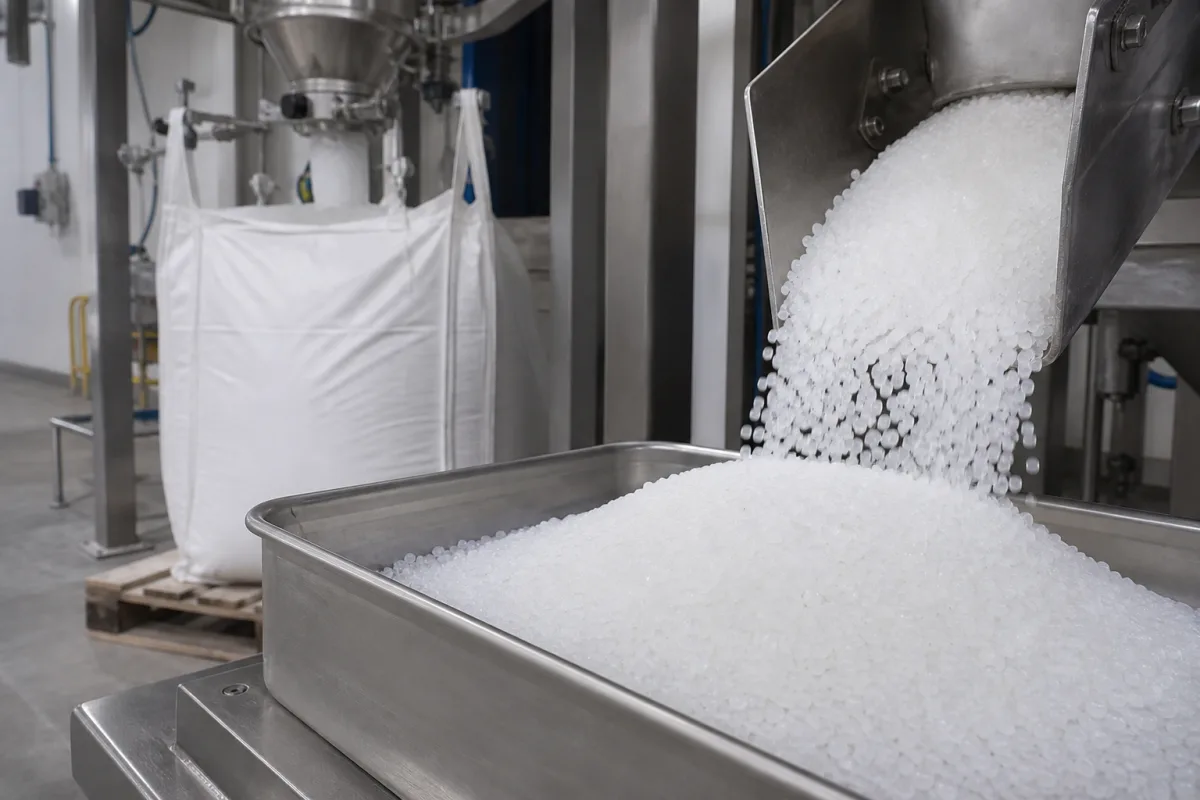
HDPE pellets for blow moulding, extrusion and moulding · Reading grade data sheets: melt flow rate and load, density method, test specimens, ESCR, processing temperatures, food-contact statements under 21 CFR 177.1520, and storage
HDPE resin is supplied as pellets in grades made for particular processes such as blow moulding, pipe or film extrusion, and injection or rotational moulding. Grades differ in flow, density, stiffness and stress-crack resistance, and data sheets report them under different test conditions. Ask three things first: which process and part the grade is for, whether the properties you compare were measured the same way, and what compliance statement and certificate the supplier will give for each lot.
High-density polyethylene resins supplied as pellets or powder for conversion, including natural and pre-coloured grades and food-contact grades. Finished HDPE products (pipes, containers, sheet), recycled HDPE flake sorting and polyethylene compounds with high filler loadings are outside this page except where compared.
CNFX editorial research · Sources checked October 12, 2026 · 4 sources
Two published blow moulding grade data sheets illustrate how HDPE grades are described. One, a high-rigidity grade for food packaging, milk and drinking water bottles on high-speed blow moulding machines, lists a melt flow rate of 0.67 g/10 min (190°C, 2.16 kg, ASTM D1238), density 0.966 g/cm³ (ASTM D1505), Vicat softening point 125°C, melting temperature 135°C and ESCR F50 of 25 h, with mechanical values on compression specimens, extrusion temperature 160–180°C and die temperature 180–200°C. [2] The other, a broad molecular weight distribution grade for bottles, containers and hollow articles up to 5 litres, lists 0.30 g/10 min (190°C, 2.16 kg), density 0.956 g/cm³ (ASTM D792), tensile strength at yield 25 MPa, flexural modulus 800 MPa and Vicat 128°C, with mechanical values on injection moulded specimens and processing at 170–200°C. [3]
Both sheets state that their values are not to be taken as specifications. [2][3]
Editorial calculation: the first sheet reports strength in kg/cm²; multiplying by 0.0981 gives tensile strength at yield of 310 kg/cm² ≈ 30.4 MPa and flexural modulus of 18,000 kg/cm² ≈ 1,765 MPa. Its flexural value is more than twice the second sheet's 800 MPa, but the two were measured on compression and injection moulded specimens respectively, and density was measured by different ASTM methods, so the figures cannot be compared directly. [2][3]
Editorial note: ask each supplier for data on the same test methods, loads and specimen preparation, or test candidate grades yourself on your machine and part.
Give the supplier the process (blow moulding, extrusion, injection, rotational moulding), part type and size, target melt flow rate with the load used, density range and method, stiffness and impact needs, ESCR needs and test condition, colour or masterbatch, food-contact or other regulatory requirements, lot certificate contents, packaging (bags or bulk), and delivery quantities.
02
Check food-contact compliance and storage
US FDA regulation 21 CFR 177.1520 (olefin polymers) covers polyethylene made by the catalytic polymerization of ethylene for food-contact articles. For polyethylene in articles that contact food other than for packing or holding food during cooking, it specifies density 0.85–1.00, a maximum n-hexane extractable fraction of 5.5% at 50°C and a maximum xylene soluble fraction of 11.3% at 25°C; for articles that pack or hold food during cooking, the n-hexane extractable limit is 2.6% at 50°C. [1]
Both data sheets reviewed declare that their grade meets 21 CFR 177.1520 and EU Regulation 10/2011; one adds this applies when used unmodified and processed according to good manufacturing practice. [2][3] That data sheet also advises storing bags dry, closed, below 40°C and out of sunlight or UV, converting material within 6 months of production, and drying material stored for more than 3 months. [3]
Editorial note: if the end use is cooking or hot fill, ask which 177.1520 item the grade is declared under, since the extractable limit differs.
03
Compare a pipe-extrusion grade's ESCR, cell class and melt index ratio
Formosa Plastics USA's data sheet for Formolene E4803 (published 30 August 2024) describes a bimodal HDPE copolymer for non-pressure conduit and telecommunications pipe, also suggested for caps and closures, blow-moulded parts and sheet. It states the grade meets ASTM F2160 and the minimum requirements of ASTM D3350-21 cell classifications 435480A and 435440A, and FDA 21 CFR 177.1520. Nominal values, measured on compression-moulded specimens prepared to ASTM D4703 Procedure C, are a density of 0.948 g/cm³, a melt index of 0.30 g/10 min at 190 °C/2.16 kg and a high-load melt index of 30.0 g/10 min at 21.6 kg, tensile strength at yield of 23.4 MPa (3,400 psi), elongation at break over 600%, 2% secant flexural modulus of 883 MPa (128,000 psi), environmental stress-crack resistance over 1,000 h under ASTM D1693 conditions B and C, NCLS over 200 h at 600 psi, brittleness temperature below −60 °C and oxidative induction time over 60 min at 200 °C. Formosa adds that the values are not for specification use. [4]
Editorial calculation: the high-load to standard melt index ratio is 30.0 ÷ 0.30 = 100, which reflects the broad molecular weight distribution of a bimodal pipe grade; its 0.948 g/cm³ density is below the 0.956–0.966 g/cm³ of the two blow-moulding grades above, trading some stiffness for the stress-crack resistance pipe needs. When a drawing calls a D3350 cell class, ask the supplier to state the full class it certifies, not only density and melt index. [4][2][3]
1 company lists this product among what they make. Company figures are quoted from each
company's own website; every card states where the relationship came from.
Sinopec Ningbo Zhenhai Refining & Chemical Company Limited
Manufacturing site to be confirmed for the order
Its website has a product page for high-density polyethylene.
Product scope checked 2026-10-12
Product page on own website · profile compiled by CNFX from public sources
Explore company information and manufacturing capabilities, then discuss the scope of your project with a relevant supplier.
Share this page
Compiled and source-reviewed by the CNFX editorial team.
Each manufacturer above links to the page on that company's own website where the product is listed, with the date we checked it. How we source and review
· Page last updated 13 October 2026
Buyer questions
Can I compare HDPE data sheets directly?
Only on the same basis; the two sheets reviewed used different density methods and specimen types, and both say their values are not to be taken as specifications. [2][3]
What does 21 CFR 177.1520 require for polyethylene?
For general food-contact articles it sets density 0.85–1.00, n-hexane extractables up to 5.5% at 50°C and xylene solubles up to 11.3% at 25°C. [1]
How should HDPE pellets be stored?
One data sheet says dry, closed, below 40°C and away from UV, used within 6 months, and dried after over 3 months' storage. [3]
What cell classification does an HDPE conduit pipe resin meet?
One bimodal non-pressure pipe grade states it meets ASTM D3350-21 cell classes 435480A and 435440A and ASTM F2160, with density 0.948 g/cm³ and ESCR over 1,000 h. [4]
Sources and what still needs a direct check
Sources checked 2026-10-12. The two data sheets give resin producers' own values for single grades, cited as examples, not endorsements; 21 CFR 177.1520 is a US federal food-contact regulation.