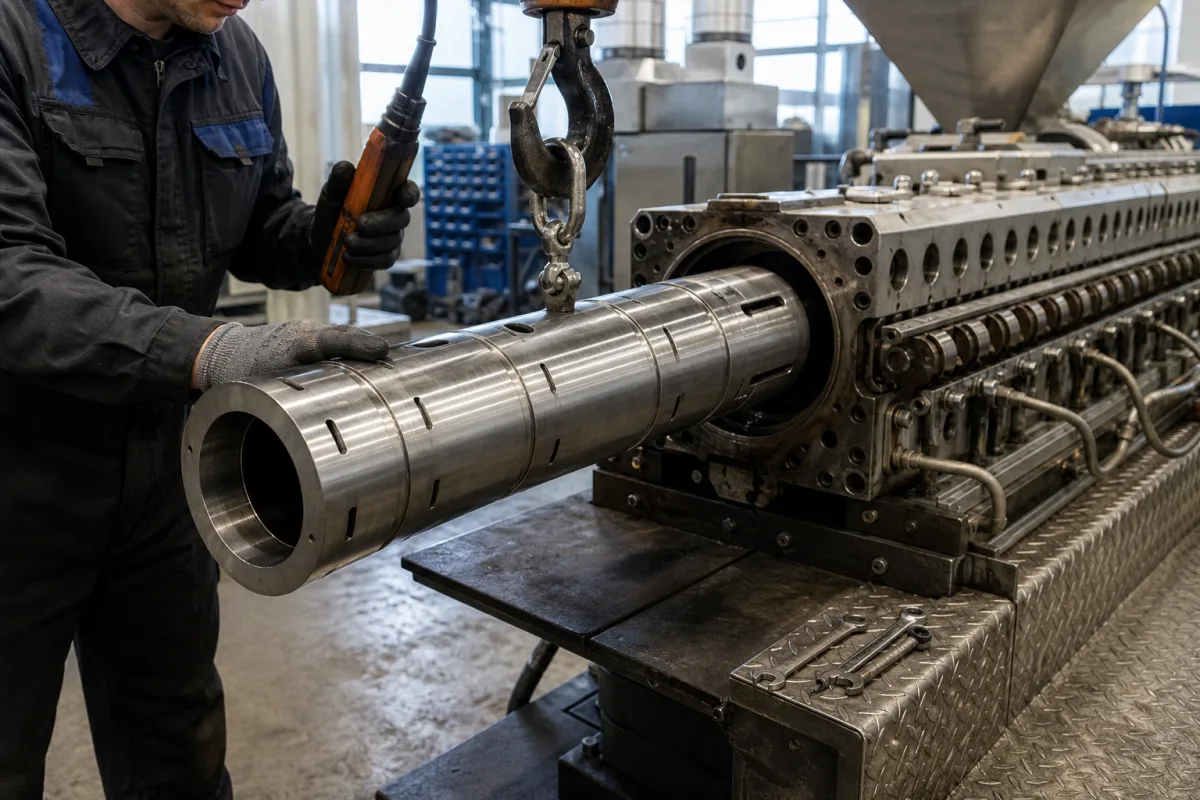
Bimetallic barrel liners for extruders and injection moulding · Iron-based, nickel-based and tungsten-carbide inlays matched to filler and corrosive resins, inlay hardness and thickness, nitrided versus bimetallic bores, backing steel strength and wear clearance
A polymer extrusion barrel liner is the hard, wear- and corrosion-resistant inner layer (inlay) of an extruder or injection-moulding barrel, bonded inside a high-strength steel housing by centrifugal casting, hot isostatic pressing or as a replaceable sleeve, so the screw and check ring run against an alloy chosen for the resin's fillers and chemistry. Ask three things first: which resins, fillers and corrosive additives the barrel will process, which inlay alloy, hardness and thickness resist that wear, and how the liner and backing steel are made, sized and tested for the machine's pressure.
Bimetallic barrel inlays, replaceable barrel liners and sleeves for single-screw extruders and injection-moulding barrels, new or for rebuilds. Screws (see polymer extrusion screw), complete twin-screw compounders, nitrided barrels as a separate product, heater bands and feed throats are outside this page except where compared.
CNFX editorial research · Sources checked October 11, 2026 · 4 sources
Bernex Bimetall lists its bimetallic layers by duty: A110, a standard iron-based layer at 58–65 HRC for plastics with up to 10% fibre or mineral filler (for example ABS, PP, PA, PET), which it says can double barrel life compared with nitrided steel; AC333 at 62–69 HRC for filled plastics up to 20% and mildly corrosive types, excluding halogen-containing plastics; C242, a low-iron nickel-based layer at 48–56 HRC for corrosive plastics such as PVC, PUR and fluoroplastics; and ACW800, tungsten carbides in a nickel matrix at 58–66 HRC for corrosive and highly filled plastics such as glass-filled ABS, SAN and PA. [1]
Xaloy's US patent 4,863,661 (1989) describes centrifugally cast surfacing alloys as iron-nickel-boron-carbon for abrasion, nickel-cobalt-boron-silicon for corrosion and nickel-boron-silicon-tungsten carbide for both, and notes that high-ferrous linings at 58–64 HRC wear well against abrasive fillers. It explains that worn bores open a clearance at the check ring and screw so melt leaks back and injection pressure is lost, forcing the barrel to be refurbished or replaced. [2]
Editorial note: give the supplier the full resin list including fillers (type and percentage), flame retardants and halogen content, because an inlay chosen for abrasion alone can corrode, and one chosen for corrosion alone can wear quickly with glass fibre.
Give the supplier the machine make and model, barrel bore and length (L/D), screw diameter, maximum injection or melt pressure, resins with filler type and percentage and corrosive additives, preferred inlay alloy, required hardness and inlay thickness, liner form (bimetallic barrel, replaceable sleeve, rebuild), feed throat and vent positions, heater and cooling arrangement, tolerances, inspection and certificates.
02
Set inlay thickness, method and backing steel
Xaloy's US patent 4,596,282 (1986) states that nitriding gives a hardened layer only 0.005–0.020 in deep whose hardness falls with depth, so wear accelerates, and that centrifugal casting melts a liner alloy inside a pre-machined steel housing that is spun to distribute it. It requires the backing steel to have high yield strength to support internal pressure without plastic deformation because the hard liner is brittle and cracks with little deformation; in its example a heat-treated 4140 housing reached 50 HRC and 247,000 psi yield, while an untreated one at 18–20 HRC and 60,000 psi would let the liner crack below 30,000 psi. It cites injection pressures of 20,000 psi and above at the high-pressure end. [3]
US 4,863,661 gives nickel-based liner thicknesses of about 0.030–0.250 in, preferably 0.050–0.065 in, with the steel housing pre-bored 0.1–0.5 in over the final bore; its example hot isostatically pressed the liner powder at 15,000 psi and 1,750 °F for three hours in a 4140 housing. [2]
Editorial calculation: the preferred inlay of 0.050–0.065 in is about 1.27–1.65 mm, against 0.13–0.51 mm (0.005–0.020 in) for a nitrided case, so the inlay offers roughly 2.5 to 13 times the wear depth before the base steel is reached. [2][3]
03
Find barrel liner manufacturers
Ask either maker which of the inlay families above — iron-based, nickel-based or tungsten carbide in nickel — it supplies, and what inlay thickness remains after honing.
04
Compare inlay thickness, hardness and size limits across makers
Reifenhäuser Reiloy's 2025 bimetallic barrel sheet gives layer thickness, hardness and size limits for each alloy. R121, a martensitic iron-based alloy with chromium carbides and carbon-boride phases, has a 1.5 mm layer, at least 65 HRC and suits plastics with up to 30% fibreglass; R131, an iron-based alloy reinforced with vanadium carbides, has a 1.5 mm layer, 60–64 HRC and suits up to 40% fibreglass. The nickel-matrix tungsten-carbide alloys R239 and R241 have layers of at least 1.0 mm and at least 58 and 59 HRC, and the nickel-cobalt R115/116, for maximum corrosion resistance, has at least 1.5 mm and 55 HRC (47 HRC above 60 mm bore). [4]
For the backing steel the sheet lists Reiloy Standard at 980 MPa tensile strength and 580 MPa 0.2% proof strength at 300 °C, against 800 and 360 MPa for C60 and 630 and 300 MPa for NiCr22Mo9Nb. Size limits differ by alloy: R121 from 14 to 400 mm bore and up to 9,000 mm long, R131 from 14 to 90 mm bore and up to 3,000 mm long. [4]
Editorial calculation: 1.5 mm is about 0.059 in, inside the 0.050–0.065 in preferred range of US 4,863,661, and 580 MPa is about 84,000 psi (1 MPa = 145.04 psi). Ask whether a quoted thickness applies after final honing, and which backing steel the quoted barrel uses. [4][2]
Alloy, hardness, filler limit and backing strength to quote against
Read the filler-limit row with the hardness row: Bernex rates its standard iron-based layer for up to 10% filler and lists other layers for highly filled or corrosive resins at similar hardness. [1]
Explore company information and manufacturing capabilities, then discuss the scope of your project with a relevant supplier.
Share this page
Compiled and source-reviewed by the CNFX editorial team.
Each manufacturer above links to the page on that company's own website where the product is listed, with the date we checked it. How we source and review
· Page last updated 13 October 2026
Buyer questions
Which barrel liner suits PVC?
A nickel-based, low-iron layer; one maker lists such a layer at 48–56 HRC for PVC, PUR and fluoroplastics. [1]
Is a bimetallic barrel better than a nitrided barrel?
A Xaloy patent notes nitrided layers are only 0.005–0.020 in deep with falling hardness, while bimetallic inlays are thicker; one maker says changing to bimetallic can double barrel life. [3][1]
Why does the backing steel matter?
The hard liner is brittle and cracks with little deformation, so the housing must resist yielding under internal pressure. [3]
How thick is a bimetallic barrel inlay?
Reifenhäuser Reiloy lists 1.5 mm for its R121 and R131 iron-based alloys and at least 1.0 mm for its R239 and R241 nickel-matrix tungsten-carbide alloys. [4]
Sources and what still needs a direct check
Sources checked 2026-10-11. Bernex describes its own layer range; the Xaloy patents describe the applicant's methods and examples. Alloy choice and life for your resins must come from supplier data and wear history on your machines.